Industrial & Logistics Lighting Guide
Comprehensive guide for lighting design in industrial facilities, warehouses and logistics centers — compliant with European standards EN 12464-1 and modern LED technologies
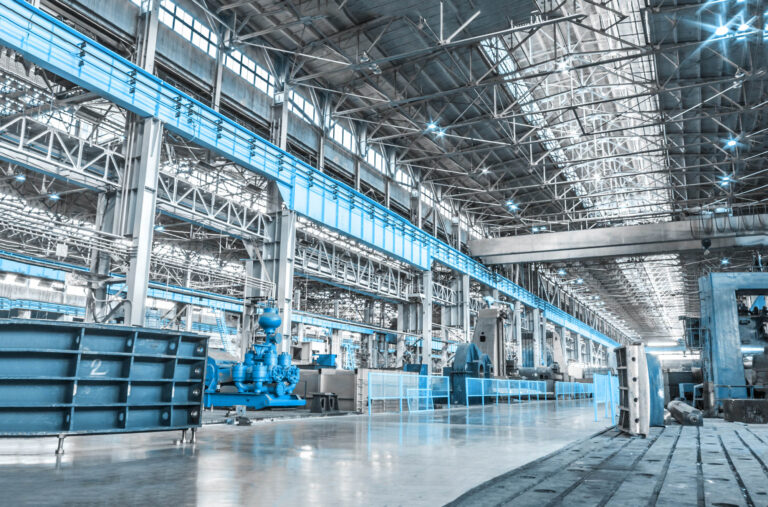
Purpose of this guide: To provide comprehensive information for the design and implementation of lighting systems in industrial facilities, warehouses and logistics centers, in accordance with European standards and modern LED solutions. This guide is intended for engineers, electricians, lighting designers, facility managers and procurement professionals.
1. Lighting Requirements per EN 12464-1
For safe and efficient work in industrial facilities and warehouses, the European standard EN 12464-1:2021 defines minimum lighting levels per activity. Values refer to the maintained average illuminance (Em), i.e. the minimum value to be maintained throughout the installation's lifetime.
1.1 Detailed requirements table by area
| Area / Activity | Em (lx) | Uo | UGRL | CRI |
|---|---|---|---|---|
| General storage areas | 100 | 0.40 | 25 | 60 |
| Traffic corridors | 100 | 0.40 | 28 | 40 |
| Warehouses — picking / sorting | 200 | 0.40 | 25 | 60 |
| Loading/unloading / docking | 150 | 0.40 | 25 | 60 |
| Order picking & packing | 300 | 0.60 | 22 | 80 |
| General industrial production | 300 | 0.60 | 22 | 80 |
| Machine work | 300 | 0.60 | 22 | 80 |
| Fine assembly | 500 | 0.60 | 19 | 80 |
| Quality control | 750 | 0.70 | 19 | 80 |
| Precision tasks (electronics) | 1000 | 0.70 | 16 | 90 |
| Very high precision | 1500 | 0.70 | 16 | 90 |
| Offices within industrial buildings | 500 | 0.60 | 19 | 80 |
| Control rooms | 500 | 0.60 | 19 | 80 |
| Rest areas / canteens | 200 | 0.40 | 22 | 80 |
| Staircases | 150 | 0.40 | 25 | 40 |
Figure 1: Visual comparison of required illuminance levels per EN 12464-1
1.2 Vertical illuminance on racking
In warehouses, vertical illuminance on rack faces is critical for reading labels and barcodes:
- Ev ≥ 200 lx on rack faces (vertical surface)
- Uo ≥ 0.40 along the racking
- Use asymmetric optics to direct light onto rack faces
💡 Practical tip: In VNA (Very Narrow Aisle) warehouses, asymmetric light distributions direct light onto vertical surfaces without causing glare to operators. Ideally, use linear luminaires mounted centrally in the aisle.
1.3 Uniformity and lighting quality
- Uniformity: Uo ≥ 0.60 in the task area, Uo ≥ 0.40 in the surrounding area
- CRI: CRI ≥ 80 for work areas. For color inspection: CRI ≥ 90
- CCT: 4000K (neutral white) or 5000-6500K (cool white) for inspection
- Illuminance ratio: Task / surrounding area ≤ 3:1 for smooth transition
Figure 2: Proper luminaire placement ensures uniform lighting without dark zones
⚡ Key principle:
The greater the precision required, the higher the illuminance level must be. Uniformity must be kept high to prevent eye fatigue and accidents.
2. Lighting Standards and Regulations
2.1 EN 12464-1:2021 — Indoor Workplace Lighting
EN 12464-1 defines:
- Minimum maintained illuminance levels Em (lux) per activity
- Minimum uniformity Uo in the task area and surrounding area
- Maximum glare rating limit (UGRL)
- Colour Rendering Index (CRI / Ra)
- Cylindrical illuminance (Ez) for communication areas
⚠️ Important: Em values refer to the end of the maintenance cycle (maintained values). During design, the Maintenance Factor (MF) must be applied so that initial illuminance is sufficiently higher.
2.2 Maintenance Factor (MF)
- LLMF — Lamp Lumen Maintenance Factor (LED depreciation, e.g. L80 = 0.80)
- LSF — Lamp Survival Factor (reliability, e.g. B10 = 0.90)
- LMF — Luminaire Maintenance Factor (luminaire dirt depreciation)
- RMF — Room Maintenance Factor (room surface depreciation)
| Space type | Environment | Maintenance cycle | MF |
|---|---|---|---|
| Clean warehouse | Low pollution | 3 years | 0.80 |
| General production | Medium pollution | 3 years | 0.70 |
| Heavy industry | High pollution | 2 years | 0.60 |
| Food (cleanroom) | Very low | 3 years | 0.85 |
2.3 Glare Control (UGR)
Glare reduces visual performance and increases accident risk. UGR scale: 10 (negligible) to 30+ (disturbing).
| Area | UGRL | Description |
|---|---|---|
| Warehouses, general circulation | ≤ 28 | Acceptable glare |
| General industrial work | ≤ 25 | Moderate glare |
| Quality control, assembly | ≤ 22 | Low glare |
| Offices within industrial buildings | ≤ 19 | Very low |
| Technical drawing / CAD | ≤ 16 | Minimal glare |
2.4 Energy Efficiency
TOTEE 20701-7/2021 requires luminous efficacy of > 90 lm/W. EU Regulation 2019/2020 sets additional Ecodesign requirements.
Energy indicators:
- LENI (kWh/m²/yr): Lighting energy consumption per m² annually
- Installed Power Density: W/m²
- Normalized Power Density: W/m²/100lx
| Area | Max W/m² (LED) | Typical LENI (kWh/m²/yr) |
|---|---|---|
| Warehouse (100 lx) | 2-3 | 5-10 |
| Logistics picking (300 lx) | 4-6 | 12-20 |
| Production (500 lx) | 6-9 | 20-35 |
| Precision work (1000 lx) | 10-15 | 35-55 |
💡 Techlumen LED: Techlumen industrial LEDs achieve up to 170-198 lm/W, dramatically reducing the LENI indicator.
3. Design Principles: High-Bay & Linear Lighting
3.1 Luminaire type selection by mounting height
Figure 3: Luminaire type selection guideline by mounting height
3.2 Spacing Rule (Spacing-to-Height Ratio)
- d — Distance between luminaires (m)
- S/H — Spacing-to-Height ratio
- Hm — Mounting height above working plane
| Beam angle | S/H | Example (H=10m) |
|---|---|---|
| 30° (Narrow) | 0.6 - 0.8 | 6-8 m |
| 60° (Medium) | 1.0 - 1.2 | 10-12 m |
| 90° (Wide) | 1.2 - 1.5 | 12-15 m |
| 120° (Very Wide) | 1.3 - 1.6 | 13-16 m |
The Spacing-to-Height (S/H) ratio is not an empirical value, but is derived through calculation based on the luminaire’s photometric distribution.
Each manufacturer should provide the corresponding maximum S/H ratio that ensures acceptable lighting uniformity.
Our company provides documented S/H values for all luminaires we manufacture, along with the corresponding photometric files for use in lighting design software (DIALux, Relux, etc.).
3.3 Luminaire Layout
Figure 4: Grid pattern vs linear placement in racking aisles
Open production areas:
- High-bay in grid pattern, d = S/H × Hm
- Wall distance ≤ 0.5 × d
Warehouses with racking:
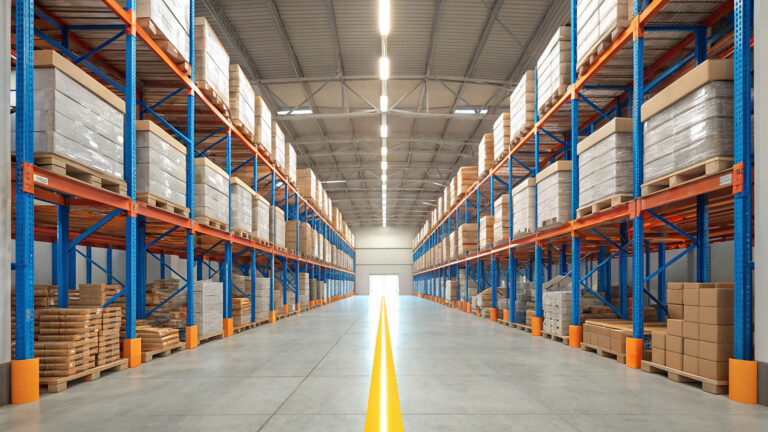
- Linear luminaires centered in each aisle
- Asymmetric optics for vertical rack illumination
4. Lighting Calculation Methodology
4.1 Lumen Method
- N — Number of luminaires
- Em — Required average illuminance (lux)
- A — Floor area (m²)
- Φ — Luminous flux per luminaire (lm)
- UF — Utilization Factor (0.40-0.80)
- MF — Maintenance Factor
Example: Warehouse 60×40m, H=10m, Em=300 lx, MF=0.70, UF=0.55
Luminaire: HB-DURO-H 185W, Φ=33,070 lm
N = (300 × 2400) / (33.070 × 0.55 × 0.70) = 57 units → 4.4 W/m²
4.2 Room Index
- L, W — Length, width (m)
- Hm — Mounting height (m)
| Room Index (k) | UF (medium refl.) | UF (high refl.) |
|---|---|---|
| 0.60 | 0.30 | 0.38 |
| 1.00 | 0.43 | 0.52 |
| 1.50 | 0.52 | 0.62 |
| 2.00 | 0.57 | 0.67 |
| 3.00 | 0.63 | 0.73 |
| 5.00 | 0.68 | 0.78 |
4.3 Lighting Design Software
- DIALux Evo: Full 3D lighting study (free). TECHLUMEN provides IES/LDT files.
- Relux: Alternative software
- TECHLUMEN LUX Calculator: Online quick calculator
💡 Tip: Download IES/LDT photometric files from techlumen.gr for use in DIALux Evo. TECHLUMEN is a DIALux community member.
5. Luminaire Types for Industry
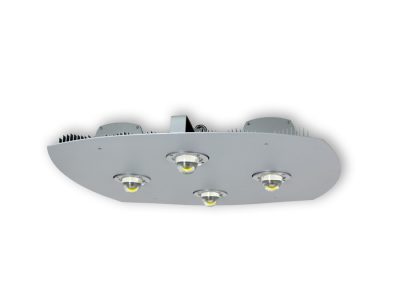
5.1 High-Bay LED
High-power units for mounting heights 6-20m:
- Flux: 10,000 - 33,000 lm
- Power: 50-200W
- Optics: 30°, 60°, 90°, 120°, asymmetric
- IP65/IP66, Dimming: DALI, 1-10V, 0-10V
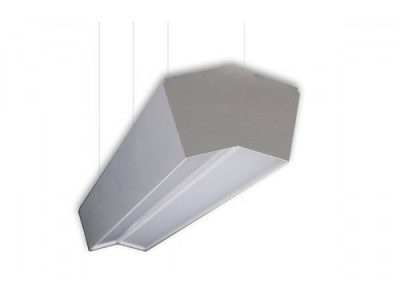
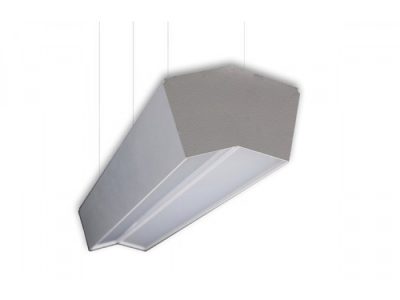
5.2 Linear LED
- Lengths: 0.3m - 2.82m (or custom)
- Flux: 3,000 - 30,000 lm
- Efficacy: Up to 170 lm/W
- IP65/IP66, Snap-in mounting
5.3 Efficacy Comparison
Figure 5: Techlumen LED technology — top efficacy
6. Emergency Lighting (EN 1838)
Emergency lighting is mandatory per EN 1838 and national Building Regulations.
| Type | Purpose | E (lx) | Duration |
|---|---|---|---|
| Escape routes | Safe evacuation | ≥ 1 lx | ≥ 1 hour |
| Anti-panic | Panic prevention | ≥ 0.5 lx | ≥ 1 hour |
| High risk areas | Safe shutdown | ≥ 10% Em (min 15 lx) | ≥ 1 hour |
⚠️ Critical: In high-risk areas (moving machinery, chemicals), emergency lighting must activate within 0.5 seconds of power failure.
6.1 Exit Signage
- Green pictograms per ISO 7010, visible from ≥ 30m
- Duration ≥ 1 hour, luminance ≥ 2 cd/m²
7. Sensors and Smart Controls
Figure 6: From LED upgrade to full smart management
7.1 Strategies
Occupancy sensors:
- Dim to 10-20% when unoccupied, savings 30-60%
Daylight harvesting:
- Automatic adjustment with natural light, savings 20-40%
Central management (DALI-2):
- Scenes, scheduling, monitoring — total savings up to 90%
7.2 Protocols
| Protocol | Advantages | Application |
|---|---|---|
| DALI-2 | Bidirectional, 64 devices/line | Large installations |
| 1-10V | Simple, low cost | Basic dimming |
| 0-10V | Wide range | BMS integration |
| Wireless | No extra wiring | Retrofit |
8. Special Applications & Environments
8.1 Cold Environments (Coolers/Freezers)
- Temperatures -25°C to +5°C, extended range drivers (-40°C)
- IP66-IP67 ingress protection, resistant to thermal shock
8.2 ATEX / Explosive Atmospheres
- ATEX certification (2014/34/EU) for zones 1, 2, 21, 22
🔴 Critical: In ATEX zones, non-certified luminaires may cause ignition. A risk assessment by a qualified engineer is required.
8.3 Food Industry
- IK10 + IP66, shatter-proof diffusers, stainless steel clips
- CRI ≥ 80 for correct food colour assessment
8.4 Outdoor Industrial Areas
- Loading bays, truck parking — IP66 min, per EN 12464-2
- UV resistance, thermal shock, vibration resistance
9. TECHLUMEN Product Recommendations
| Model | Type | Flux (lm) | Power (W) | lm/W | IP |
|---|---|---|---|---|---|
| HB-DURO-H | High-Bay LED | 11.424-33.070 | 68-185 | up to 198 | IP66 |
| VELISTI-SPX | Linear IP66 | up to 30,520 | 30-185 | up to 163 | IP66 |
9.1 HB-DURO-H — High-Efficiency High-Bay
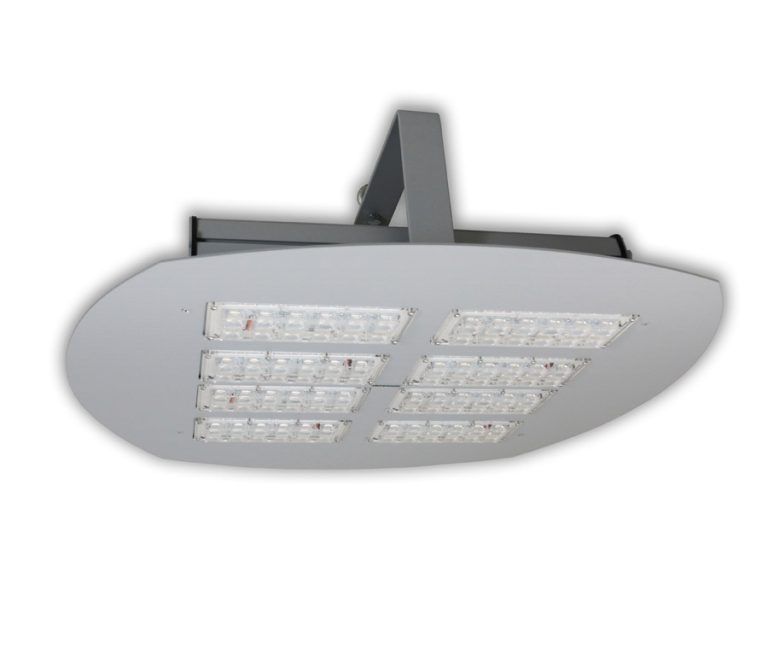
- Efficacy: Up to 198 lm/W
- Temperature: -20°C to +60°C
- Lifetime: L70/B10 > 100,000 hours
- Dimming: DALI, 1-10V, 0-10V
- Body: Die-cast aluminium, integrated heat sink
Optics: 30° (>12m) | 60° (8-12m) | 90° (6-8m) | 120° (low) | Asymmetric (racking)
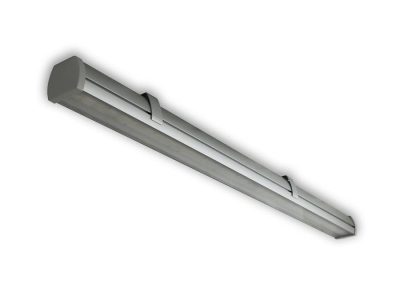
9.2 VELISTI-SPX — Weatherproof Linear
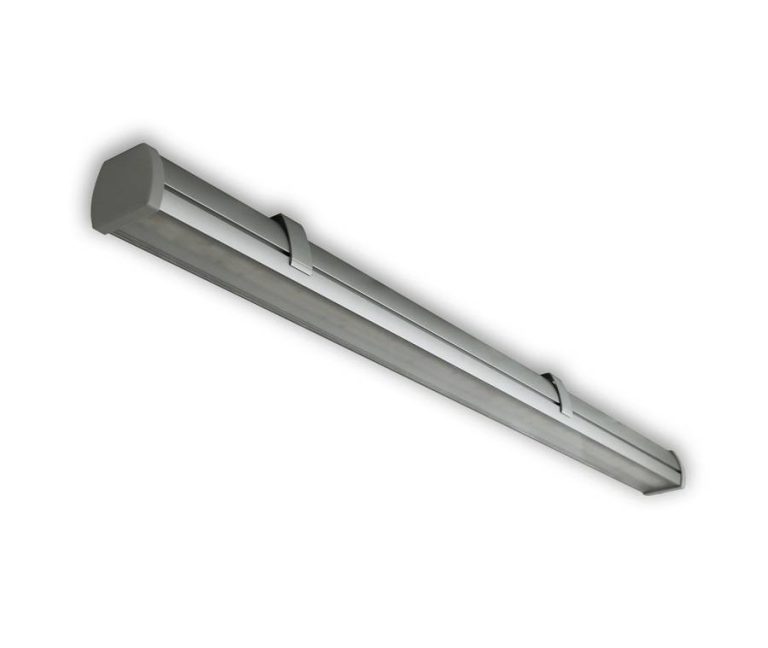
- Lengths: 30cm - 282cm
- Efficacy: Up to 163 lm/W
- Mounting: Snap-in quick installation
- Emergency: Integrated 3h battery option
- Durability: IK08, UV-stabilized polycarbonate
Figure 7: TECHLUMEN luminaire selection decision tree
10. Cost & Return on Investment (ROI)
10.1 Life Cycle Cost Analysis
Luminaire evaluation should be based on Total Cost of Ownership (TCO), not just the initial purchase cost.
- Energy cost = Power (kW) × Hours/year × €/kWh × Years
- Maintenance cost = Replacements + Labour + Scaffolding
10.2 Comparison Example — 2,400 m² Warehouse
| Parameter | Metal Halide | Techlumen LED |
|---|---|---|
| Number of luminaires | 80 × 400W | 57 × 185W |
| Installed power | 32.000 W | 10.545 W |
| Annual consumption (4000h) | 128.000 kWh | 42.180 kWh |
| Annual energy cost (€0.18/kWh) | 23.040 € | 7.592 € |
| Annual savings | — | 15.448 € |
| Lifetime | ~15,000 h (3-4 years) | >100,000 h (>25 years) |
| Replacements in 10 years | ~3 cycles | 0 |
| Investment payback | — | < 2 years |
Figure 8: LED investment pays back in less than 2 years
11. Lighting Project Implementation Steps
Needs Analysis
Record activities, heights, dimensions, operating hours and special requirements (ATEX, food, cold storage etc.)
Lighting Study
DIALux/Relux study with TECHLUMEN photometric files. Calculate lux, uniformity, UGR. Apply MF. Select luminaires, optics.
Techno-economic Evaluation
TCO comparison, ROI and payback period calculation. CO₂ savings estimation.
Product Selection & Design
Select dimming, sensors. Prepare installation and electrical drawings.
Installation
Mount luminaires, wiring, BMS/DALI connection. Snap-in system for quick installation.
Measurements & Commissioning
Measure lux on task area, vertical illuminance, UGR. Compare with study and standards.
Maintenance & Monitoring
Clean luminaires, monitor consumption, verify MF.
12. Conclusion
Proper lighting in an industrial space rests on three pillars:
- Requirements analysis: Activity analysis, heights, layout, special conditions
- Standards compliance: EN 12464-1, EN 1838, TOTEE 20701-7, Ecodesign
- Proper product selection: High efficacy, durability, flexibility, dimmability
Need help with your lighting?
TECHLUMEN offers free DIALux lighting studies and techno-economic evaluations for every industrial project.
Request a Free Study