Comprehensive guide for professional lighting design of roads, streets and public urban spaces — fully compliant with EN 13201 and modern LED technologies
📄 Version 1.0 — 2025
📏 EN 13201:2015
⚡ EN 13201-5 Energy
🌍 CIE 150 Light Pollution
Purpose of this guide: To provide comprehensive information for the design and implementation of street and urban lighting systems according to the European standard EN 13201. This guide is intended for lighting designers, electrical engineers, urban planners, municipal authorities, and contractors involved in the specification and installation of outdoor public lighting.
1. EN 13201 Regulatory Framework
EN 13201 is the principal European standard for road lighting. It establishes the complete framework from road classification to energy performance assessment. Understanding this standard is essential for any professional involved in street lighting design.
1.1 Structure of EN 13201
Part
Scope
EN 13201-1
Road classification and selection of lighting classes based on traffic parameters
EN 13201-2
Performance requirements: minimum maintained values for luminance, illuminance, uniformity, glare, and surround ratio
EN 13201-3
Calculation methods for photometric performance of road lighting installations
EN 13201-4
Methods of measuring lighting performance in the field (verification)
EN 13201-5
Energy performance indicators (PDI, AECI) for assessing installation efficiency
EN 13201 Design Process Flow
Road
Classification
EN 13201-1
Select Lighting
Class (M/C/P)
EN 13201-2
Photometric
Calculation
EN 13201-3
Field
Verification
EN 13201-4
Energy
Assessment
EN 13201-5
Design Workflow →
Each step feeds into the next. The process is iterative — adjust luminaire selection or geometry if requirements are not met.
The five-step EN 13201 design workflow from road classification to energy assessment.
2. Lighting Classes: M, C, P
EN 13201 defines three families of lighting classes, each tailored to specific road user types and traffic conditions. Selecting the correct lighting class is the foundation of every compliant design.
The three lighting class families defined by EN 13201, each with distinct photometric criteria.
💡 Design Tip: Always begin a street lighting project by classifying the road according to EN 13201-1. The lighting class determines all subsequent photometric requirements. A common error is to skip this step and simply match existing luminaire wattages.
3. Key Photometric Parameters
Understanding the photometric parameters defined in EN 13201-2 is essential for evaluating and comparing lighting designs. Each parameter serves a specific purpose in ensuring visual comfort and safety.
3.1 M-Class Parameters (Motorised Traffic)
Symbol
Parameter
Description
Range
Lav
Average luminance
Mean maintained luminance on the road surface, measured in the direction of travel
0.30–2.00 cd/m²
Uo
Overall uniformity
Ratio of minimum to average luminance (Lmin/Lav). Prevents dark patches.
≥ 0.35–0.40
Ul
Longitudinal uniformity
Ratio of min to max luminance along the centre line. Controls the "zebra effect".
≥ 0.50–0.70
TI
Threshold increment
Measure of disability glare. Lower values = less glare.
≤ 10–15%
SR
Surround ratio
Illuminance ratio on adjacent areas vs. road surface.
≥ 0.50
Understanding Uniformity: Uo and Ul
Overall Uniformity (Uo) = Lmin / Lav
Med
Low
High
Med
High
Lmin
Uo checks the entire road surface
for dark spots and uneven patches
Longitudinal Uniformity (Ul) = Lmin / Lmax
Max
Min
Max
Min
← "Zebra Effect" when Ul is too low →
Ul checks along the centre line
of each lane for alternating light/dark
Left: Overall uniformity (Uo) assesses the entire road surface. Right: Longitudinal uniformity (Ul) checks for the "zebra effect" along each lane.
3.2 M-Class Performance Requirements
Class
Lav (cd/m²)
Uo (≥)
Ul (≥)
TI (≤)
SR (≥)
M1
2.00
0.40
0.70
10%
0.50
M2
1.50
0.40
0.70
10%
0.50
M3
1.00
0.40
0.60
15%
0.50
M4
0.75
0.40
0.60
15%
0.50
M5
0.50
0.35
0.40
15%
0.50
M6
0.30
0.35
0.40
15%
0.50
3.3 C-Class Requirements (Conflict Zones)
Class
Eav (lux)
Uo (≥)
Application
C0
50
0.40
Major intersections, complex junctions
C1
30
0.40
Roundabouts, major pedestrian crossings
C2
20
0.40
Shopping streets, bus stops
C3
15
0.40
Merging areas, minor intersections
C4
10
0.40
Residential intersections
C5
7.5
0.40
Low-traffic junctions
3.4 P-Class Requirements (Pedestrian Areas)
Class
Eav (lux)
Emin (lux)
Ev,min (lux)
Application
P1
15
3
5
High-crime areas, major pedestrian routes
P2
10
2
3
Standard pedestrian areas
P3
7.5
1.5
2.5
Residential walkways
P4
5
1
1.5
Secondary paths
P5
3
0.6
1
Cycle paths, rural walkways
P6
2
0.4
0.6
Low-traffic pedestrian areas
Motorway (M1)
2.0
cd/m² (Lav)
Arterial (M2)
1.5
cd/m² (Lav)
Roundabout (C1)
30
lux (Eav)
Sidewalk (P2)
10
lux (Eav)
4. Design Geometry & Layout
The photometric performance of a street lighting installation is determined not only by the luminaire but also by the geometric layout: pole height, spacing, overhang, tilt angle, and arrangement pattern.
4.1 Pole Height by Road Type
Road Type
Typical Height
Spacing / Height
Notes
Motorway / Highway
12–15 m
3.0–3.5
High-mast also used
Arterial road
10–12 m
3.0–3.5
Single or staggered
Collector road
8–10 m
3.0–4.0
Opposite or staggered
Residential street
5–8 m
3.5–4.5
Single side typical
Pedestrian path
3.5–5 m
4.0–5.0
Bollard or post-top
4.2 Arrangement Patterns
Luminaire Arrangement Patterns
Single-Sided
W ≤ H (road width ≤ mounting height)
Most common for narrow roads
Staggered (Zigzag)
1.0× H < W ≤ 1.5× H
Alternating sides, medium roads
Opposite (Bilateral)
W > 1.5× H
Directly opposite, wide roads
Central (Median-Mounted)
Dual carriageway with median
→ → →
← ← ←
Twin-arm brackets on central reservation
= LED Luminaire
= Road surface
= Centre line
= Median
Four standard luminaire arrangement patterns. The choice depends on road width relative to mounting height (W/H ratio).
4.3 Tilt Angle, Overhang & Geometry
Street Lighting Geometry — Cross Section
ROAD SURFACE
Path
Path
Height (H)
Overhang (OH)
Road Width (W)
Tilt (α)
Key Dimensions:
H = Mounting height (m)
OH = Overhang from road edge (m)
W = Road width (m)
α = Tilt angle (0°–15°)
Modern LED: 0°–5° tilt recommended
Larger tilts increase glare & ULOR
Cross-section showing the critical geometric parameters for street lighting design. H, W, OH, and tilt angle must all be modelled in photometric software.
⚠️ Important: In DIALux EVO and RELUX, always model the actual tilt angle and overhang. Even 5° of tilt can shift the peak illuminance by several metres along the road axis, potentially causing the design to fail compliance.
5. LED Technology Advantages
The transition from conventional sources (HPS, MH, mercury vapour) to LED has transformed street lighting. The advantages extend far beyond energy savings.
Efficacy
180
lm/W (LED system)
Lifetime
100k
hours (L80B10)
Energy Saving
70%
vs HPS typical
ULOR
0%
full cut-off optics
5.1 CCT Selection Guide
LED street luminaires are available in a range of correlated colour temperatures (CCT). In recent years, European and Greek practice has converged on 3000K as the standard for urban street lighting, driven by environmental regulations, dark-sky initiatives, and documented health benefits of reduced blue light emission. Higher CCTs (4000K+) are now reserved for motorways and specific high-speed applications.
Colour Temperature (CCT) Spectrum for Street Lighting
2700K
Warm
3000K
★ Recommended 4000K
Neutral White 5000K
Cool White 5700K
High blue
Residential / Ecological / Parks
Urban Streets / Standard (EU)
Motorways only (with caution)
TECHLUMEN recommends 3000K as the default CCT for urban street lighting — aligned with current European and Greek practice. Use 4000K only for motorways or special applications where explicitly required.
CCT
Advantages
Disadvantages
Recommended Use
2700–3000K
Low blue content, warm appearance, dark-sky compliant, reduced ecological impact, preferred by European municipalities
Slightly lower lm/W than neutral white
Urban streets, residential areas, historic centres, ecological corridors — current EU standard
4000K
Higher mesopic efficiency, good visual acuity at speed
Higher blue content, increasingly restricted by regulation
Motorways, high-speed arterials, industrial zones
5000–5700K
Highest scotopic/mesopic efficiency, maximum visual acuity
High blue emission, ecological & health concerns
Motorways, industrial zones (with caution)
6. Energy Performance Indicators (EN 13201-5)
EN 13201-5 introduced two key energy performance indicators that allow objective comparison between different lighting designs. These metrics are increasingly required in public procurement specifications.
6.1 Power Density Indicator (PDI / Dp)
Dp = P / (Lav × S × W) [W / (cd/m² × m²)]
Where P = system power (W), Lav = average maintained luminance, S = pole spacing (m), and W = road width (m). Lower Dp values indicate better energy efficiency.
6.2 Annual Energy Consumption Indicator (AECI / De)
De = Σ(Pi × ti) / (S × W) [Wh/m² per year]
This indicator accounts for dimming profiles and operational hours, rewarding installations with intelligent control strategies.
✅ Procurement Insight: When evaluating tenders, always compare PDI and AECI values. A luminaire with a higher purchase price but significantly lower AECI will almost always be more cost-effective over the 20-year lifecycle of the installation.
7. Smart Controls & Adaptive Lighting
Modern street lighting is increasingly integrated into smart city ecosystems. The combination of LED technology and digital controls enables substantial operational savings.
7.1 Control Protocols
Protocol
Description
Key Benefit
DALI-2 / D4i
Digital addressable lighting interface. D4i extends with standardized power/data for sensors.
Individual luminaire control, bi-directional
0–10V / 1–10V
Simple analogue dimming signal
Low cost, basic scheduled dimming
Zhaga Book 18
Standardized socket for plug-and-play sensor/communication modules
Future-proof, vendor-independent
LoRaWAN / NB-IoT
Low-power wide-area wireless for Central Management Systems
Example of a fixed-schedule dimming profile. Presence-detection and adaptive strategies can achieve 40–55% savings.
Strategy
Description
Typical Savings
Fixed schedule
Pre-programmed dimming levels based on time of night
20–30%
Presence detection
Sensors detect traffic/pedestrians, raise light from reduced baseline
30–50% on low-traffic roads
Adaptive (data-driven)
Real-time adjustment based on traffic density, weather, ambient light
35–55% with dynamic response
8. Light Pollution & Environmental Considerations
Responsible outdoor lighting design must address the environmental impact of artificial light at night (ALAN). Light pollution affects astronomical observation, disrupts ecosystems (particularly migratory birds, bats, and insects), and impacts human circadian rhythms.
8.1 ULOR & Environmental Zones
Zone
Description
ULOR Limit
Ev at Window (lux)
E0
UNESCO Starlight Reserves, astronomical sites
0%
0
E1
Dark landscapes (national parks, rural areas)
0%
2
E2
Low-brightness areas (rural residential)
2.5%
5
E3
Medium-brightness areas (suburban)
5%
10
E4
High-brightness areas (urban centres)
15%
25
✅ TECHLUMEN Standard: All TECHLUMEN street luminaires feature full cut-off optics with ULOR = 0% at designed tilt angle. Our standard CCT for urban applications is 3000K, in line with current European practice. For environmentally sensitive areas, 2700K is available on request.
9. Road Surface Properties & R-Tables
For M-class (luminance-based) calculations, the reflective properties of the road surface are critical. EN 13201 uses standardized reduced luminance coefficient tables (r-tables) to model how different surfaces reflect light toward the observer.
R-Table
Surface Type
Reflectance
Character
R1 (C1)
Concrete, light asphalt
Highest
Predominantly diffuse
R2 (N1)
Standard asphalt with light aggregate
Medium-high
Default choice when surface data unavailable
R3 (N2)
Standard dark asphalt
Medium
More specular than R2
R4 (N3–N4)
Smooth, wet, or very dark surfaces
Lowest
Highly specular — worst case
⚠️ Critical: Using R2 when the actual road is dark asphalt (R3/R4) will result in calculated luminance values that cannot be achieved in practice. The difference can be 15–20%, potentially moving the design below the required class. Always confirm the surface type with the road authority.
10. Practical Design Workflow
A systematic design process ensures compliance, optimal performance, and cost efficiency.
Road Classification: Classify each road section per EN 13201-1 (traffic volume, speed, junction density, area type)
Select Lighting Class: Determine appropriate M, C, or P class from the classification matrix
Define Geometry: Establish pole height, spacing, arrangement, tilt, and overhang
Select Luminaire & Optic: Choose luminaire with appropriate optical distribution, wattage, and CCT using IES/LDT files
Photometric Calculation: Run the design in DIALux EVO or RELUX; verify all parameters meet the class
Energy Assessment: Calculate PDI and AECI per EN 13201-5, including dimming profiles
Obtrusive Light Check: Verify EN 12464-2 / CIE 150 compliance for the environmental zone
Documentation: Prepare design report with calculation results, datasheets, and compliance summary
10.1 Maintenance Factor (MF)
MF = LLMF × LSF × LMF × RSMF
Factor
Description
Typical LED Value
LLMF
Lamp Lumen Maintenance Factor (LED depreciation)
0.90–0.95 (at L80B10)
LSF
Lamp Survival Factor (catastrophic failure)
1.00 (LED)
LMF
Luminaire Maintenance Factor (dirt on optic)
0.90–0.95 (IP66)
RSMF
Road Surface Maintenance Factor
1.00 (typically)
💡 Guideline: For LED street lighting, a composite MF of 0.80–0.85 is widely used for a 25-year design life with standard maintenance. Always document the MF assumption in your design report.
11. Common Design Mistakes to Avoid
Mistake
Consequence
Solution
Ignoring the r-table
Calculated luminance not achievable in practice
Confirm actual road surface type; use R3 as conservative default
Over-specifying wattage
Waste energy, excessive glare, over-illumination
Design to the lighting class, not to the replaced lamp wattage
Upgrade class by 1–2 steps at junctions and crossings
No dimming profile
20–40% wasted energy savings potential
Implement at minimum a clock-based dimming schedule
Wrong CCT
Complaints and potential regulatory violations
Use 3000K for urban streets (EU standard); 4000K only for motorways/industrial
12. Total Cost of Ownership (TCO)
The true cost of a street lighting installation extends far beyond the initial purchase price. A proper TCO analysis considers the full 20–25 year lifecycle.
Cost Component
HPS Installation
LED Installation
Luminaire purchase
Lower initial cost
20–40% higher initial
Energy (20 years)
Baseline (100%)
50–70% savings
Lamp replacements
5–7 over lifecycle
Zero (LED integral)
Maintenance visits
Every 3–4 years
Minimal (IP66, sealed optic)
Dimming savings
Limited (HPS dims poorly)
Additional 20–40%
CO₂ emissions
Baseline
60–80% reduction
20-year TCO
Baseline (100%)
Typically 40–60% of HPS
✅ ROI: For municipalities considering LED retrofits, the payback period is typically 3–5 years. With EU Green Deal funding and national subsidy programs, effective payback can be even shorter.
13. Specification Checklist
When preparing a tender or specification document for street lighting, ensure the following items are addressed:
#
Requirement
Typical Value
1
Road classification & lighting class per EN 13201
M1–M6 / C0–C5 / P1–P7
2
Minimum photometric requirements
Lav, Uo, Ul, TI, SR
3
CCT and minimum CRI
3000K (urban), 4000K (motorway), CRI ≥ 70
4
Maximum ULOR
0%
5
IP rating
IP66 (minimum)
6
IK impact resistance
IK08 min (IK10 for vandal-prone)
7
Surge protection
≥ 10 kV (line-earth)
8
Control interface
DALI-2 / D4i / Zhaga Book 18
9
Maintenance factor assumption
MF 0.80–0.85
10
PDI and AECI per EN 13201-5
Maximum allowed values
11
Warranty
≥ 5 years (incl. driver)
12
Photometric data format
IES LM-63 or EULUMDAT LDT
13
Certifications
CE, ENEC, CB scheme
14. Frequently Asked Questions (FAQ)
What is the difference between luminance and illuminance?
Illuminance (lux) measures the amount of light falling on a surface — it is a property of the surface being lit. Luminance (cd/m²) measures the brightness of the surface as seen by an observer — it depends on both the illuminance and the reflective properties of the road surface. M-class roads use luminance because drivers view the road at a low angle; C-class and P-class areas use illuminance.
Can I replace a 250W HPS lamp with a 250W LED?
No — this is a very common mistake. A 250W LED produces approximately 3× more useful light than a 250W HPS due to higher efficacy and directional optics. A typical replacement is 60–100W LED for a 250W HPS, depending on the road class requirements. Always design to the EN 13201 class, not to the old lamp wattage.
Is 5000K or higher CCT acceptable for street lighting?
While some early LED street lighting used 5000–6000K, the trend across Europe — and particularly in Greece — has firmly settled on 3000K as the standard for urban street lighting. Higher CCT luminaires emit more blue light, which has documented negative effects on ecosystems and human health. Most European municipalities now specify ≤3000K for urban roads, with 4000K reserved only for motorways and high-speed roads where mesopic visibility is prioritised. TECHLUMEN recommends 3000K as the default for all urban applications.
What software should I use for street lighting calculations?
The two most widely used professional tools in Europe are DIALux EVO (free, by DIAL GmbH) and RELUX (free, by Relux Informatik AG). Both support EN 13201 calculations with road surfaces, observer positions, and full M-class luminance analysis. TECHLUMEN provides LDT photometric files compatible with both platforms.
What is Zhaga D4i and why does it matter?
Zhaga D4i combines the Zhaga Book 18 mechanical interface (a standardized socket on the luminaire) with the DALI-2 D4i electrical interface. This creates a truly interoperable, future-proof smart lighting platform. You can add sensors, communication modules, or other smart devices from any D4i-compatible vendor — without rewiring or replacing the luminaire. It is the leading standard for smart-ready street lighting in Europe.
How long does LED street lighting actually last?
Quality LED street luminaires are rated at L80B10 at 100,000 hours, meaning after 100,000 operating hours, at least 90% of luminaires will still produce ≥80% of their initial light output. At typical street lighting operating hours (approximately 4,200 hours/year), this equates to roughly 24 years — essentially the full lifecycle of the installation before infrastructure replacement is needed.
15. Recommended TECHLUMEN Products
TECHLUMEN offers a complete range of LED luminaires for every street and urban lighting application — from motorways and arterials to pedestrian paths and parks. All products are manufactured in Thessaloniki, Greece, with CE certification, full photometric data (LDT/IES), and a 5-year warranty.
15.1 Street & Arterial Luminaires
TECHLUMEN street luminaires are designed for M and C lighting classes per EN 13201, featuring full cut-off optics (ULOR = 0%), aluminium construction, IP66 protection, and resilience in demanding climatic conditions.
Product
Power
Luminous Flux
Efficacy
IP / IK
Best suited for
DROMOS
12–150W
2,280–24,150 lm
up to 161 lm/W
IP66
Collector & arterial roads — ENEC certified
DROMOS-C
34–200W
5,270–36,300 lm
137–193 lm/W
IP66
Arterials, boulevards, wide carriageways
CYCLOP-2
12–118W
2,028–18,072 lm
118–204 lm/W
IP66
Modern urban streets, CRI up to 90
CYCLOP-2-P
12–118W
2,028–18,072 lm
118–204 lm/W
IP66
Pole top for squares & main streets
POLIS
12–88W
up to 14,184 lm
120–204 lm/W
IP66
Contemporary urban design, pole top
PYRSOS
27–60W
4,410–10,380 lm
154–193 lm/W
IP65 / IK09
Architectural urban lighting, emergency ready
ASTRADA
50–112W
7,926–17,287 lm
141–174 lm/W
IP67
Catenary (cable-suspended) street lighting
💡 Selection Tip: For M3–M4 roads (two-lane arterials), the DROMOS at 60–100W covers most applications. For M1–M2 boulevards, the DROMOS-C in higher wattages is recommended. The CYCLOP-2 series excels in modern urban environments thanks to its minimalist design.
15.2 Urban & Heritage Luminaires
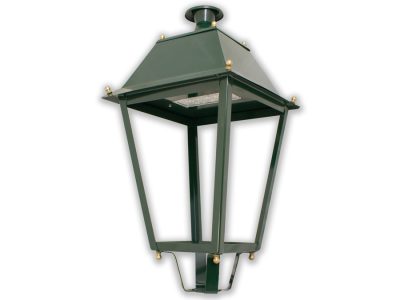
Classic design for traditional and neoclassical urban environments — historic centres, squares, commercial pedestrian streets.
Product
Power
Luminous Flux
Efficacy
IP
Best suited for
PERIUS-80
12–56W
2,028–9,096 lm
120–204 lm/W
IP66
Pole top, squares, main pedestrian streets
PERIUS-60
12–56W
2,028–9,096 lm
120–204 lm/W
IP66
Pole top, parking areas, secondary roads
PERIUS Urban
18–60W
3,190–10,380 lm
154–193 lm/W
IP66
Classic column, galvanized steel body
CIVITA
12–56W
2,028–9,096 lm
120–204 lm/W
IP66
Pole top or wall mount, versatile installation
15.3 LED Retrofit — Upgrading Existing Luminaires
For municipalities looking to upgrade legacy street luminaires (HPS/MH) without replacing poles and housings, especially for heritage lanterns and conservation-listed fixtures.
Product
Power
Luminous Flux
Efficacy
IP
Best suited for
DROMOS-X
12–73W
1,960–11,600 lm
137–182 lm/W
IP66
Retrofit into existing housings & heritage lanterns
✅ Upgrade without infrastructure change: The DROMOS-X fits inside the existing luminaire housing, converting traditional HPS/MH fixtures to high-efficiency LED. Ideal for municipalities with heritage lanterns where aesthetics must be preserved while technology is upgraded.
15.4 Autonomous Solar Lighting System
For areas without access to the electrical grid or for sustainability-driven applications.
Product
Luminous Flux
Efficacy
IP
Warranty
Best suited for
iLO Solar
8,540–8,710 lm
190–194 lm/W
IP66
25 years
Remote roads, parks, island areas
15.5 Bollards, Columns & Pedestrian Lighting
For P lighting classes per EN 13201 — footpaths, cycle lanes, pedestrian streets, parks, and parking areas. Impact resistance (IK) and anti-vandal construction are key requirements.
Product
Type
Power
Luminous Flux
IP / IK
Best suited for
GAMMA-K
Pole light
12–118W
2,028–18,072 lm
IP66 / IK06
Column 2–7m, 1/2/3/4 arms, CRI 90
GAMMA-900
Bollard
12–38W
2,028–6,276 lm
IP66
900mm bollard, pathways, entrances
TESSA-B
Bollard
9–27W
1,440–4,550 lm
IP66 / IK08
Modern bollard, CRI 90, 10-year corrosion warranty
TESSA
Bollard
16–38W
1,960–6,540 lm
IP66 / IK08
Higher-power bollard, pedestrian streets
TRIXX
Bollard
12–32W
2,028–4,654 lm
IP66
Minimalist bollard, 550mm or 800mm height
STOCK
Bollard
9–27W
1,440–4,550 lm
IP65 / IK08
Pathways, gardens, CRI 90
VOLA
Garden
6W
860–2,210 lm
IP66
Indirect pathway lighting, CRI 90
OPUS-2-C
Cement bollard
6–14W
780–2,450 lm
IP66
Cement body, high durability
15.6 Floodlights — Parking & Large Areas
For car parks, major junctions, and urban open areas requiring high luminous flux and wide light distribution.
Product
Power
Luminous Flux
Efficacy
IP
Best suited for
FL-I-1
12–56W
2,028–9,096 lm
118–204 lm/W
IP66 / IK09
Small car parks, entrances, junctions
FL-I-3
132–168W
16,380–27,288 lm
118–162 lm/W
IP66
Medium car parks, roundabouts
SPC-H
31–160W
4,456–26,424 lm
146–206 lm/W
IP66
Lightweight & compact, area enhancement
RECTO-S
18–42W
1,980–5,240 lm
85–163 lm/W
IP66
Architectural outdoor lighting
15.7 Wallwashers & Architectural Lighting
For highlighting buildings, bridges, monuments, and urban landmarks — combined with functional street lighting for integrated urban schemes.
Product
Power
Luminous Flux
IP
Best suited for
GLIM
8–84W
1,272–13,600 lm
IP66
Façade wallwashing, bridges, emergency ready
GLIM-e
8–84W
1,213–6,940 lm
IP66 / IK09
Economy wallwasher, monuments, accenting
GLIM-SV
8–84W
3,360–7,920 lm
IP67
High ingress protection, harsh conditions
QUADRO
6–27W
up to 4,550 lm
IP66
Compact projector, DALI/DMX/RGBW, trees & gardens
QUADRO-S
4–16W
380–2,240 lm
IP66
Mini projector, DALI/Casambi/DMX/RGBW
15.8 In-ground Recessed Luminaires
For pedestrian streets, squares, building entrances, and ground-level architectural accenting. Stainless steel 316 construction, IK10 impact resistance.
Product
Power
Luminous Flux
IP / IK
Best suited for
GAIA-100
13–58W
1,980–8,935 lm
IP67 / IK10
Linear in-ground 1000mm, pedestrian streets
GAIA-50
6–27W
990–3,970 lm
IP67 / IK10
Linear in-ground 500mm, pathways
IGN-250
12–50W
1,300–6,820 lm
IP68
Circular in-ground Φ250mm, building accenting
IGN-200
9–38W
950–5,000 lm
IP68
Circular in-ground Φ200mm, monuments, trees
IGR-160
6–19W
690–2,600 lm
IP68
Adjustable direction, architectural accenting
📋 Photometric Files & Technical Support: For every product, TECHLUMEN provides complete photometric files in LDT (EULUMDAT) and IES format, compatible with DIALux EVO and RELUX. Request a free photometric study for your project at www.techlumen.gr or contact us at [email protected].
Related Standards & References
EN 13201-1 to 13201-5 — Road lighting
EN 12464-2 — Lighting of outdoor work places
CIE 150:2017 — Guide on the limitation of obtrusive light
CIE 115:2010 — Lighting of roads for motor and pedestrian traffic
IEC 62722-2-1 — LED luminaire performance
IEC 61547 — EMC requirements for lighting equipment