Landscape & Architectural Lighting Guide
Comprehensive guide for professional exterior lighting design — façades, monuments, parks, gardens and urban landscapes with LED technology
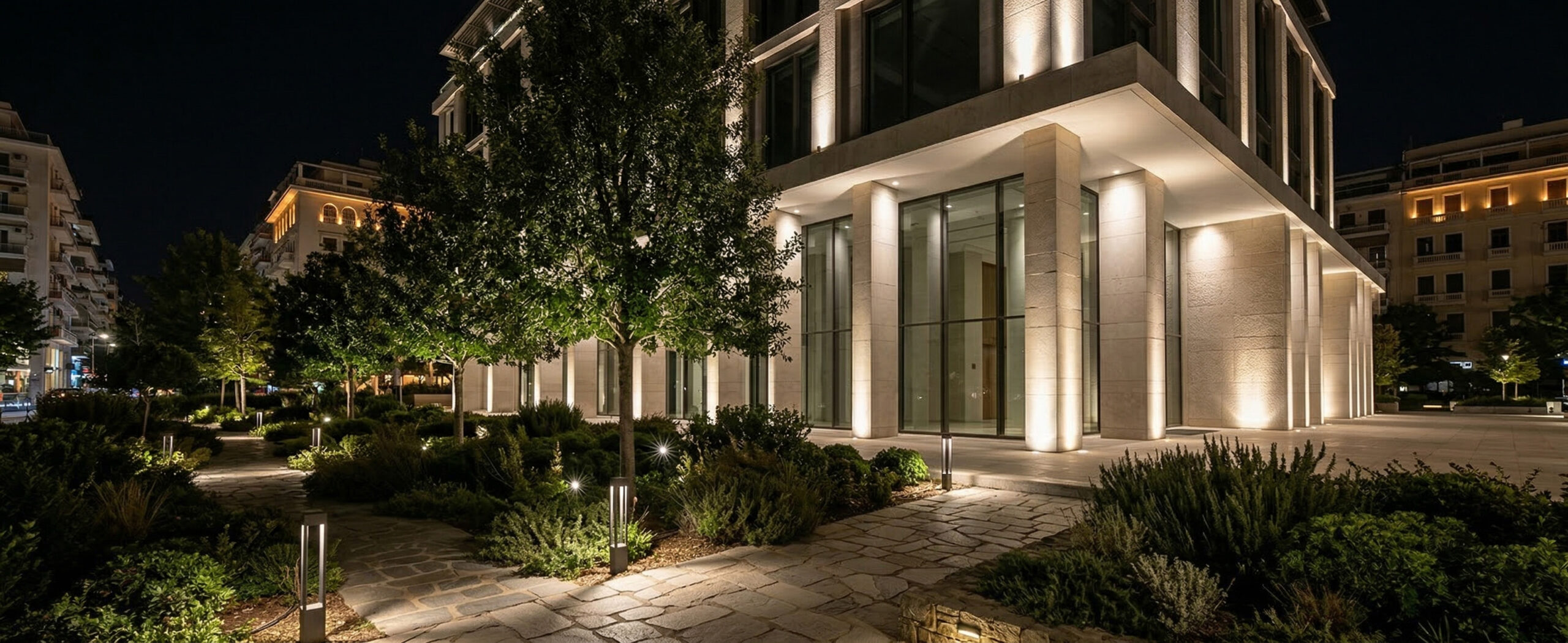
Purpose of this guide: To provide comprehensive information for the design and specification of exterior landscape and architectural lighting using modern LED technology. This guide is intended for lighting designers, architects, landscape architects, electrical engineers, municipalities and developers working on projects where the aesthetic quality of light is as important as its technical performance.
1. Introduction & Design Philosophy
Landscape and architectural lighting transforms the nighttime identity of buildings, public spaces, and natural environments. Unlike functional lighting (streets, workplaces), its primary purpose is to reveal form, texture, and spatial hierarchy — creating visual experiences that extend the life of a space well beyond daylight hours. Great architectural lighting follows a hierarchy: first, ensure safety and orientation; then define spatial boundaries and wayfinding; and finally, create atmosphere, drama, and emotional impact. The best designs achieve all three with restraint — the absence of light is often as important as its presence.
Three pillars of architectural lighting design:
1. Reveal, don't flood — Use light to emphasise form, texture and detail, not to create uniform brightness
2. Layer the light — Combine ambient, accent and task layers at different intensities
3. Control glare and spill — The luminaire itself should never be the focal point; the lit subject is
2. Lighting Techniques
Professional landscape and architectural lighting draws from a vocabulary of established techniques. Selecting the right technique for each element is the foundation of the lighting concept.Core Architectural Lighting Techniques
Uplighting / Floodlighting
Downlighting
Grazing / Wall Washing
Grazing
≤30cm
Silhouetting / Backlighting
Object
Light behind creates silhouette
Path & Bollard Lighting
3–5m typical
In-Ground / Recessed
IP67+ required, drive-over rated
Accent / Spotlighting
Statue
Narrow beam
Linear / Contour Lighting
Outlines form & edges
Underwater / Fountain
IP68, 12/24V DC, RGBW
Nine core lighting techniques for landscape and architectural applications. Each creates a distinct visual effect and requires specific luminaire types and positioning.
| Technique | Luminaire Position | Typical Beam | Best For |
|---|---|---|---|
| Uplighting | Ground level, aimed up | 10°–40° (narrow to medium) | Façades, columns, trees, monuments |
| Downlighting | Elevated (tree, structure) | 30°–60° (medium to wide) | Pathways, seating areas, "moonlighting" |
| Grazing | ≤30cm from surface | Asymmetric / elliptical | Textured walls, stone, brick, relief |
| Wall washing | ~1m from surface | Wide asymmetric | Smooth surfaces, even illumination |
| Silhouetting | Behind the subject | Wide flood | Sculptures, plants, decorative elements |
| Path lighting | Bollard (0.5–1.0m) | 360° or asymmetric | Walkways, garden paths, driveways |
| In-ground | Flush with ground | Narrow to medium | Columns, trees, façade base |
| Accent/spot | Remote, aimed at subject | 6°–20° (very narrow) | Statues, focal plants, signage |
| Linear/contour | Along edges or profiles | 120°–180° | Building outlines, cornices, steps |
| Underwater | Submerged (IP68) | Variable | Fountains, pools, water features |
3. Façade & Monument Lighting
Façade illumination requires careful analysis of the building's architecture, materials, and surroundings. The goal is to reveal the designer's intent and highlight the features that give the building its character.3.1 Illuminance Levels for Façades
The recommended illuminance depends on the surface reflectance, the ambient brightness of the surroundings, and the desired visual impact. CIE 094 provides guidance:| Surface Reflectance | Low Ambient (E1–E2) | Medium Ambient (E3) | High Ambient (E4) |
|---|---|---|---|
| Light (ρ > 0.6) — white marble, light stone | 20–60 lux | 60–150 lux | 150–300 lux |
| Medium (ρ 0.3–0.6) — sandstone, concrete | 40–100 lux | 100–250 lux | 250–450 lux |
| Dark (ρ < 0.3) — dark stone, brick | 60–200 lux | 200–400 lux | 400–600 lux |
🌿 Design Tip: Always perform a nighttime site visit before finalising the design. Assess ambient light levels, identify viewing angles, and determine which architectural features deserve emphasis. A daytime site visit alone is not sufficient — the character of surfaces changes dramatically under artificial light.
3.2 Façade Lighting Strategies
Three Approaches to Façade Lighting
Uniform Wash
Even coverage
Best for: smooth surfaces
Selective Accent
Columns & features only
Best for: classical architecture
Layered Composition
Multiple layers & intensities
Best for: complex, modern buildings
Three approaches to façade lighting. Uniform wash suits smooth surfaces; selective accent reveals structural features; layered composition creates depth and hierarchy.
3.3 Material & Colour Temperature Matching
| Building Material | Recommended CCT | CRI | Notes |
|---|---|---|---|
| White marble / limestone | 3000–4000K | ≥ 80 | Warm white enhances warmth; neutral white maintains purity |
| Sandstone / travertine | 2700–3000K | ≥ 80 | Warm tones complement natural golden hues |
| Red brick | 2700K | ≥ 90 | High CRI essential to render red tones accurately |
| Grey concrete | 3000–4000K | ≥ 70 | Neutral white avoids yellow cast on grey surfaces |
| Corten steel / copper | 2700K | ≥ 90 | Warm light enhances the rich patina |
| Glass / metal curtain wall | 3000–4000K | ≥ 70 | Internal illumination often more effective than external |
| Dark stone / basalt | 3000K | ≥ 80 | Higher illuminance required; warm light adds life |
4. Landscape & Garden Lighting
Landscape lighting extends the usability and visual appeal of outdoor spaces. It encompasses gardens, parks, plazas, courtyards, and natural settings. The key principle is subtlety — the light should feel like a natural extension of the environment, not an intrusion.4.1 Landscape Elements & Recommended Techniques
| Element | Primary Technique | Typical Luminaire | CCT | Notes |
|---|---|---|---|---|
| Large trees | Uplighting from base | In-ground or spike-mount | 2700–3000K | Use 2–3 fixtures per tree; avoid single-point source |
| Hedges / shrubs | Uplighting or grazing | Spike spot, compact flood | 3000K | Low wattage, wide beam to create volume |
| Flower beds | Low-level accent | Spike spot, step light | 3000K, CRI≥90 | High CRI to render colours accurately |
| Pathways | Bollard or step lighting | Bollard (0.5–1m), step light | 3000K | 1–5 lux average; uniform spacing 3–5m |
| Water features | Underwater / edge lighting | IP68 submersible, linear | RGBW or 3000K | 12/24V DC; stainless steel 316L housing |
| Steps / retaining walls | Step light / linear recessed | Recessed wall light, LED strip | 3000K | Safety priority; min 50 lux on treads |
| Sculptures / art | Accent spotlight | Adjustable projector, spike spot | 3000K, CRI≥90 | Narrow beam (6°–15°); aim for 5:1 contrast ratio |
| Pergolas / gazebos | Downlighting, indirect | Concealed linear, pendant | 2700–3000K | Mount inside structure; avoid visible sources |
Path Lighting
1–5
lux (Eav)
Accent Contrast
5:1
min. object : surround
Tree Uplighting
2–3
fixtures per tree
Step Treads
≥50
lux (safety)
⚠️ Ecological Impact: Landscape lighting can significantly affect local ecosystems. Minimise impact by using warm CCT (≤3000K), avoiding upward light into tree canopies during nesting season, directing light away from water courses (to protect aquatic insects and amphibians), and using timers or sensors to switch off after midnight. Always follow local biodiversity guidelines.
5. Colour & Dynamic Lighting (RGBW)
Modern LED technology enables full-colour and tuneable white lighting, opening creative possibilities for architectural and landscape applications.5.1 LED Colour Technologies
| Technology | Description | Typical Use | Limitations |
|---|---|---|---|
| Static White | Fixed CCT (e.g. 3000K) | Permanent installations, façades | No flexibility; CCT change requires luminaire swap |
| Tunable White | Adjustable CCT (2200–6500K) | Adaptive façade lighting, circadian applications | Limited to white spectrum; higher cost |
| RGB | Red + Green + Blue LEDs | Colour effects, events | Poor white rendering; visible colour banding |
| RGBW | RGB + dedicated White LED | Colour + clean white in one fixture | Best compromise for architectural colour |
| RGBA / RGBWW | RGB + Amber or Warm White | Premium colour mixing, saturated pastels | Higher cost; complex control |
✅ Recommendation: For permanent architectural installations that require both high-quality white light and occasional colour scenes, specify RGBW luminaires. They provide clean 3000K white for everyday use and full-colour capability for events, holidays, or civic celebrations — from a single fixture.
5.2 Colour Design Principles
- Less is more: Restrained use of colour creates more impact than saturating every surface. Use colour as an accent, not a blanket.
- Match the context: Historic buildings typically benefit from warm white or subtle amber tones. Full-colour RGB is better suited to contemporary structures, bridges, and event spaces.
- Maintain CRI for white: When using RGBW fixtures in white mode, verify that the white channel delivers CRI ≥ 80 independently. Mixed-channel white is often visually poor.
- Consider the neighbourhood: Saturated colour lighting at night can be disruptive to residents. Use timers and limit colour scenes to appropriate hours.
6. Optical Performance & Beam Selection
Choosing the correct beam angle is critical in architectural lighting. Too wide, and the light washes out the detail; too narrow, and hot spots and scalloping appear.| Beam Designation | Beam Angle | Typical Application |
|---|---|---|
| Very Narrow Spot (VNSP) | 5°–10° | Long-throw accent, tall columns, tower tops |
| Narrow Spot (NSP) | 10°–18° | Sculptures, signage, architectural details |
| Spot (SP) | 18°–25° | Tree uplighting, medium-distance accent |
| Medium Flood (MFL) | 25°–40° | Façade sections, large trees, garden areas |
| Wide Flood (WFL) | 40°–60° | Wall washing, large façade areas, ground cover |
| Very Wide Flood (VWFL) | 60°–120°+ | General ambient, path lighting, step lighting |
| Asymmetric | Various | Grazing, wall washing without spill upward |
| Elliptical | 10°×60° etc. | Narrow strip effects, cornice lighting |
Beam Angle Selection by Throw Distance
2m
5m
10m
20m
30m+
VWFL 60°–120°
WFL 40°–60°
MFL 25°–40°
SP / NSP 10°–25°
VNSP 5°–10°
Throw Distance →
General guide for beam angle selection based on throw distance. Always verify with photometric calculation.
Rule of thumb: For uplighting a surface at distance D, select a beam angle where the beam diameter at distance D approximately equals the width of the area you want to illuminate. Use the formula: Beam Diameter ≈ 2 × D × tan(θ/2), where θ is the beam angle.
7. IP, IK & Material Selection
Outdoor luminaires must withstand harsh environmental conditions. The choice of IP rating, IK impact resistance, and housing material is critical for reliability and longevity.| Application | Minimum IP | Minimum IK | Recommended Material |
|---|---|---|---|
| Façade-mounted | IP65 | IK07 | Die-cast aluminium, powder coated |
| In-ground (pedestrian) | IP67 | IK10 | 316L stainless steel, tempered glass |
| In-ground (drive-over) | IP67 | IK10+ | 316L SS, load rating ≥5 tons |
| Underwater (≤1m) | IP68 (1m/30min) | IK08 | 316L SS, bronze, or engineering polymer |
| Underwater (>1m) | IP68 (depth-rated) | IK08 | 316L SS or bronze; pressure-rated |
| Spike mount (garden) | IP65 | IK06 | Aluminium or composite; UV-stable |
| Bollard | IP65 | IK10 | Aluminium, 316L SS, or cast iron |
| Linear (outdoor) | IP66 | IK07 | Extruded aluminium, silicone lens |
| Coastal / marine | IP66 | IK08 | 316L SS or marine-grade aluminium; C5-M coating |
⚠️ Coastal Environments: Standard powder-coated aluminium will corrode within 2–3 years in coastal locations. Specify 316L stainless steel or C5-M marine-grade coating for any installation within 1km of the sea.
8. Controls & Scenes
Architectural and landscape lighting benefits enormously from intelligent control systems. Unlike street lighting (where the goal is energy saving), the primary purpose here is to create different moods, respond to events, and manage the visual experience.8.1 Control Protocols for Architectural Lighting
| Protocol | Best For | Key Feature |
|---|---|---|
| DALI-2 | Static/tunable white, dimming | Industry standard, reliable, 64 addresses per line |
| DMX512 | RGBW colour control, dynamic scenes | Industry standard for entertainment and architectural colour; 512 channels per universe |
| DMX-RDM | As DMX + remote configuration | Bi-directional feedback for remote addressing and diagnostics |
| KNX | Building-integrated systems | Full building automation integration (HVAC, blinds, security) |
| 0–10V | Simple dimming | Low cost; suitable for small installations with basic needs |
| Wireless (Bluetooth Mesh, Zigbee) | Retrofit, gardens | No wiring needed; app-controlled; limited range |
🌿 Scene Programming: For architectural façades, plan at minimum three scenes: Everyday (warm white, moderate intensity), Late Night (reduced to 30–50%, warmer CCT), and Event/Celebration (full colour or enhanced intensity). Add astronomical clock scheduling so scenes adapt to sunset/sunrise automatically.
9. Energy & Environmental Responsibility
Landscape and architectural lighting must balance aesthetic ambition with environmental responsibility. Over-illumination wastes energy and contributes to light pollution.9.1 Key Principles
- Light only what needs to be lit: Avoid general floodlighting. Use precise optics to contain light within the intended target area.
- Minimise upward light: ULOR should be 0% wherever possible. For uplighting, use shields and louvers to prevent spill beyond the building edge.
- Use warm CCT (≤3000K): Reduces blue light emission and ecological impact — consistent with dark-sky best practice.
- Implement curfew schedules: Reduce intensity by 50% after midnight; switch off non-essential architectural lighting by 01:00.
- Dim, don't switch off abruptly: Gradual dimming is more respectful of neighbours and creates a better visual transition.
- Avoid illuminating natural habitats: Keep light away from trees during nesting season, water courses, and hedgerows.
Target ULOR
0%
no upward light spill
After Midnight
50%
dimming minimum
Max CCT
3000K
for ecological areas
Curfew
01:00
switch off non-essential
10. Design Workflow
A structured design process ensures that the aesthetic vision is achievable, compliant, and maintainable.- Site Analysis: Daytime and nighttime visits. Photograph the site from all key viewing angles. Note ambient light levels, surface materials and colours, and identify the architectural or landscape features to be emphasised.
- Concept Development: Establish the lighting intent — what story does the light tell? Create preliminary sketches or mood boards showing the desired effect.
- Technique Selection: Assign lighting techniques (uplighting, grazing, accent, etc.) to each element. This defines the luminaire typology required.
- Luminaire Specification: Select luminaires based on optical performance (beam angle, CRI, CCT), mechanical requirements (IP, IK, material), and control compatibility (DALI, DMX).
- Photometric Simulation: Use DIALux EVO or RELUX to verify illuminance levels, uniformity, and spill light. For complex projects, consider 3D rendering with AGi32 or Dialux.
- Mock-up & Testing: For prestige projects, always install a test section on-site before final ordering. Evaluate beam width, colour, and intensity at night.
- Documentation: Prepare luminaire schedule, aiming diagrams, cable routing plan, control system schematic, and maintenance access requirements.
- Commissioning & Aiming: Final on-site adjustment of every luminaire. This step is critical — even a 5° change in aiming can make or break an installation.
✅ Critical Step: Never skip the nighttime mock-up. What looks perfect in software may look entirely different in reality due to material reflectance, adjacent lighting, and atmospheric conditions. Budget for 1–2 nights of on-site testing.
11. Common Mistakes to Avoid
| Mistake | Consequence | Solution |
|---|---|---|
| Visible luminaires | Glare, visual clutter, attention on fixture not subject | Conceal fixtures; use shields, recessing, and discreet mounting |
| Over-illumination | Flat, washed-out appearance; energy waste; light pollution | Use lower lumen packages; dim down; design for contrast, not brightness |
| Single-point uplighting of trees | Harsh shadow, unnatural "spotlight" effect | Use 2–3 fixtures per tree at different angles |
| Wrong CCT for material | Cold light on warm stone (or vice versa) looks lifeless | Match CCT to material colour (see Section 3.3) |
| Ignoring maintenance access | Fixtures in inaccessible positions = no maintenance = failure | Plan access routes; use tool-less opening; specify long-life products |
| No shielding on in-ground | Direct glare into eyes of pedestrians | Use honeycomb louvers or asymmetric optics for in-ground fixtures |
| Ignoring daytime appearance | Visible cable runs, ugly fixtures during daylight | Select architecturally discreet luminaires; plan cable concealment |
| No control system | Cannot adjust scenes, dim at night, or respond to events | Always specify at minimum DALI or DMX; add astronomical clock |
12. TECHLUMEN Product Recommendations
TECHLUMEN manufactures a complete range of luminaires specifically designed for landscape and architectural applications. The table below maps each application type to the recommended product families.12.1 Projectors & Spotlights
| Product | Type | Application | Key Features |
|---|---|---|---|
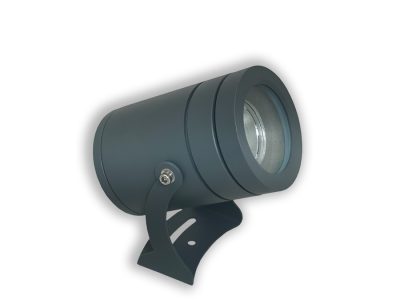
| TICO | Compact LED spot | Tree uplighting (with spike), garden accent, monument highlighting, façade detail | Beam angles 18°–55°, IP65, accessories: spike, tree strap, honeycomb, pole bracket, wall mount. 3000K, 5yr warranty |
| TICO-RGBW | Compact RGBW LED spot | Dynamic colour accent on trees, façades, gardens, hotels, event spaces | 12W RGBW (W=3000K), beams 18°–55°, IP66, DALI controlled, series connection 6–15 fixtures. Same accessories as TICO |
| TICO 60 | Medium LED projector | Façade uplighting, large tree illumination, long-throw accent | Higher lumen output, adjustable aiming, IP65 |
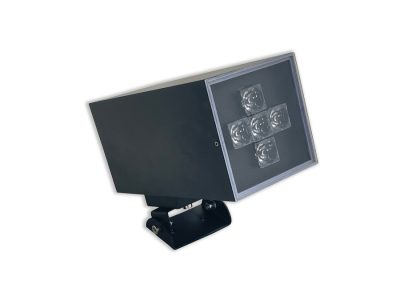
| QUADRO Series | LED projector | Medium to large façades, monument floodlighting, architectural accent | Robust construction, multiple wattages, precise optics |
| RECTO RGBW | RGBW LED projector | Dynamic façade colour, event lighting, civic celebrations | Full RGBW colour mixing, DMX control, IP66 |
12.2 Tree & Garden Lighting
| Product | Type | Application | Key Features |
|---|---|---|---|
| ALOS | Tree lighting zone | 360° tree ring lighting, medium and large trees, feature planting | Circular mounting system around tree base, uniform canopy illumination, IP65 |
| TICO + Spike | Spike-mount LED spot | Individual tree uplighting, shrub accent, garden focal points | Spike accessory for ground mounting, tree strap for branch mounting, 18°–55° beams |
| REA | Copper floor-standing spot | Premium garden lighting, luxury courtyards, accent lighting with artistic character | Copper body with two flexible "branches" (2×3W spots), adjustable direction, aluminium base with bronze powder-coat, IP66 |
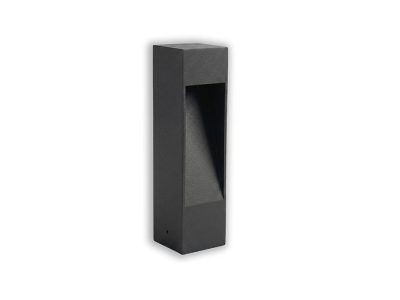
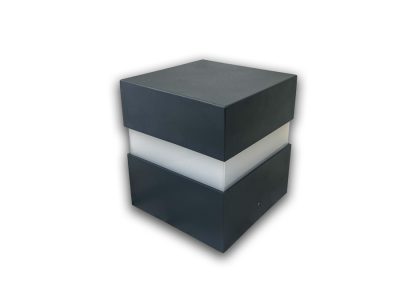
12.3 Bollards & Path Lighting
| Product | Type | Application | Key Features |
|---|---|---|---|
| VOLA 30 | Pathway LED light | Garden paths, walkways, discreet indirect lighting | Aluminium, 300mm height, indirect light output, 6–13W, IP66, IK09, any RAL colour, 5yr warranty |
| TRIXX | Modern LED bollard | Contemporary paths, hotel gardens, residential entries | Slim modern design, tunable CCT option, IP65, IK10 |
| OPUS 2 | LED bollard (aluminium) | Park pathways, public plazas, residential walkways | Clean geometric form, IP65 |
| OPUS 2 C | LED bollard (cement) | Contemporary urban design, plazas, architectural landscapes | Exposed cement finish, unique material aesthetic |
| TESSA B | LED bollard | General path and garden lighting | Versatile design, IP65 |
| GAMMA 900 | LED bollard | Wide area path lighting, parks, public spaces | 900mm height, robust construction |
| STOCK | LED bollard | Commercial and public outdoor areas | Durable, functional design |
12.4 In-Ground & Recessed
| Product | Type | Application | Key Features |
|---|---|---|---|
| IG-D2 | In-ground spot (fixed) | Directional ground-level illumination, pathway edge marking, wall base grazing | 3–13W, IP68, IK10, 316 stainless steel, Ø92mm, 2700–5000K, CRI 70–90, 5yr warranty |
| IGR 160 | In-ground spot (adjustable) | Adjustable accent from ground, sculptures, flexible aiming | IP67, adjustable tilt, 316L stainless steel |
| GAIA 100 | In-ground linear (100cm) | Façade base washing, long linear ground effects, pathway edge | IP67, continuous linear, walkover rated |
| GAIA 50 | In-ground linear (50cm) | Shorter linear accents, step edges, planter surrounds | IP67, compact linear, walkover rated |
12.5 Linear & RGBW
| Product | Type | Application | Key Features |
|---|---|---|---|
| THIN IP67 | Outdoor linear LED | Cornice lighting, architectural contours, cove lighting, step edges | Ultra-slim profile, IP67, continuous runs |
| SPECTRA-2 | RGBW linear LED | Dynamic façade colour, bridge lighting, feature walls, event venues | RGBW full colour, IP66, DMX512, anodized aluminium option |
12.6 Underwater
| Product | Type | Application | Key Features |
|---|---|---|---|
| IGP 250 RGBW | Underwater pool/fountain light | Swimming pools, decorative fountains, water features, ponds | IP68, RGBW, 316L stainless steel, 12/24V DC, DMX optional |
✅ Design Support: TECHLUMEN provides complete photometric files (LDT/IES) for all products listed above, compatible with DIALux EVO and RELUX. Our engineering team can assist with product selection, photometric simulations, and custom solutions for special projects. Contact us at [email protected] for project-specific recommendations.
13. Frequently Asked Questions (FAQ)
What is the difference between grazing and wall washing?
Grazing places the luminaire very close to the surface (typically ≤30cm), creating dramatic shadows that reveal texture — ideal for rough stone, brick, or relief work. Wall washing positions the luminaire further away (~1m+) and uses a wider beam to create even, smooth illumination — ideal for flat or smooth surfaces where uniform brightness is desired.
How many fixtures do I need to uplight a tree?
For small trees (3–5m), one fixture may suffice if positioned to illuminate the trunk and lower canopy. For medium trees (5–10m), use 2–3 fixtures at different angles around the base. For large specimen trees (10m+), plan 3–4 fixtures with a mix of narrow and medium beams to light the trunk, canopy, and any significant branching structure.
Should I use RGB or RGBW for architectural colour?
Always prefer RGBW for permanent architectural installations. Pure RGB creates colour well but produces poor-quality white (typically greenish or pinkish). RGBW adds a dedicated white LED channel that delivers clean, high-CRI white light for everyday use, with full-colour capability available when needed.
What voltage should I use for garden lighting?
For residential gardens and areas accessible to the public, 24V DC (SELV — Safety Extra Low Voltage) is strongly recommended. It eliminates the risk of electric shock, simplifies installation, and allows lightweight cabling. 230V AC is used for higher-power installations (>100W per run) or where cable distances exceed 30–40m, but requires RCD protection and cable burial to regulation depth.
How do I avoid light pollution with architectural uplighting?
Three strategies: (1) Use luminaires with precise optics and honeycomb louvers to confine the beam to the building surface. (2) Ensure the beam terminates at the building edge — no light should escape above the roofline. (3) Implement an astronomical clock and curfew dimming to reduce or switch off uplighting after midnight. Some municipalities now mandate maximum upward light limits for architectural installations.
Can TECHLUMEN provide custom architectural lighting solutions?
Yes. TECHLUMEN offers a range of projectors, linear luminaires, in-ground fixtures, and underwater lights suitable for architectural and landscape applications. Our engineering team can assist with photometric simulations, custom optic selection, RGBW colour specification, and DMX/DALI control integration for projects of any scale.
Related Standards & References
- CIE 094:1993 — Guide for floodlighting
- EN 12464-2 — Lighting of outdoor work places
- CIE 150:2017 — Guide on the limitation of obtrusive light
- EN 13201 — Road lighting (for public paths & plazas)
- IDA / IES — Model Lighting Ordinance (dark-sky compliance)
- EN 60598-2-13 — Ground-recessed luminaires
- EN 60598-2-7 — Portable luminaires for garden use
- IEC 61347-2-13 — LED driver requirements