Lighting Guide
for Hotels & Hospitality Spaces
Comprehensive scientific guide with references to international standards, academic research and industry best practices
Welcome to the comprehensive lighting guide for hospitality professionals. This guide covers all aspects of lighting design, from basic theory to the most advanced technologies and applications. It is based on international standards (IEC, IEEE, CIE, WELL Building Standard), academic research and expertise from leading lighting manufacturers.
Layers of Light
The three fundamental layers that create the perfect atmosphere
An effective lighting design is based on the three fundamental lighting layers that work together to create atmosphere and functionality.[1][2]
Ambient Lighting(General Lighting)
This is the main, diffused lighting of the space, providing overall brightness and serving as the base. Ambient lighting ensures that a space is uniformly illuminated – usually through central ceiling fixtures, ceiling lights, spotlights or even natural light.
Task Lighting(Functional Lighting)
This layer focuses on specific areas where activities take place. It includes wall sconces next to beds, desk lamps, bathroom mirror lighting. It not only provides functionality, but adds depth and interest to the space.
Accent Lighting(Decorative Lighting)
Highlighting decorative or architectural elements. Targeted lighting that draws attention to artwork, details, plants, wall textures. Uses spotlights, track lighting, hidden lighting (LED strips) for drama and depth.
Key Principle: The combination of three layers with controls (dimmers, central systems) allows easy atmosphere changes. A central control system enables selection of "scenes" at the push of a button.[3][4]
Chapter Key Points
- The three layers (Ambient, Task, Accent) must always coexist
- Dimming capability is essential for each layer
- Central control systems for quick "scene" changes
- Each layer has a distinct role: Ambient = brightness, Task = function, Accent = character
Lighting by Space
Specialized solutions for each hotel area
Each hotel area has a different use and requires a separate lighting approach. From the impressive lobby to private rooms and vibrant dining spaces.[3][4]
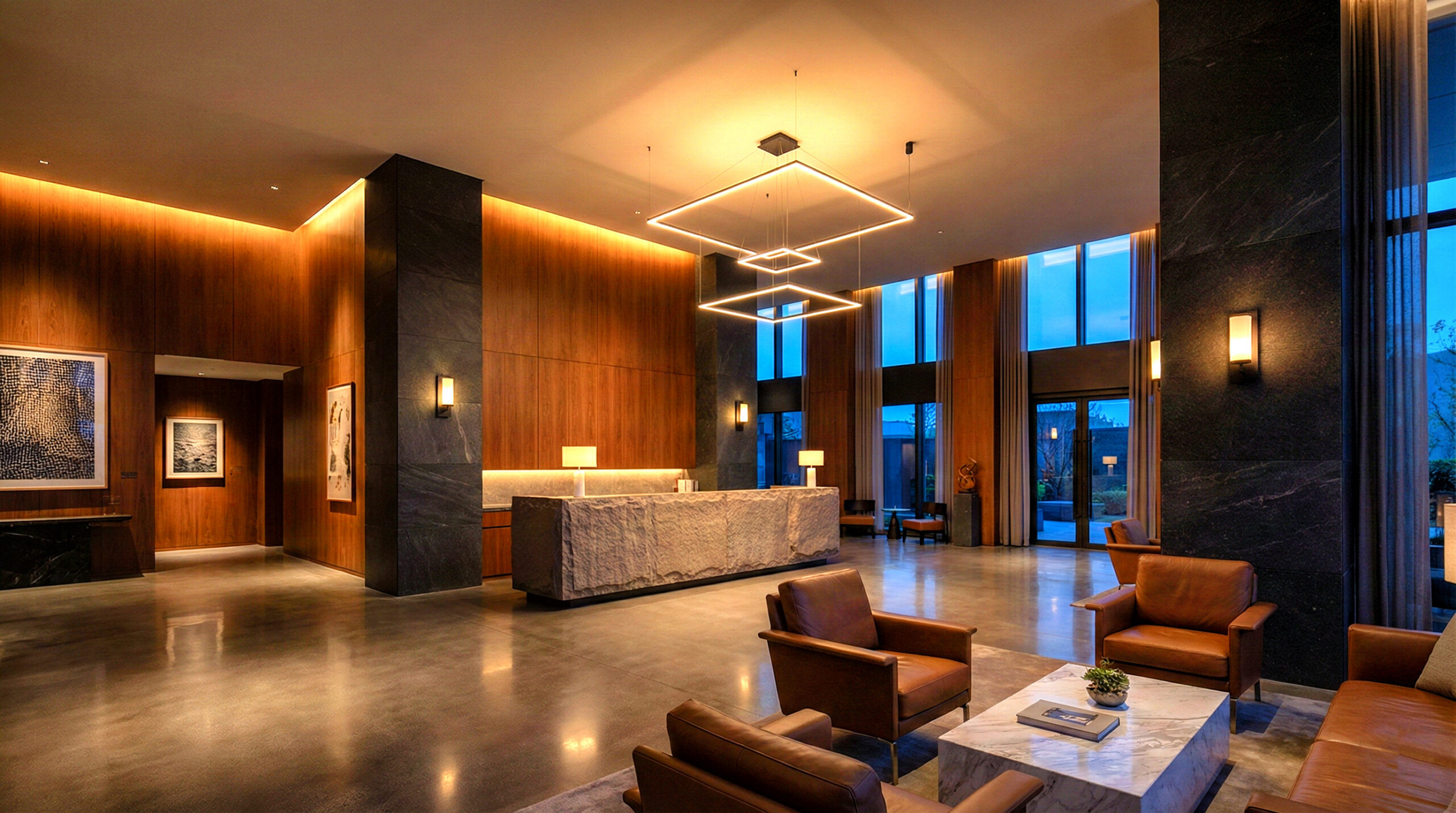
Lobby (Reception & Impression)
The lobby is the guest's first point of contact with the hotel – this is where the critical first impression is formed.
Lobby Lighting Strategies
1. Central "Wow Effect" Fixture
A large central fixture (chandelier or pendant composition) above reception creates warmth and the necessary "wow" effect. It draws the eye toward the reception area, conveys a sense of luxury and makes the guest feel welcome.
2. Hidden Guiding Light
Hidden lighting or backlight behind the reception desk automatically guides the visitor's eye toward reception, providing clear, friendly direction.
3. Multi-layered Lighting
- Diffused ambient lighting for brightness and safety
- Accent lighting for highlighting architectural details, artwork
- Decorative fixtures that enhance the space's identity
4. Hidden Lighting and Material Enhancement
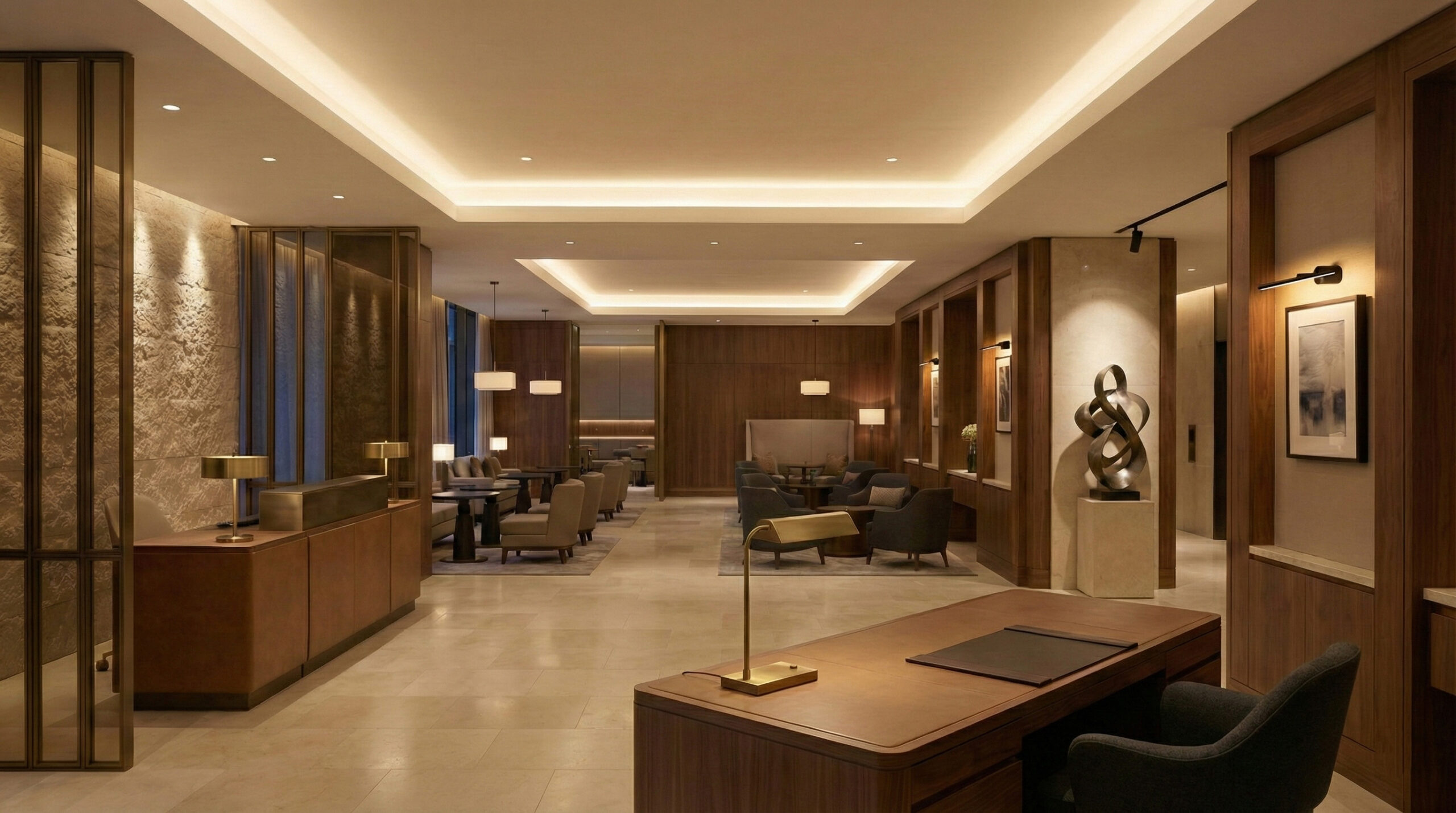
Hidden lights in coves or around perimeters make the space appear larger and more impressive. Directional spots highlight plants, artwork, textures of luxury materials (stone, marble, wood).
Lobby Philosophy: Balance between comfort and impression. The lobby should feel familiar and safe, but also impress with elegant lighting touches.
Guest Rooms (Comfort & Adaptability)
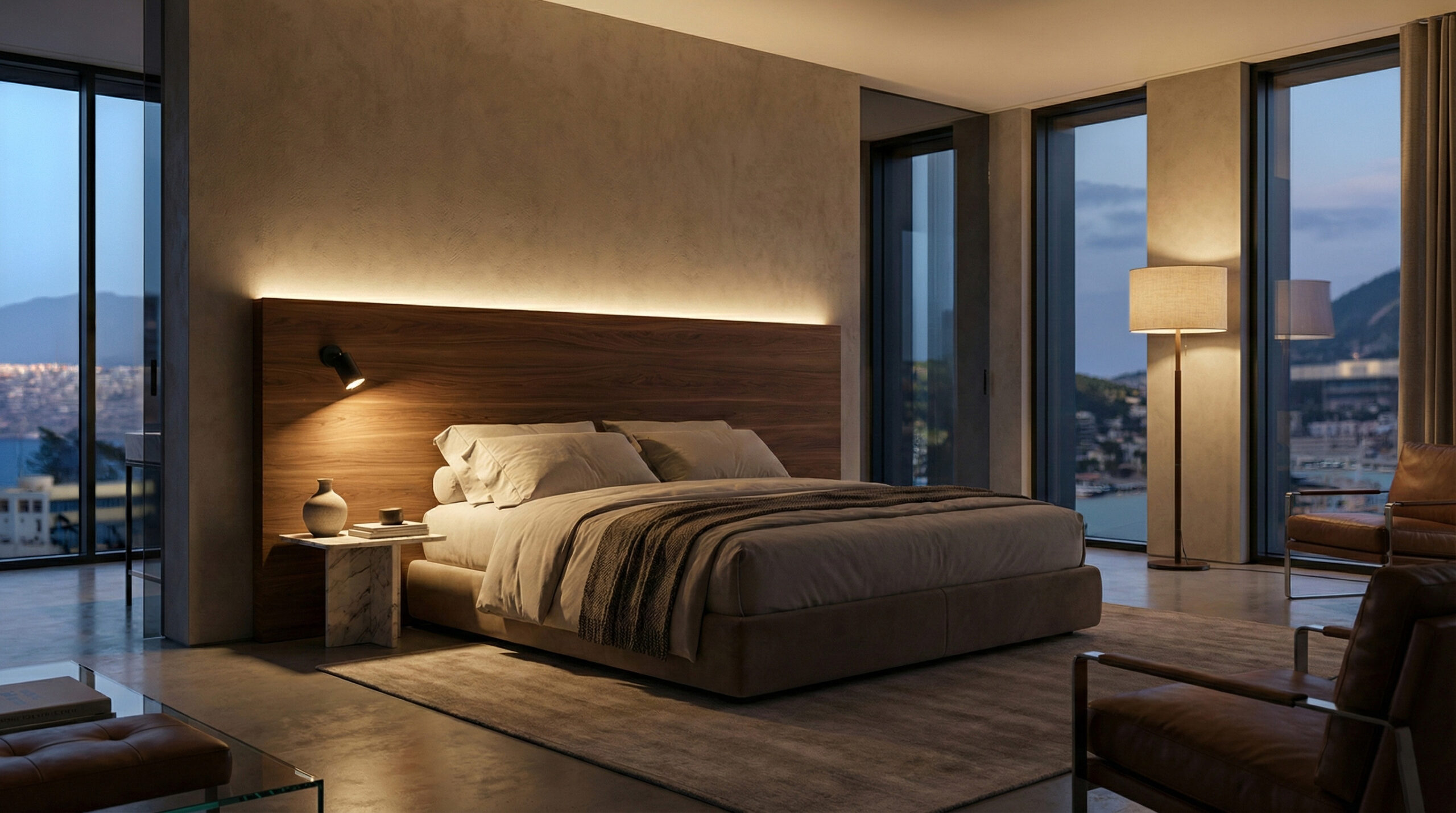
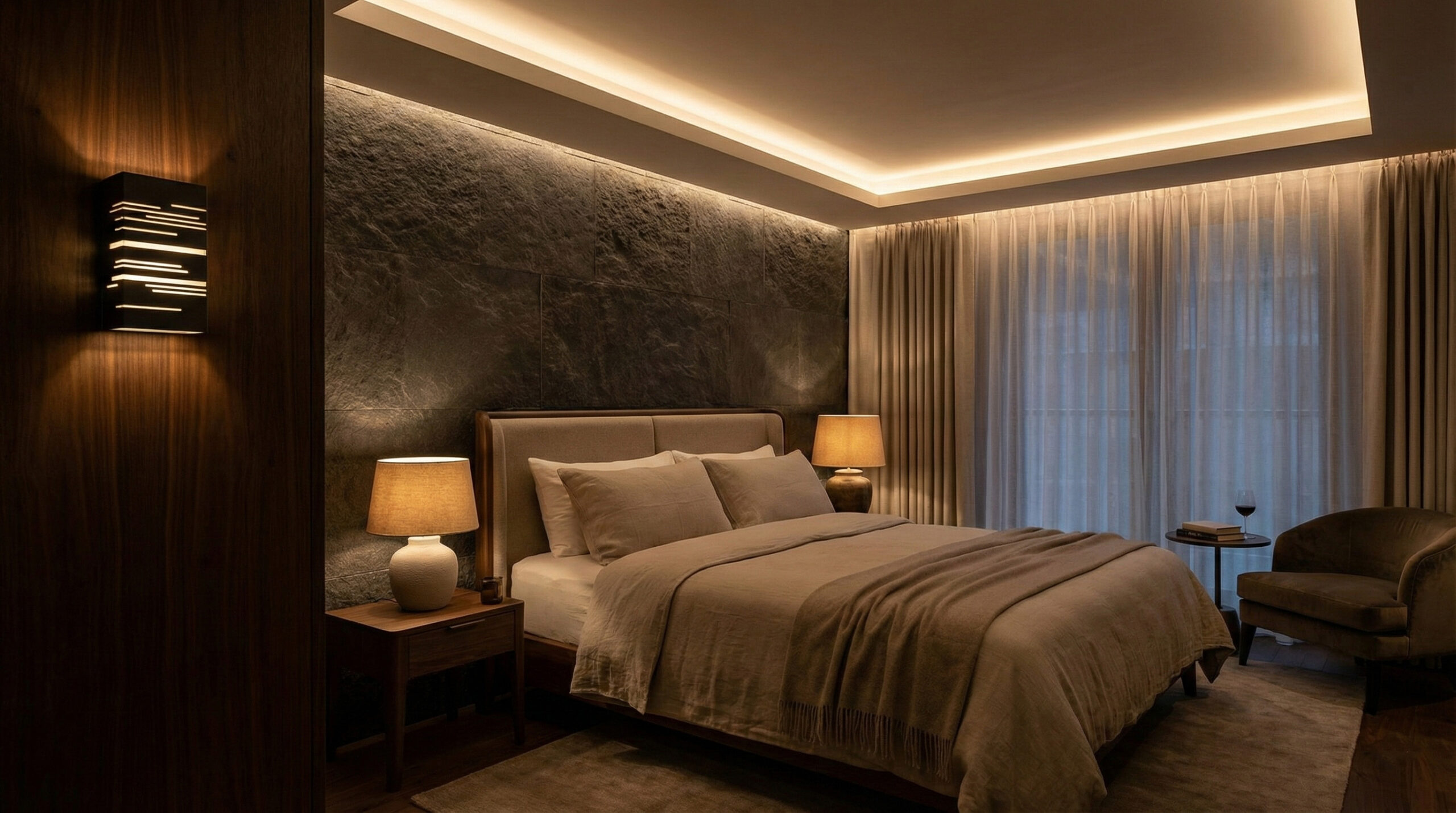
In rooms, lighting should create a sense of comfort – a "nest" where the guest relaxes – but also be adaptable.
Room Lighting Elements
- General Lighting with Dimmer: Recessed spots or ceiling fixtures with intensity control
- Peripheral Lighting: Table and floor lamps for soft light
- Reading Lights: Wall sconces with adjustable swing-arm on each side of bed
- Easy Controls: Switches and dimmers near the bed, master control panel
- Night Lighting: LED strip under the bed for safe nighttime movement
Importance of High CRI: CRI ≥90 is recommended so colors render naturally. The guest preparing for a meeting wants the mirror to show correct tie or makeup shades.[9][10]
Dining Areas (Restaurants, Bars)
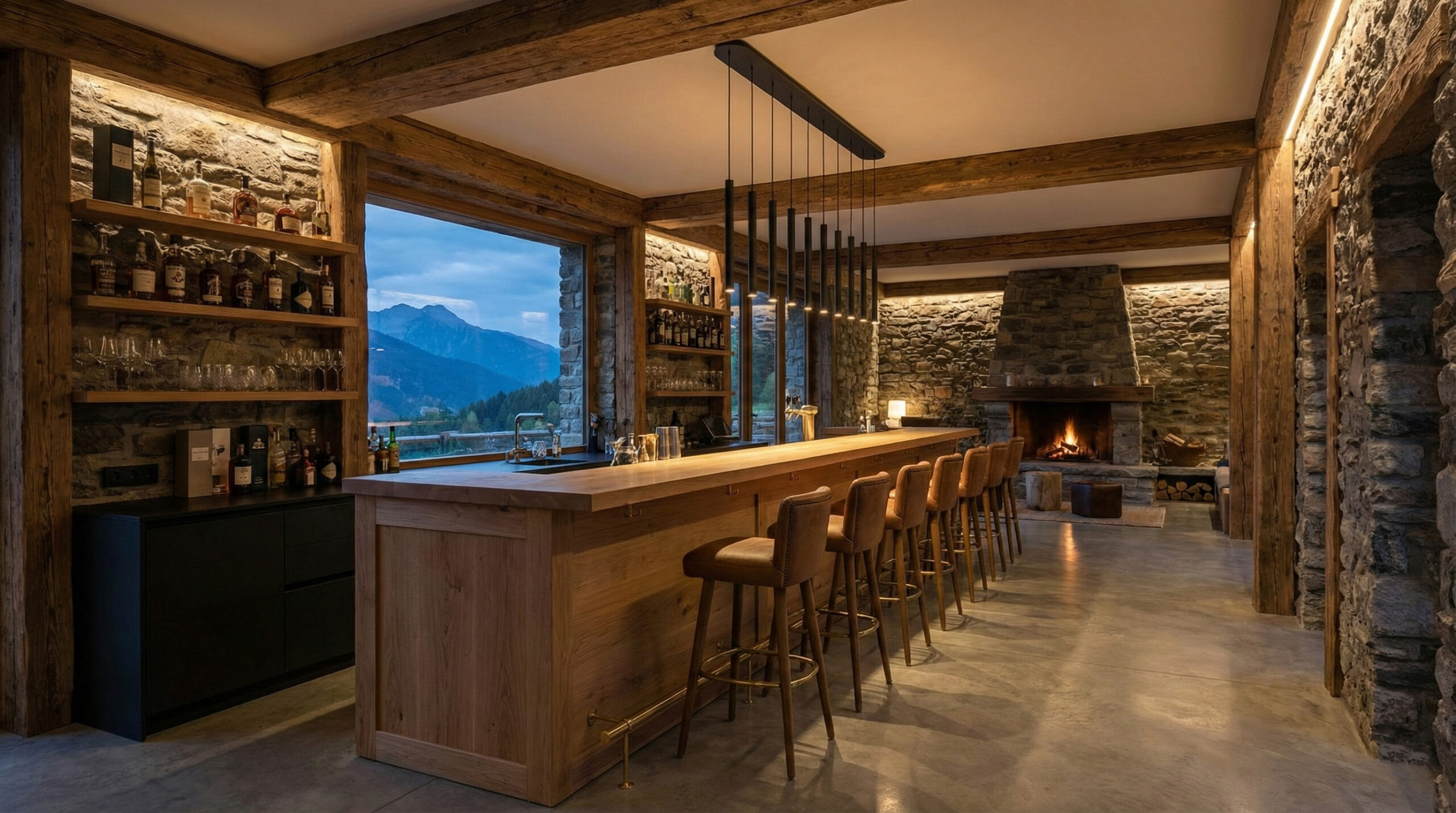
Dining areas require lighting that enhances the dining or entertainment experience, creates attractive atmosphere and serves practical needs.
Warmth & Atmosphere
Basic principle: warm lighting (below ~3000K) creates a warm, welcoming atmosphere. Research shows:[5][6]
due to good lighting
due to poor lighting
Flexibility with Dimming
Fixtures should be dimmable. During the day higher levels for functionality, in the evening they lower for intimate atmosphere.
Direct and Indirect Combination
- General Diffused: Hidden ceiling lighting or adjustable spots
- Bar and Buffet Enhancement: LED behind bottles, strips under shelves
- Table Lighting: Pendant lights above tables - "islands" of light
- Light and Shadow Play: Separating bright/dark areas for privacy
Flow and Functionality
Corridors, exits, movement paths adequately lit. Small floor-embedded lights mark stairs. Staff need light at workstations.
CRI Importance in Dining: CRI ≥90 for natural food color rendering. A steak's red, salad's green, beer's amber must look appetizing.[9]
Chapter Summary
- Lobby: Impression + Guidance + Brand identity
- Rooms: Comfort + Adaptability + Easy controls
- Warm lighting (2700-3000K) for cozy dining atmosphere
- Dimming essential for day→night transitions
- CRI ≥90 for natural color rendering
Color Temperature (CCT) & Atmosphere
How light color affects mood and behavior
Correlated Color Temperature (CCT) is a critical parameter affecting atmosphere. It refers to whether light appears "warm" (yellowish) or "cool" (white to blue). Measured in Kelvin (K).[5][6]
Color Temperature Scale
Temperature Characteristics
Warm Light (2700K – 3000K)
Creates a sense of warmth, intimacy and relaxation. Ideal for lobbies, lounges, restaurants, bars, rooms. Most hospitality spaces use 2700K because this "warm" hue induces comfort and relaxation – similar to candlelight or sunset.
Neutral Light (3500K – 4000K)
Balanced light without strong hues. Useful for breakfast areas (morning), corridors, gyms. Natural, clean light that's neither too warm nor too cool.
Cooler Light (5000K+)
Clear, vibrant sensation – increased alertness and concentration. Can seem impersonal or "clinical" in wrong environments. Suits kitchens, meeting rooms, morning hours.
| Temperature | Characteristics | Ideal Spaces | Atmosphere |
|---|---|---|---|
| 2700-3000K Warm White | Yellowish, warm light | Lobby, Rooms, Restaurants, Bars | Relaxation, Intimacy |
| 3500-4000K Neutral | Balanced | Breakfast, Corridors, Gyms | Natural, Clean |
| 5000-6500K Cool | Blue tint | Kitchens, Workspaces | Alertness |
Tunable White (Dynamic Adjustable White)
Innovative trend: fixtures that change CCT at any moment, from 2700K (warm) to 6500K (cool daylight), manually or automatically. Same fixture: morning cool daylight, evening warm amber.[7][8]
Example: Restaurant uses warm tones in evening (cozy feel), cooler during cleaning. Hotels with adjustable lighting: welcoming atmosphere on arrival, serene in rooms.
Tunable White Advantages
- Flexibility: Space transforms (conference→wedding) with CCT change
- Savings: No need for different fixtures
- Wellness: Circadian rhythm support
- Seasonal Adaptation: Summer cool, winter warm
Circadian Lighting
Advanced application: dynamic lighting that mimics the sun's daily cycle, with CCT and intensity changes throughout 24 hours.[20][21]
How It Works
- Morning: Cool-blue tones (5000-6500K), high intensity → suppresses melatonin, wakefulness
- Midday: Neutral (4000K), high intensity
- Evening: Warm orange-red (2700-3000K), low intensity → melatonin production, sleep
Goals and Benefits
Supporting natural biological clock:
- Better sleep and rest quality
- Improved mood, reduced stress
- Increased morning energy
- Overall wellness and wellbeing
- Reduced jet lag for travelers
Wellness Hotel: Spa resort with circadian lighting: lights "wake up" gradually (sunrise simulation), evening they automatically dim. Guests reported improved sleep, reduced jet lag.[20][21]
Practical Implementation - Requirements:
- Tunable white fixtures with two LED channels (warm + cool)
- DALI-2 controllers or other digital system
- Scene programming or time-based automation
- Light sensors (optional)
Caution: Tunable white fixtures should have high CRI across the full range. Transitions smooth and gradual – no abrupt changes.
CCT Summary
- Warm lights (2700-3000K) for relaxation in common areas
- Neutral/cool (4000K+) for alertness in work areas
- Tunable white = flexibility and adaptation
- Circadian lighting = biological clock support + wellness
- Space transformation (ballroom: conference→wedding)
- CCT choice as important as intensity
Color Rendering Index CRI / R9 & Materials
Why color fidelity is critical for atmosphere
Often overlooked but extremely important technical factor: the color rendering of fixtures, expressed through CRI (Color Rendering Index) and R9.[9][10]
What are CRI and R9?
CRI (0-100): How faithfully lighting renders colors compared to natural light. CRI close to 100 = colors appear as in sunlight. General CRI (Ra) is calculated as average across 8 pastel colors, DOES NOT include "deep red".
R9: Sub-value that evaluates how saturated red color is rendered. Very critical because many objects contain red/orange tones (skin, wood, food, fabrics).[9]
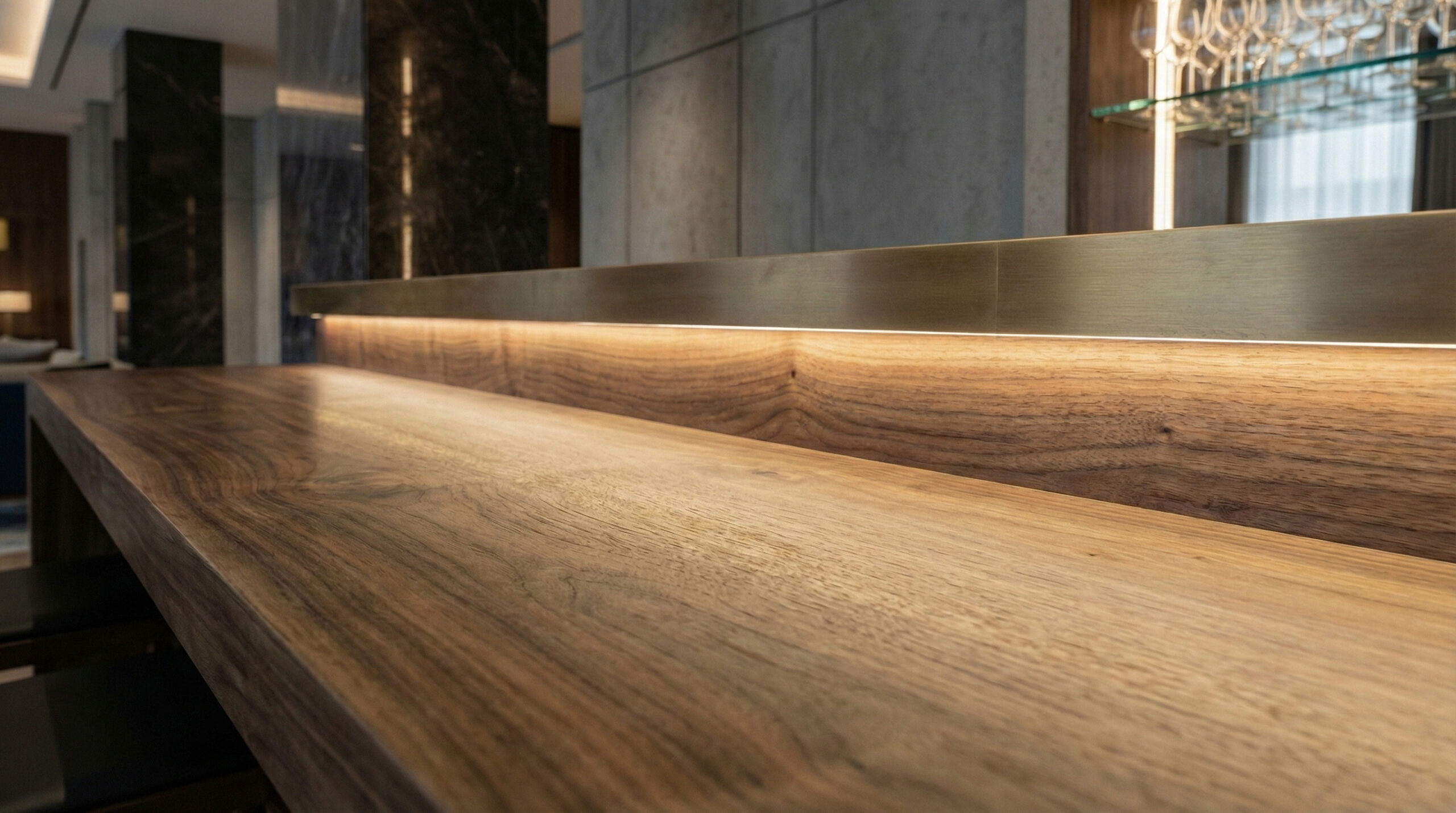
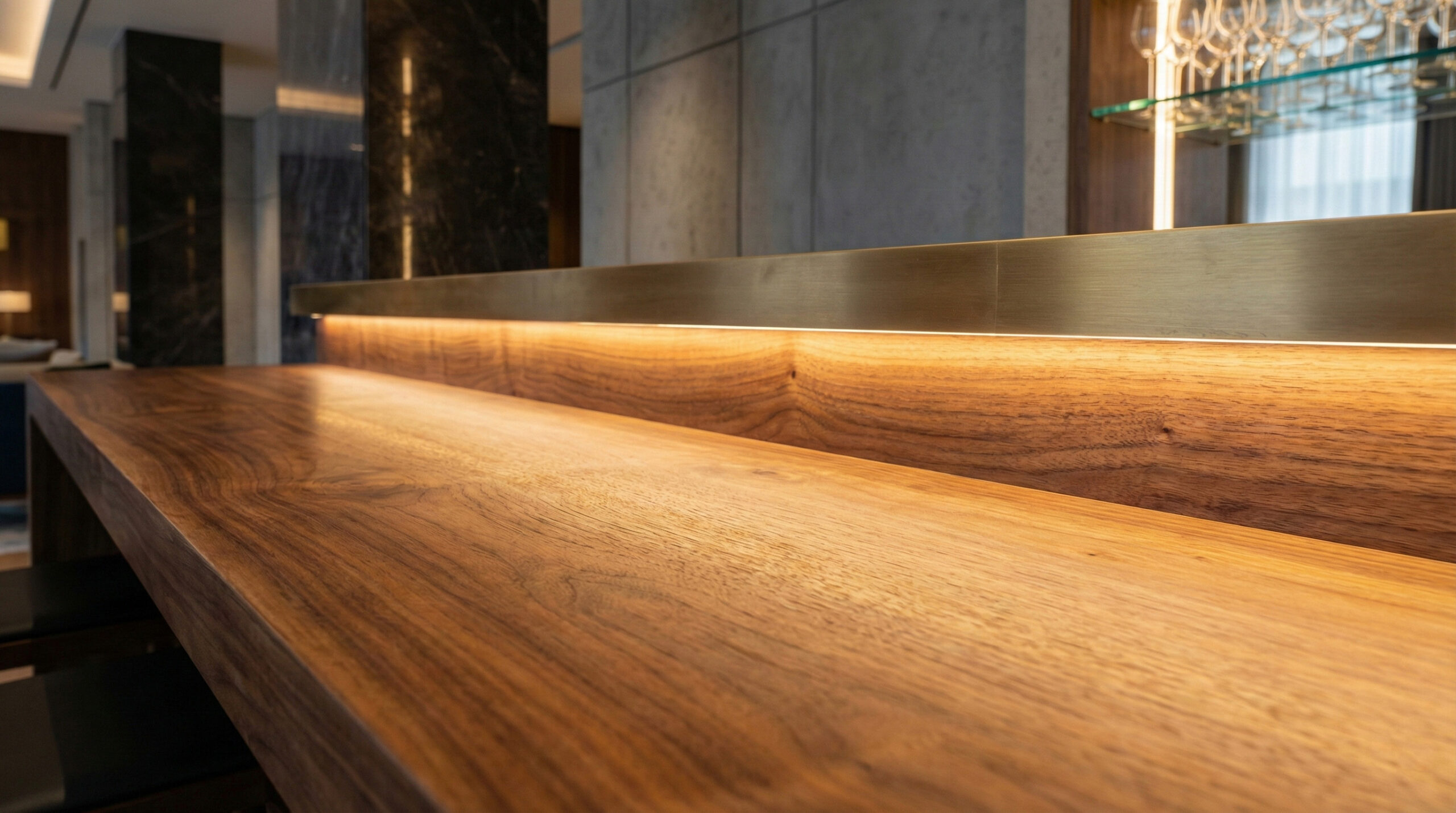
Critical Observation: A cheap LED may advertise "CRI 80" but have R9 even negative! This means failure in rendering red shades. Two 3000K lamps with different R9 give completely different sensations: one (low R9) makes space cold and colorless, the other (high R9) "brings it alive".
Low CRI (<80)
Problems:
- Wood appears gray/greenish
- Warm notes lost
- Skin looks pale ("zombie effect")
- Marble appears dull
- Food unappealing
High CRI (≥90, R9≥50)
Advantages:
- Wood warm and rich
- Natural golden reflections
- Healthy skin tones
- Marble with depth
- Food appetizing
CRI/R9 Impact on Hotel Materials
In hotels, high color rendering properly showcases all materials and tones. If lighting lacks CRI/R9, even the most luxurious materials appear dull or "off-tone".[10]
Disaster Example: After installing budget LEDs in luxury lobby: Italian marble looked gray, wood veneer greenish, guests' skin in mirror looked pale (like sick). All because lighting had inadequate red spectrum. "The contractor only changed the lights – marble looks cheap, walnut looks like laminate and the guest in the mirror looks like they have the flu". CCT was the same (3000K), but "the most important was missing: the red".
Impact on Key Materials
Wood: Wooden furniture contains red and orange notes. With low R9, these are lost → wood appears cold, greenish or gray. The richness of wood grain is lost – the golden reflections that make it look expensive.
Marble and Stone: Natural stone reflects light in complex ways. If full spectrum is missing, marble "washes out", loses contrast and depth, appears flat. High CRI reveals shadows, veins, texture, luxury.
Fabrics and Colors: Velvet red seats, colorful rugs. With low CRI: dull, unattractive. Deep reds (R9) and purples may appear brown or gray, losing their intensity.
Human Skin: The most important! Low R9 values make skin tones appear unnatural, with gray-green tint – the "zombie effect". In hotel bathroom, guest sees themselves pale and sick in mirror. If they "see" themselves looking bad, they won't love the room.
Food: In restaurants: food must look appetizing. Low CRI/R9 makes a steak's red look brown, salad's green dull. High CRI ≥90 = natural, vibrant colors → appetizing food.
Quality Requirement: In luxury hospitality applications, CRI 80 is considered inadequate and "destructive". Today CRI 90+ and R9 ≥50 is specified for lobbies, restaurants, suites. These values are called "gallery grade" – museum quality. Even the WELL Building Standard specifies R9 ≥ 50 for quality lighting.[11][12][13]
Practical Tips
- Always check specifications for both CRI and R9 values
- Don't settle for description "Warm White 3000K" – two 3000K products differ dramatically
- Request photometric reports (test reports) citing CRI_Ra and CRI_R9 before installation
- Include in specifications: "LED 3000K, CRI > 90, R9 > 50 – R9 certificate to be submitted before installation"
- Don't let a €10 lamp ruin a €10,000 wall
CRI/R9 Summary
- CRI ≥90 and R9 ≥50 for luxury hospitality spaces
- High R9 = vibrant woods, marbles, fabrics, healthy skin
- Low R9 = "zombie effect", gray materials, unappealing food
- Always request test reports with R9 citation
- "Gallery grade" (CRI 90+, R9 50+) for museum quality
- Investment in high CRI/R9 showcases materials and décor
Flicker-Free Dimming
Digital lighting control for perfect adjustment
Dimming capability is essential in hospitality spaces: it allows creating different atmospheres and energy savings. However, intensity reduction in LEDs can be accompanied by an unwanted phenomenon: visual "flicker".[17][18][19]
The Flicker Problem
Flicker is rapid brightness fluctuations – sometimes perceived as trembling or pulsing light. It can cause:
- Eye strain and fatigue
- Headaches in sensitive individuals
- Completely ruins atmosphere if visible
- Mobile cameras capture it (striping in video)
Cause
Main reason: the method of intensity control in LEDs. Traditional "analog" methods (phase cut with TRIAC dimmer, 0-10V) don't match LED nature well. In incandescent lamps, cutting the sine waveform simply reduced filament temperature. But LEDs have electronic circuits (drivers) that react much more complexly. When you "clip" LED voltage abruptly, the driver becomes unstable → flicker occurs.[17]
Flicker Standards: IEEE 1789-2015 and CIE TN 006:2016 define recommended practices for flicker and temporal light modulation in LEDs. PstLM (flicker) and SVM (stroboscopic effect) indices are used for evaluation.[16][17][18][19]
| Technology | Flicker | Dimming Quality | Use |
|---|---|---|---|
| Analog (Phase Cut / 0-10V) | ✗ Common | Moderate, unstable <20% | Legacy systems (avoid) |
| DALI / DALI-2 | ✓ Flicker-free | Excellent, down to 1% | Professional hotels |
| DMX / KNX | ✓ Flicker-free | Excellent, precise | Theaters, Large complexes |
The Solution: Digital Dimming (DALI)
The solution comes with digital dimming systems. The DALI (Digital Addressable Lighting Interface) standard is the global open industry method for professional lighting control, based on international standard IEC 62386.[14][15][16]
Unlike analog methods, DALI sends digital signals (1s and 0s) to drivers, telling them exactly what to do. Result: absolutely stable dimming, without flicker, with capability for independent control of each fixture.
Essentially, we "command" the LED how bright to be, instead of torturing it by reducing voltage. With DALI-2 we can dim a quality LED down to 1% of its intensity smoothly, without a trace of flicker or hum.
Velvet Dimming: Lights dim "like velvet", like old incandescent lamps, maintaining color rendering stability and without annoying pulses.
Additional DALI Advantages
1. Grouping & Zones
Allows grouping fixtures into zones (all lights in a room or corridor) with easy reprogramming if layout changes. No wiring changes needed – only digital reprogramming.
2. Two-Way Communication
System can report back if a lamp has failed, sending maintenance notification. Can monitor operating hours of each fixture and warn before failure.
3. Smart Management
Corridors can automatically dim to 10% at night, meeting rooms controlled by scene panels, lobby changes atmosphere with one button.
4. Reduced Maintenance
System "knows" when a fixture has a problem. Maintenance team notified immediately – not when a guest notices.
5. Energy Savings
With precise control, you can have the right light level everywhere – no more than needed. Automatic adjustments based on natural light or motion reduce consumption by up to 40-60%.
Alternative Systems
DMX
Used mainly in theatrical/dramatic lighting. Provides very fast response and dynamic lighting (e.g., color changes in RGB LED). Suitable for ballrooms, nightclubs.
KNX
Complete building automation system (not just lighting). Controls lighting, HVAC, shading, security. Used in large hotel complexes for centralized management.
Implementation Practical Tips
- Select DALI-2 drivers and fixtures from reliable manufacturers
- Ensure all fixtures are flicker-free (request certificates)
- Design lighting zones logically (e.g., each room a separate zone)
- Program scenes for different uses (morning, afternoon, evening, cleaning)
- Train staff on system use
- Maintain installation documentation for future expansions
Application Example: Boutique hotel installed DALI-2 throughout. Result: Staff adjusts lobby with tablet (morning: bright 4000K, evening: warm 2700K at 40%). Rooms have bedside panels with scenes: Reading, Romantic, Sleep. Corridors automatically dim to 20% after midnight. Zero flicker, 45% energy savings.
Dimming Summary
- Analog dimming (phase cut, 0-10V) → flicker and problems
- DALI-2 = digital control, flicker-free, dimming to 1%
- Advantages: grouping, two-way communication, smart management
- Reduced maintenance and 40-60% energy savings
- Don't try to control 2026 LEDs with 1980s techniques
- Investment in modern standards = perfectly smooth system
Enhancing Guest Experience Through Lighting
How lighting creates unforgettable experiences and memories
Proper lighting is not just a technical matter – it's a powerful tool for shaping the overall guest experience. In a high-end hotel, every element weaves the "scenario" of hospitality. Lighting has the ability to directly influence mood, perception and the memories the visitor will take away.[20][21]
How Lighting Affects Experience
1. Sense of "Home"
Lighting is central to making guests feel comfortable and "at home". In successful hospitality design, we create a "home away from home" – an environment where visitors feel warmth and familiarity.
Soft light tones and properly placed sources create feelings of relaxation or romance. The guest "glides" into the space imperceptibly, without noticing the design, simply experiencing the pleasant atmosphere.
2. Identity & Branding
Lighting contributes to hotel identity and branding. A distinctive chandelier in the lobby, the way the facade is lit at night, the characteristic pool or spa lighting – all create memories and impressions that visitors associate with the hotel.
In the social media era, a stunningly lit lounge or an "instagrammable" lighting art piece can become a reference point and free advertising.
3. Psychological Dimension
Appropriate lighting enhances the emotions we want at each stage of the stay:
- Arrival: Bright but warm lobby full of light gives a sense of security and positive energy
- Room: Light dims to offer refuge and rest
- Restaurant: Warm light encourages conversation and relaxation
- Spa: Soft, diffused lighting promotes calm and rejuvenation
4. Guidance and Orientation
Lighting functions as a silent guide. Bright areas draw the eye and guide visitor flow without needing signs. Discreet floor lighting can mark the path to restrooms, while an impressive fixture draws attention toward the bar.
Creating Unforgettable Moments
Drama and Impression
At key moments, lighting can create "wow moments" etched in memory:
- First glimpse of the impressively lit lobby
- Room with soft welcoming light awaiting the guest
- Watching sunset from the bar with perfectly lit view
- Romantic dinner with candles and discreet ambient lighting
Emotional Connection
Lighting affects emotion at an unconscious level. Research shows people remember more how a space made them feel than its specific details. A hotel with lighting that creates warmth, comfort and familiarity will stay in the visitor's heart.
Influence on Behavior
Dwell Time
As we saw earlier, good lighting makes guests stay longer in dining areas. The same applies to lounge areas, spa, and other common spaces. The more time visitors spend in these spaces, the greater the likelihood they'll spend more money and create positive memories.
Quality Perception
Lighting directly affects quality perception. A space with thoughtful, professional lighting is perceived as more luxurious and higher quality – even if other elements are mediocre. Conversely, poor lighting can downgrade even the most refined décor.
Perception Example: Two hotels with similar furniture and décor. One has CRI 80 lighting with ceiling fixtures, the other CRI 95 with multi-layered lighting and dimming. Guests at the second consistently rate "luxury" and "comfort" higher – even though both have the same furniture!
Lighting and Wellness
Circadian Rhythm Support
As mentioned in the CCT chapter, circadian lighting supports the natural biological clock. In wellness and spa hotels, this becomes a central experience element. Guests report deeper sleep, more morning energy, and overall sense of wellbeing.[20][21]
Stress Reduction
Soft, warm lighting without flicker and with proper CCT reduces stress. Conversely, intense cool lighting with flicker increases cortisol levels. A hotel designed with wellness in mind chooses lighting that calms and relaxes.
Adapting to Different Guests
Age Differences
Older guests need more light to feel comfortable and safe. A hotel can offer rooms with "Enhanced Lighting" option that provides higher light levels at critical points (bathroom, corridors) without losing atmosphere.
Cultural Preferences
Different cultures have different lighting preferences. Generally, Asian guests tend to prefer brighter spaces, while Europeans prefer softer and more discreet. An international hotel can offer lighting options that satisfy different preferences.
ROI of Good Lighting
(8.2→9.0)
Revenue
(Room Rate)
Cost
Immediate Benefits
- Higher Ratings: Better reviews on Booking, TripAdvisor
- More F&B Revenue: Guests stay longer, order more
- Premium Pricing: Justifies higher room rates
- Repeat Visits: Positive experience → returning guests
Long-term Benefits
- Brand Recognition: Distinctive identity through lighting
- Word-of-Mouth: Guests talk about their experience
- Social Media: Instagrammable moments = free marketing
- Staff Satisfaction: Better work environment = lower turnover
Case Study: Boutique hotel invested €80,000 in lighting upgrade (CRI 95, tunable white, DALI-2). Within 12 months: +0.8 points on Booking (8.2→9.0), +15% bar/restaurant revenue, +12% ADR (average daily rate), 45% reduction in energy costs. Investment payback in 2.5 years.

Implementation Tips
1. Start with Design
Don't buy fixtures before making a plan. Work with a lighting designer who understands hospitality. Define goals: What atmosphere do you want? What brand identity?
2. Invest in Quality
Don't compromise on CRI, R9, flicker-free drivers. The cost difference between mediocre and excellent lighting is 20-30% but the experience difference is enormous.
3. Offer Control
Give guests the ability to adjust light in their rooms. Simple, easy-to-read controls – not 10 switches that confuse.
4. Maintain the System
The best lighting loses its value if not maintained. Regularly check for burnt lamps, clean fixtures, update scene programming.
5. Train Staff
Staff must understand how to use the system and why it's important. When they understand the value, they protect it and use it correctly.
Guide Key Messages
- Lighting is not a technical detail – it's a central element of experience
- It directly affects mood, behavior and memories
- Good lighting = higher ratings, more revenue, brand recognition
- Investment in quality (CRI 90+, tunable white, flicker-free) pays off
- Offer control to guests, train staff
- Lighting must serve hospitality storytelling
Sources & References
This guide is based on international standards, academic research and expertise from leading lighting manufacturers:
International Standards Referenced
- IEC 62386 — International DALI digital lighting control standard
- IEEE 1789-2015 — Recommended practices for flicker modulation in LEDs
- CIE TN 006:2016 — Visual aspects of time-modulated lighting systems
- IEC TR 61547-1:2020 — Objective flickermeter for lighting
- WELL Building Standard v2.0 — Lighting requirements for building wellness certification
Ready to Create Unforgettable Experiences?
TECHLUMEN creates high-quality professional LED lighting
for hospitality spaces in Greece, the Balkans and Middle East.
Technology: CRI 90+, Tunable White, DALI-2, Flicker-Free
Headquarters: Thessaloniki, Industrial Area