
Horticultural Lighting
in Controlled Environments
A practical LED lighting design guide — from photobiology to stage-specific "light recipes." Based on university sources, ASABE/IES standards, and peer-reviewed literature.
01 What light does to plants
In crop production, light serves two roles: an energy source (photosynthesis) and information (a signal that regulates growth, morphology, and flowering).
Photosynthesis
Conversion of light energy into chemical energy (sugars) using CO₂ and water as raw materials. Light quantity (PPFD/DLI) is the primary limiting factor.
Photomorphogenesis
Light as "information": regulates stem elongation, leaf thickness, stomatal opening, and plant architecture. Depends primarily on spectrum.
Photoperiodism
Plants "measure" the duration of night/day. Requires low intensity at a specific time, not high PPFD.
Phototropism
Directional growth toward the light source. The orientation/position of lighting can alter canopy photosynthetic utilization.
Photoreceptors — the plant's "sensors"
| Photoreceptor | Spectrum | Role |
|---|---|---|
| Chlorophylls a, b | Blue 430nm / Red 660nm | Photosynthesis — photon absorption |
| Carotenoids | 400–500nm | Accessory photosynthesis, photoprotection |
| Phytochromes (Pr/Pfr) | 660nm (R) / 735nm (FR) | Flowering, germination, shade avoidance, elongation |
| Cryptochromes | Blue & UVA | Stretching inhibition, circadian rhythm |
| Phototropins | Blue & UVA | Phototropism, stomatal regulation |
| UVR8 | UV-B (280–320nm) | Defense mechanisms, pigments |
02 Light spectrum & plants
The classic PAR zone (400–700nm) is the foundation, but the practical "ePAR" (400–750nm) now recognizes the contribution of far-red to canopy photosynthesis.
Schematic absorption spectra of photoreceptors — Chl a/b, phytochromes Pr/Pfr, cryptochromes
🔵 Blue (400–500nm)
Activates cryptochromes/phototropins. Associated with "compact" growth, leaf thickness, stomatal opening. Experimentally, ~7% blue is sufficient for normal function. The relationship is not linear — excessive blue can "hold back" growth.
🔴 Red (600–700nm)
Nearly double the quantum yield compared to blue. The primary driver of biomass. Activates phytochrome responses (germination, flowering, pigment formation).
🟣 Far-Red (700–750nm)
Regulates R/FR ratio, shade avoidance, flowering. Recent research (Zhen & Bugbee 2020): FR photons can be equally efficient in the canopy when combined with 400–700nm. Practical "ceiling": 10–20% FR.
🟢 Green & UV
Green (500–600nm): Lower photosynthetic efficiency, but critical for white working light and penetration into dense canopies. Used in V-HORTI.
UV: In small doses increases pigments/defense. At high doses reduces biomass.
Caution — Far-Red: On its own it has minimal photosynthetic effect. Its value is synergistic. Excessive FR can produce larger but thinner, lighter-colored leaves and undesirable height.
03 Lighting metrics
If we're talking in lux, we're speaking the wrong language. For crops we measure in photons — PPF, PPFD, DLI, PPE. Reference standard: ANSI/ASABE S640.
| Metric | Unit | What it measures | Practical significance |
|---|---|---|---|
| PPF | μmol/s | Fixture output | Fixture comparison |
| PPFD | μmol/m²/s | Photons at canopy | Primary photosynthesis regulator |
| DLI | mol/m²/day | Total 24h photons | Central design target |
| PPE | μmol/J | Photons per Joule | Energy efficiency |
Rule: Lux/foot-candles = human-centric units. For plants we always use a PAR/PPFD meter (quantum sensor). Lux meters are not professional practice in crop production.
The "0.0036 rule" — The critical PPFD ↔ DLI relationship
DLI = PPFD × hours × 0.0036
Inverse: Target PPFD = Target DLI ÷ (hours × 0.0036)
Conversion table: PPFD for a given DLI
| Target DLI | PPFD @12h | PPFD @16h | PPFD @18h |
|---|---|---|---|
| 5 | ~116 | ~87 | ~77 |
| 10 | ~231 | ~174 | ~154 |
| 13 | ~301 | ~226 | ~201 |
| 16 | ~370 | ~278 | ~247 |
| 20 | ~463 | ~347 | ~309 |
| 25 | ~579 | ~434 | ~386 |
| 30 | ~694 | ~521 | ~463 |
| 35 | ~810 | ~608 | ~540 |
04 DLI targets per crop
The right target is not "set 300 μmol." It depends on the crop, growth stage, system (greenhouse or closed), and other factors (CO₂, temperature, nutrition).
| Crop / Stage | DLI (mol/m²/day) | Notes |
|---|---|---|
| Cuttings | 4–6 (gentle) / 5–10 (general) | Gentle photosynthesis, rooting without stress |
| Vegetable seedlings | 5–10 / up to ~13 | Compact, healthy transplants |
| Microgreens | 9–12 | Rapid production 7–14 days |
| Lettuce | 12–17 | PPFD 250–350, above = waste |
| Spinach | 14–20 | Requires adequate light |
| Parsley | 10–15 | — |
| Cilantro | 15–20 | — |
| Basil | 15–25 | Higher DLI = more aromatic |
| Tomato / Cucumber | 20–30 | Peak production: 30–35 |
Calculation example (greenhouse — December)
📐 Supplemental lighting for lettuce
DLI outside: 10 · Greenhouse loss: 40% → inside receives 60%
DLI inside: 10 × 0.60 = 6 mol/m²/day
Target DLI: 14 → Deficit: 14 − 6 = 8 mol/m²/day
System PPFD: 200 μmol/m²/s
Hours = 8 ÷ (200 × 0.0036) = 8 ÷ 0.72 ≈ 11.1 hours/day
Tip: With dimming (0–10V / DALI / wireless) you can implement DLI-control: fixtures turn on in the morning/afternoon and off at midday, targeting a daily DLI setpoint. A practical threshold: activate when ambient PPFD < ~200 μmol/m²/s.
05 Three types of artificial lighting
Don't confuse them: each has an entirely different goal, intensity, and schedule.
Supplemental
Covers the DLI deficit in greenhouses. Typically 100–400+ μmol/m²/s. DLI-based schedule.
Sole-source
Growth chambers / vertical farming. All DLI from artificial light. Levers: hours, PPFD, distance.
Photoperiodic
Low intensity ≥2 μmol/m²/s. Day extension or night interruption. Regulates flowering, not DLI.
06 Installation types
Each crop type requires a different approach to fixture placement and optics.
🏠 Top Lighting
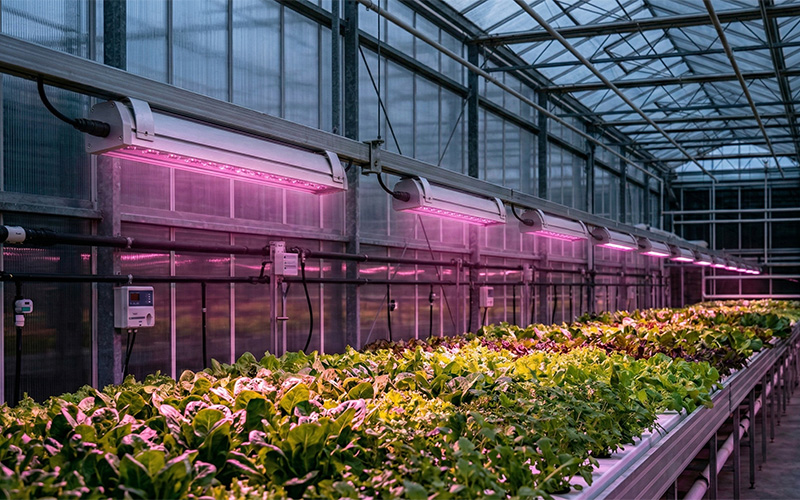
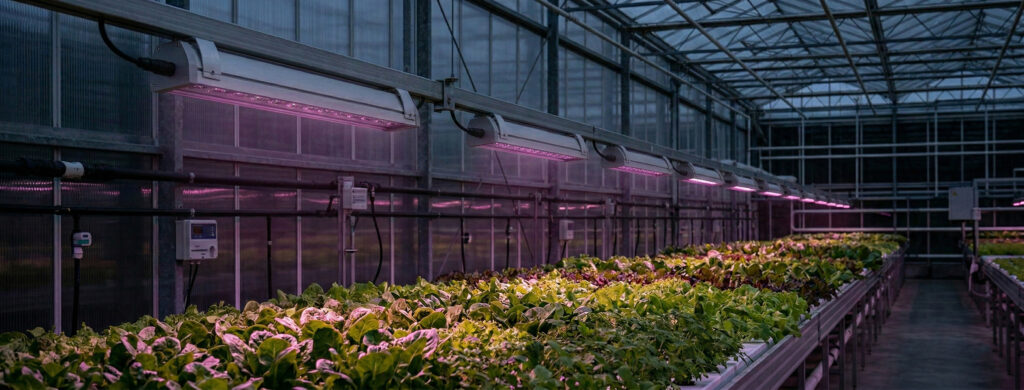
Greenhouse — overhead lighting. HPS/MH require large distances due to heat. LEDs allow closer placement, better spectrum, dimming.
🌿 Interlighting
Linear fixtures within the canopy. Reduces mutual shading in tall crops (tomato, cucumber). Requires a "cool" source — LED is ideal.
🏢 Vertical Farming
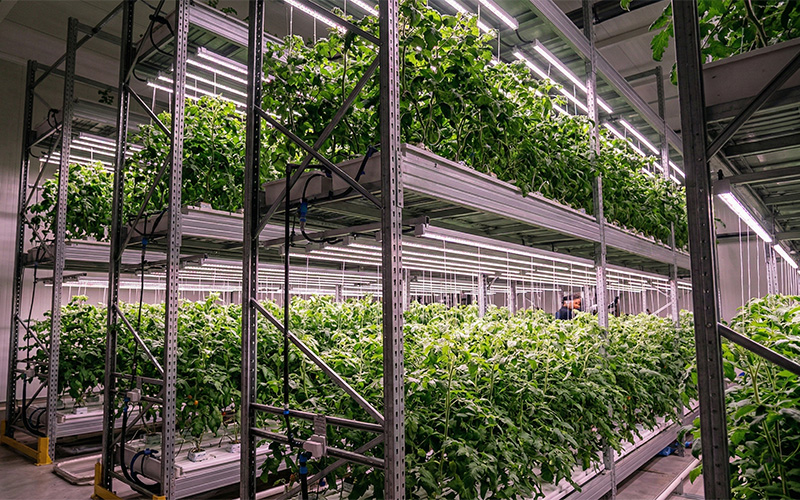
Multi-tier installation, full environmental control. Low-profile fixtures, critical thermal management, uniformity per shelf.
HPS vs LED
HPS (High Pressure Sodium)
- Efficacy ~0.9–1.7 μmol/J
- High thermal radiation (IR)
- Fixed spectrum (mainly orange/red)
- Large mounting distance
- Lower initial cost
- Shorter lifespan
LED
- Efficacy >2.5 μmol/J (top-tier >3.0)
- Low thermal radiation
- Full spectrum control
- Installation close to plants
- Digital control, dimming, "recipes"
- Lifespan >70,000h
07 Lighting uniformity
Average PPFD is not enough. If 30–40% of the surface receives far less light, you will have uneven growth, ripening differences, and product rejection.
Example PPFD map (% of maximum) — Target: U90 > 80%
IES metrics for horticultural lighting
U90
Percentage of points >90% of maximum. Corresponds to ±5% uniformity. Ideal target.
U80
Percentage of points >80% of maximum. ±10% uniformity. Minimum acceptable target.
Spill light: Even if uniformity is good, light that "escapes" to aisles/floors means waste. Proper optics can reduce spill and improve both uniformity and energy consumption.
08 Fixture selection
What to ask for, what standards exist, and why Watts or lumens are not enough.
Specification checklist
- PPF (μmol/s) & PPE (μmol/J) — efficacy, not just Watts
- Spectral distribution (SPD/SQD) — and how it changes with dimming
- PPFD map / PPID — at canopy height, with uniformity indices
- TM-33 data (IES) — for professional uniformity design
- Ingress protection (IP65/IP66) — critical in greenhouses with humidity
- Thermal management — driver durability, cleanability, corrosion resistance
- Control capability — dimming, schedules, wireless control
Reference standards: ANSI/ASABE S640 (terminology/units) · ANSI/IES TM-33-18 (fixture electronic data) · DLC Technical Requirements V3.0 (qualification) · IES RP-45-21 (Recommended Practice Horticultural Lighting).
Initial sizing (first estimate)
# of fixtures ≈ (Target PPFD × m²) ÷ (PPF per fixture × CU)
CU (coefficient of utilization) ≈ 0.70–0.80. The final answer requires a uniformity design.
09 Light recipes per growth stage
Practical "setpoints" for PPFD, hours, and spectrum as a starting point — always with PPFD measurement at canopy height and a DLI target.
1. Propagation / Cutting rooting
Goal: gentle photosynthesis without stress, rapid rooting, elongation control
Quantity & duration
- DLI: 5–10 mol/m²/day (general university recommendation)
- Gentle strategy: 4–6 mol/m²/day
- Photoperiod: 16–18h (provided there are no photoperiodic restrictions)
- PPFD (conservative, DLI 5–8 @18h): ~80–125 μmol/m²/s
- PPFD (intensive, DLI 10 @16–18h): ~140–155 μmol/m²/s
Spectrum
- Base: "white"/full spectrum + red, with adequate blue
- Blue (400–500nm): ≥~7% — sufficient to avoid photosynthesis dysfunction (Hogewoning et al.)
- Far-red (700–750nm): minimal — low R/FR leads to stretching
- UV: avoid — at high doses reduces photosynthetic rates/biomass
2. Nursery / Seedling production
Goal: fast but compact growth, thick leaves, balanced root system, low "stretching tendency"
Quantity & duration
- DLI: 5–10 mol/m²/day (university starting point)
- Intensive vegetable production: DLI ~13
- Photoperiod: 16–18h
- PPFD (DLI 9–10 @16h): ~155–175 μmol/m²/s
- PPFD (DLI 13 @16h): ~225–230 μmol/m²/s
Spectrum
- Blue: increased vs other stages — reduces stretching, "compact" growth, leaf thickness
- ⚠ Excessive blue → stunting (holds back growth)
- Red: primary efficient photosynthesis
- Far-red: low → high R/FR = proper seedling development
- White/green: visual inspection & ergonomics
3A. Lettuce — basic "recipe"
Goal: maximum quality/biomass without energy waste
Quantity & duration
- DLI: 12–17 mol/m²/day
- PPFD range: 250–350 μmol/m²/s (MU Extension)
- Above ~350: energy waste/risk
- Option ①: PPFD 250 × 14–18h → DLI ≈ 12.6–16.2
- Option ②: PPFD 300 × 12–16h → DLI ≈ 13.0–17.3
- Option ③: PPFD 350 × 10–14h → DLI ≈ 12.6–17.6
Spectrum
- Base: white + red (or white only if truly "full spectrum")
- Blue: moderate — helps quality/color, but excess reduces leaf size
- Far-red: 10–20% max — increases growth/light capture but excess → thinner, lighter-colored leaves
- EOP: blue/UVA last 5–10 days (see recipe 7)
3B. Leafy greens & herbs — indicative DLI targets
Practical translation of university DLI values into PPFD
DLI per crop
- Spinach: 14–20 mol/m²/day
- Parsley: 10–15 mol/m²/day
- Cilantro: 15–20 mol/m²/day
- Basil: 15–25 mol/m²/day
PPFD translation (@16h)
- DLI 10 → ~174 μmol/m²/s
- DLI 15 → ~260 μmol/m²/s
- DLI 20 → ~347 μmol/m²/s
- DLI 25 → ~434 μmol/m²/s
4. Microgreens
Rapid production 7–14 days
Quantity & duration
- DLI: 9–12 mol/m²/day
- Photoperiod: 14–16h (common indoor practice)
- PPFD @16h: ~156–208 μmol/m²/s
- PPFD @14h: ~179–238 μmol/m²/s
Spectrum
- Base: full spectrum/white + red, adequate blue
- Quality "finishing" (last 2–4 days): growers grow with full-spectrum and "finish" with blue + UV to enhance phytonutrients
5. Fruiting crops in greenhouse (tomato, cucumber, squash)
Goal: cover winter/overcast DLI deficit, stabilize production & quality
DLI-based operation
- DLI: 20–30 mol/m²/day (peak tomato: 30–35)
- Greenhouses receive 30–50% less light vs outdoors (cover/structure losses)
- PPFD top-light: 150–250 μmol/m²/s (typical operating range)
Practical supplemental "recipe"
- ① Measure DLI inside → DLI deficit
- ② Calculate hours: deficit ÷ (PPFD × 0.0036)
- ③ Morning + afternoon, not midday
- ④ ON threshold: ambient PPFD <200 μmol/m²/s
Spectrum
- Red: primary component (efficacy)
- Blue: adequate (stomata, leaf thickness — extreme spectra → undesirable responses)
- Far-red: 10–20% max — FR photons equally effective in canopy when combined with 400–700nm (Zhen & Bugbee 2020)
Interlighting (intracanopy)
- For tall/dense crops (tomato, cucumber)
- Reduces mutual shading, activates shaded leaves
- Requires "cool" sources — LED is ideal
6. Fruiting crops in closed system (sole-source / plant factory)
All DLI from artificial light — PPFD requirements increase rapidly
Quantity & duration
- DLI: 20–30 (or 30–35 for very high production intensity)
- Photoperiod: 16–18h
- DLI 25 @18h → ~386 μmol/m²/s
- DLI 30 @18h → ~463 μmol/m²/s
- DLI 35 @18h → ~540 μmol/m²/s
Spectrum & installation
- Same logic as greenhouse
- Far-red: synergistic but quality "ceiling" (10–20%)
- Critical uniformity on each shelf
- Low-profile fixtures, thermal management
7. Quality "finishing" — End-of-Production (red lettuce, MSU)
One of the most applicable examples of a stage-specific "light recipe," with specific numbers
Base cultivation (MSU experiment)
- Germination: 180 μmol/m²/s continuous warm white, until day 4
- Growth: PPFD 150 μmol/m²/s, 50% warm-white (2700K) + 50% red (660nm)
- Constant DLI/PPFD throughout the cycle
EOP — end-of-cycle enhancement
- Add UVA: 30 μmol/m²/s (315–399nm)
- or Blue: 30 μmol/m²/s (400–499nm)
- Only at the end (Phase 3) → increased anthocyanins/phenolics + "reddening"
- ⚠ Continuous blue throughout the cycle → reduced yield
Practical transfer: Keep base production PPFD/DLI constant (e.g. 250–300 PPFD) and add EOP UVA or blue in small doses for 5–10 days before harvest, monitoring coloration/size. The MSU result shows that "end of cycle" is the most efficient timing.
8. Photoperiodic "recipes" (flowering control)
Goal: photoperiodism (information), not photosynthetic DLI — very low intensities, negligible DLI
Minimum intensity
- ≥10 foot-candles ≈ 2 μmol/m²/s at plant height
Option 1: Night Interruption (NI)
- Schedule: 22:00–02:00 (4 hours) — peak plant sensitivity
- Some crops respond to 2–3 hours
Option 2: Day Extension (DE)
- Natural day 9h, target 14h → lighting ~5.5h around sunset
Option 3: Cyclic NI
- 5 minutes ON / 20 minutes OFF × 4 hours
- ≥5min light ≥10fc every 30min
- Energy savings ~83%
- Possible slight flowering delay in some species
Spectrum for NI/DE
- LED: Red 660nm + Far-Red 730nm
- FR important for rapid flowering in long-day plants (Purdue: e.g. pansy/petunia)
- Equal parts R:FR can stimulate flowering (MU Extension)
- Low R/FR in night-break promotes flowering
- Intensity: ~2 μmol/m²/s
Plant categories
- Long-day: need >14–18h photoperiod → NI or DE
- Short-day: need long dark period (DO NOT interrupt!)
- Day-neutral: not affected — no photoperiodic lighting needed
10 Economic evaluation
The right question is not "how much does it consume" but: how much does it cost per mol of light and what production value does that mol deliver.
Cost per mol (Purdue model)
Fixed cost (fixture depreciation ÷ lifetime hours) + Operating cost (electricity) → Compare with additional production value.
Rule of thumb
Light increase +1% ≈ +0.5–1% harvestable product. But only if nothing else is limiting (CO₂, temperature, nutrients).
Energy (kWh/day) = (Watts × hours) ÷ 1000
Greenhouse: pursue yield/earliness. Closed system: cost per kg + consistency.
11 Common mistakes
The most common errors in horticultural lighting design.
Targeting only "average PPFD" without uniformity. Solution: light-map, U90/U80 or at least min/avg + CV.
Using a lux meter as a plant metric. Solution: PPFD meter / quantum sensor — always.
Buying based on Watts or lumens. Solution: PPE (μmol/J) + PPFD map at canopy height.
Excessive far-red for "faster growth." Risk of stretching, thin leaves, worse canopy efficiency. Test per crop!
Confusing photoperiodic with supplemental. Photoperiodic = ~2 μmol/m²/s. Supplemental = 100–400+ μmol/m²/s.
Spectrum "recipe" without a stable DLI. First lock in DLI, then experiment with spectrum.
Fixed hours without DLI-control. Solution: DLI-based schedule (morning/afternoon, PPFD threshold).
12 Implementation checklist
A practical plan of action in 9 steps.
- Record crop, stage, goal (mass, quality, flowering, earliness)
- Define DLI target per stage (from tables/literature)
- Measure or estimate natural DLI inside (× greenhouse transmittance)
- Calculate number of fixtures (target PPFD × m² ÷ PPF × CU)
- Design layout (PPFD map, uniformity U90/U80, spill light)
- Calculate hours/day to cover DLI deficit
- Adjust spectrum for morphology/flowering (after "locking in" DLI)
- Implement DLI-based control (dimming, PPFD threshold, stage-specific schedules)
- Install logging (PPFD/DLI/energy) — weekly review
13 TECHLUMEN Solutions
Two LED fixture series designed for every installation type — durability, efficacy, spectral precision.
V-HORTI
Nichia Hortisolis Technology — Single-chip, fixed spectrum
Single-chip Hortisolis design that maintains a stable spectrum. Produces red, blue, far-red (shade avoidance) and green (white working light). Ideal for installations with fixed spectral requirements.
HORTILUX
Spectral versatile — 4 LED chip types, wireless control
4 independently controlled LED types: Blue (450nm), Red (631nm), Far-Red (730nm), Hortisolis. Preset or custom spectra, wireless control via tablet/mobile, scheduling per hour or based on sunset. Ideal for installations requiring spectral flexibility.