Warehouse & Cold Storage Lighting Guide
Complete technical reference for high-bay, racking aisle, and cold store lighting design — from ambient warehouses to –30 °C freezer environments.
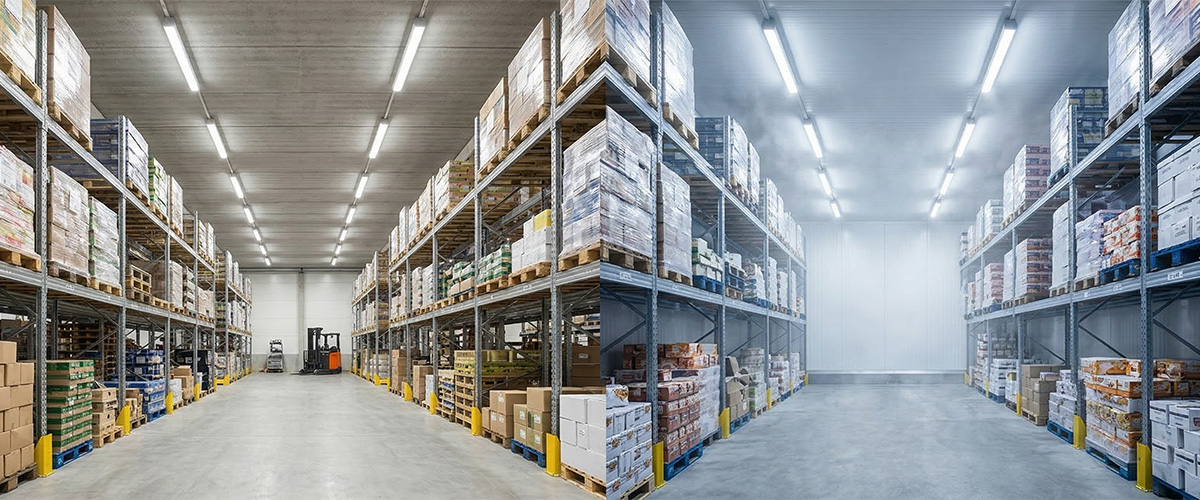
Purpose of this guide: Provide lighting designers, facility managers, and procurement engineers with a comprehensive technical reference for warehouse and cold storage lighting. Covers EN 12464-1 requirements, luminaire selection for extreme temperatures, high-bay design principles, racking aisle strategies, and energy optimisation for 24/7 operations.
1. Introduction & Regulatory Framework
Warehouse and cold storage facilities present unique lighting challenges: high ceilings (8–15 m), narrow racking aisles, extreme operating temperatures (–30 °C to +40 °C), demanding duty cycles (often 24/7), and stringent safety requirements for forklift traffic zones. Effective lighting design directly impacts picking accuracy, worker safety, energy consumption, and operational efficiency.
Modern LED technology has transformed warehouse lighting. Compared to legacy high-pressure sodium (HPS) or metal halide (MH) lamps, LED high-bay luminaires offer instant-on performance, superior colour rendering, flicker-free operation, and energy savings of 50–70 %. In cold stores, LEDs gain an additional advantage: unlike fluorescent tubes that struggle below 0 °C, LEDs perform better at low temperatures, with higher efficacy and longer lifespan.
Key Regulatory Framework
| Standard / Regulation | Scope | Key Requirements |
|---|---|---|
| EN 12464-1:2021 | Indoor workplace lighting | Maintained illuminance, uniformity, UGR, CRI per task area |
| EN 1838 | Emergency lighting | Escape route ≥1 lux, anti-panic ≥0.5 lux |
| ATP Agreement | Cold chain transport/storage | Temperature classes, insulation, perishable goods storage |
| IEC 60598-1 | Luminaire safety | Construction, IP rating, thermal endurance |
| EN 12193 | Sports & general area lighting | Referenced for large open floor areas |
| National Energy Codes | Country-specific energy performance | Installed lighting power density (W/m²) limits — each EU member state sets national targets |
| National Fire Codes | Country-specific fire regulation | Emergency lighting, signage, escape routes — consult applicable national code |
💡 Design Tip: Always verify the specific edition of EN 12464-1 referenced in the project specification. The 2021 revision introduced updated UGR tables and refined maintenance factor guidance that directly affect warehouse calculations.
2. Lighting Standards & Requirements
EN 12464-1 specifies minimum maintained illuminance (Ēm), uniformity (Uo), glare rating (UGR), and colour rendering (Ra) for every warehouse task area. The table below summarises the most relevant entries for warehouse and cold storage environments.
EN 12464-1 Requirements — Warehouse & Storage Areas
| Area / Task | Ēm (lux) | Uo | UGRL | Ra (CRI) |
|---|---|---|---|---|
| Storage areas — no traffic | 100 | 0.40 | 25 | 60 |
| Storage areas — with traffic | 150 | 0.40 | 25 | 60 |
| Picking / packing zones | 300 | 0.60 | 22 | 80 |
| Dispatch & receiving docks | 300 | 0.60 | 22 | 80 |
| Cold store — general | 200 | 0.40 | 25 | 60 |
| Freezer store (≤ –18 °C) | 200 | 0.40 | 25 | 60 |
| Loading bays | 150 | 0.40 | 25 | 60 |
| Aisles — main traffic routes | 150 | 0.40 | 25 | 60 |
| Control / office areas | 500 | 0.60 | 19 | 80 |
| Charging stations (forklift) | 150 | 0.40 | 25 | 60 |
Vertical Illuminance — Often Overlooked
In warehouse environments with vertical racking, horizontal illuminance alone is insufficient. Workers need to read labels and identify products on shelves at heights of 1–6 m. EN 12464-1 recommends a vertical illuminance of at least 50 % of the horizontal maintained value on the racking face. For picking zones, this means ≥150 lux on the vertical plane.
⚠️ Critical: Vertical illuminance on racking faces is the single most common deficiency in warehouse lighting designs. Standard high-bay spacing calculated for horizontal floor lux will almost always underperform on vertical surfaces between aisles. Dedicated aisle luminaires or asymmetric optics are essential.
3. Warehouse Zones & Cold Storage Classification
A typical warehouse or cold chain facility contains multiple temperature zones, each with different lighting requirements, duty cycles, and environmental challenges. Proper zoning is the first step in lighting design.
Figure 1 — Four temperature zones in a cold chain warehouse. IP rating and maintenance factor requirements increase as temperature decreases. Condensation management becomes critical at zone boundaries.
Transition Zones — The Hidden Challenge
The boundary between temperature zones (e.g., the doorway between a +15 °C ambient warehouse and a –20 °C freezer) creates severe condensation. Warm, moist air entering the cold zone condenses on every cold surface — including luminaires, cables, and emergency signs. Luminaires in these transition zones require the highest IP rating of the two adjacent zones, plus additional condensation-resistant design features such as Gore-Tex™ breather valves.
| Zone | Temperature Range | Humidity | Min. IP | Min. IK | Special Requirements |
|---|---|---|---|---|---|
| Ambient warehouse | +15 to +25 °C | 40–60 % | IP20 | IK06 | Standard indoor luminaires |
| Chilled store | +2 to +8 °C | 80–95 % | IP65 | IK08 | Sealed, moisture-resistant |
| Frozen store | –18 to –25 °C | Low (dry cold) | IP65 | IK08 | Cold-rated drivers, thermal shock resistant |
| Deep freeze | –25 to –30 °C | Very low | IP66 | IK08 | –40 °C rated components, remote drivers possible |
| Transition zone | Variable | Condensation | IP66 | IK10 | Breather valve, anti-condensation, heated lens option |
| Loading dock | Variable | Variable | IP65 | IK10 | Impact-resistant, rapid thermal cycling |
4. Luminaire Selection: IP, IK & Temperature Ratings
Selecting the correct luminaire for each warehouse zone requires matching three critical parameters: ingress protection (IP), impact resistance (IK), and operating temperature range (Ta).
IP Rating Guide for Warehouse Environments
| IP Rating | Dust Protection | Water Protection | Typical Application |
|---|---|---|---|
| IP20 | Finger-safe | None | Dry ambient warehouse, office |
| IP44 | Objects >1 mm | Splash-proof | Loading dock (covered), forklift charging |
| IP54 | Dust-protected | Splash-proof | General warehouse with wash-down risk |
| IP65 | Dust-tight | Water jets | Chilled store, frozen store, food production |
| IP66 | Dust-tight | Powerful jets | Deep freeze, transition zone, wash-down area |
| IP67 | Dust-tight | Temporary immersion | Floor-level, extreme wash-down |
IK Impact Rating — Forklift Zones
Forklift traffic creates significant impact risk, especially in narrow-aisle warehouses. Luminaires mounted at heights reachable by forklifts (below 4 m) or in direct traffic zones should have a minimum IK08 rating, with IK10 recommended for high-traffic areas.
| IK Rating | Impact Energy | Equivalent | Warehouse Use |
|---|---|---|---|
| IK06 | 1 joule | 0.25 kg from 400 mm | Office, low-risk storage |
| IK08 | 5 joules | 1.7 kg from 300 mm | General warehouse, racking aisles |
| IK10 | 20 joules | 5 kg from 400 mm | Forklift zones, loading docks, VNA |
ℹ️ Temperature Rating: Every LED luminaire has an operating ambient temperature range (Ta). Standard products are typically rated +5 °C to +40 °C. For cold stores, you need luminaires specifically rated to –30 °C or –40 °C. Using standard luminaires in cold stores voids the warranty and risks premature driver failure within 6–12 months.
Operating Temperature Specifications
| Application | Required Ta Range | Driver Consideration | Lens / Housing |
|---|---|---|---|
| Ambient warehouse | +5 to +45 °C | Standard | Standard polycarbonate or glass |
| Chilled store | –10 to +35 °C | Cold-start capable | Anti-condensation coating recommended |
| Frozen store | –30 to +35 °C | Cold-rated electrolytic capacitors | Thermal-shock-resistant, silicone gaskets |
| Deep freeze / blast | –40 to +35 °C | Remote driver (warm zone) or –40 °C rated | Impact-resistant, anti-ice lens treatment |
5. High-Bay Lighting Design
High-bay luminaires are the primary lighting tool for warehouse spaces with mounting heights between 6 m and 15 m. The design challenge is achieving uniform horizontal and vertical illuminance across large floor areas while managing glare for forklift operators and warehouse staff looking upward at racking.
Mounting Height vs. Beam Angle Selection
| Mounting Height | Recommended Beam Angle | Spacing-to-Height Ratio (S/H) | Typical Wattage |
|---|---|---|---|
| 6–8 m | 90°–120° | 1.2–1.5 | 80–120 W |
| 8–10 m | 60°–90° | 1.0–1.2 | 120–200 W |
| 10–12 m | 45°–60° | 0.8–1.0 | 200–300 W |
| 12–15 m | 30°–45° | 0.6–0.8 | 300–500 W |
Spacing (S) = S/H Ratio × Mounting Height (H)
Example: S/H = 1.0 at H = 10 m → S = 10 m between luminaires
Figure 2 — Cross-section showing high-bay luminaire placement above racking aisles. The Spacing-to-Height (S/H) ratio determines uniform floor and vertical illuminance. Luminaires should ideally centre over aisles, not over racking tops.
CCT Selection for Warehouses
For warehouse environments, 4000 K is the standard recommendation — providing a neutral white light that maximises visual acuity for picking and label reading without the harshness of higher CCTs. In cold stores, 4000 K also provides a psychological "warmer" feel that can improve worker comfort in otherwise austere environments.
💡 Design Tip: In very high-ceiling warehouses (>12 m), consider luminaires with adjustable power settings. A 200 W high-bay that can be set to 120 W, 150 W, or 200 W via DIP switch allows fine-tuning after installation, avoiding the common problem of over-lit or under-lit zones.
6. Racking Aisle & Vertical Illumination
Racking aisles are the most demanding area in warehouse lighting design. Workers must read small labels, identify colour-coded bins, and scan barcodes on vertical racking faces at heights from 0.5 m to 6+ m. Horizontal floor illuminance alone does not solve this problem — dedicated vertical illumination strategies are required.
Aisle Types & Lighting Approaches
| Aisle Type | Width | Height | Recommended Luminaire | Strategy |
|---|---|---|---|---|
| Wide aisle | ≥3.0 m | 6–10 m | High-bay with wide beam | Centred above aisle, S/H ≤1.0 |
| Narrow aisle | 1.6–2.8 m | 8–12 m | Linear LED / narrow high-bay | Continuous row above aisle centreline |
| VNA (Very Narrow Aisle) | 1.2–1.6 m | 10–15 m | Vertical-mount linear LED | Mounted on racking uprights at intervals |
| Drive-in racking | N/A (forklift enters) | 6–10 m | Recessed linear in rack beam | Under-shelf luminaires per level |
| Mobile / shuttle racking | Variable | 8–12 m | High-bay above + rack-integrated | Dual approach: overhead + on-rack lighting |
Vertical Illuminance Requirements
To ensure adequate visibility on racking faces, the vertical illuminance at the task plane (face of the rack) should achieve the following minimums:
| Task | Vertical Illuminance (Ev) | Height Range | Notes |
|---|---|---|---|
| Manual picking (labels) | ≥150 lux | 0.5–2.5 m | CRI ≥80 for label colour discrimination |
| Barcode scanning | ≥200 lux | 0.5–6.0 m | Even illuminance critical for scanner reliability |
| Forklift picking (high level) | ≥100 lux | 2.5–6.0 m | Supplemented by forklift headlights |
| Bin identification | ≥100 lux | 0.5–4.0 m | Colour discrimination important |
Figure 3 — Three aisle lighting strategies shown in cross-section. (A) Overhead high-bay suits wide aisles — light comes from above, good floor illuminance but limited vertical reach on upper shelves. (B) Continuous linear row suits narrow aisles — better uniformity and vertical coverage from a concentrated linear source. (C) Rack-mounted luminaires suit VNA — LEDs mounted on the inner face of each rack upright illuminate every shelf level directly, providing the best vertical illuminance for barcode scanning and label reading.
⚠️ Procurement Insight: In narrow-aisle warehouses, the cost of rack-mounted luminaires (approach C) is offset by up to 40 % fewer ceiling luminaires and significantly improved picking accuracy. Include the total cost of reduced picking errors in your ROI calculation.
7. Cold Store Lighting: Thermal & Condensation Challenges
Cold store and freezer environments impose severe stresses on lighting equipment that go beyond simple temperature ratings. Understanding these failure modes is critical for specifying luminaires that will survive 10+ years in cold chain applications.
Primary Failure Modes
| Failure Mode | Cause | Zone | Prevention |
|---|---|---|---|
| Driver failure | Electrolytic capacitor degradation at low Ta | Frozen / deep freeze | Use –40 °C rated capacitors or remote driver in warm zone |
| Condensation ingress | Warm air entering cold luminaire housing during door opening | Transition zones | IP66 + breather valve (Gore-Tex membrane) |
| Thermal shock cracking | Rapid temperature cycling (+20 °C → –25 °C) | Loading docks, transitions | Silicone gaskets, flexible housing design |
| Ice formation on lens | Moisture freezing on luminaire surface | Frozen store | Anti-ice lens coating, slight heat from LED operation |
| Cable / connector failure | Standard PVC becomes brittle below –10 °C | All cold zones | Silicone-jacketed cables, cold-rated connectors |
| Gasket hardening | Rubber gaskets lose flexibility in cold | Frozen / deep freeze | Silicone gaskets rated to –60 °C |
✅ LED Advantage in Cold Stores: LED luminaires actually perform better in cold environments. Lower ambient temperatures reduce junction temperature, increasing efficacy by 5–10 % and extending lifetime. The primary risk is the driver, not the LED itself. Specify luminaires with either integral cold-rated drivers or remote driver options.
Condensation Management Strategies
Condensation is the number-one enemy of cold store lighting. When a warehouse door opens, warm humid air rushes in and condenses on cold luminaire surfaces. Over time, this moisture penetrates seals, corrodes electrical contacts, and causes premature failure. The following strategies mitigate this risk:
| Strategy | How It Works | Best For | Cost Impact |
|---|---|---|---|
| Gore-Tex breather valve | Allows pressure equalisation without water ingress | All cold store luminaires | +5–8 % per luminaire |
| Self-heating lens | Low-wattage heating element prevents ice/fog on lens | Transition zones, loading docks | +15–20 % per luminaire |
| Silicone-potted driver | Encapsulates driver electronics against moisture | Frozen / deep freeze | Included in cold-rated models |
| Remote driver | Driver installed in warm zone, connected via extended cable | Deep freeze (–30 °C and below) | Labour cost for cable routing |
| Air curtain at doorway | Reduces warm air intrusion into cold zone | Cold store entry | Facility-level investment |
Figure 4 — Transition zone between warm and cold areas. Condensation forms where warm humid air meets cold surfaces. Luminaires in the transition area require the highest protection ratings (IP66, IK10) plus breather valves and anti-condensation features.
8. Controls, Sensors & Energy Management
Warehouse lighting offers some of the highest energy-saving potential through intelligent controls, because large areas are often unoccupied for extended periods. In a typical warehouse, occupancy-based dimming and daylight harvesting can reduce lighting energy consumption by 40–70 %.
Control Strategies by Zone
| Zone | Control Strategy | Typical Saving | Technology |
|---|---|---|---|
| Racking aisles | Occupancy detection — dim to 20 % when empty, 100 % on detection | 50–65 % | Microwave sensor (per aisle or group) |
| Open warehouse floor | Daylight harvesting + occupancy | 30–50 % | Daylight sensor + PIR |
| Loading docks | Schedule + occupancy | 40–55 % | Astronomical clock + microwave |
| Cold store | Occupancy — off when empty (caution: minimum light for cameras) | 60–80 % | Microwave sensor (PIR ineffective in cold) |
| Office / control room | Daylight + occupancy + personal control | 30–40 % | DALI-2 + daylight sensor |
| Charging areas | Schedule-based | 20–30 % | Timer / BMS integration |
⚠️ Cold Store Sensors: Standard PIR (passive infrared) sensors do not work reliably in cold stores because they detect body heat against the ambient temperature. When both the body surface and the environment are cold, the temperature differential is insufficient. Always specify microwave (high-frequency) sensors for cold store applications — they detect movement, not heat.
DALI-2 Architecture Benefits
DALI-2 (Digital Addressable Lighting Interface) is the preferred protocol for warehouse lighting control. It offers individual luminaire addressing, status monitoring, emergency testing integration, and energy metering — all on a simple two-wire bus that can coexist with mains cabling.
💡 Design Tip: In cold stores with infrequent access (e.g., deep freeze accessed 2–3 times per shift), use occupancy-based ON/OFF rather than dimming. LEDs handle instant switching without degradation, and the energy saving from fully OFF periods in cold stores is dramatic — often 70–80 % of annual lighting energy.
9. Energy Efficiency & ROI in 24/7 Facilities
Warehouses operating 24 hours a day, 7 days a week accumulate 8,760 operating hours annually — making energy efficiency paramount. A medium-sized warehouse (10,000 m²) with legacy HID lighting (15 W/m²) consumes over 1.3 GWh per year. Replacing with modern LED (5 W/m²) plus controls (effective 3 W/m²) reduces this to under 0.3 GWh — a saving of over €100,000 annually at typical European energy rates.
LED vs. Legacy Technology Comparison
| Parameter | Metal Halide (400 W) | T5 Fluorescent (2×80 W) | LED High-Bay (200 W) |
|---|---|---|---|
| System power | 460 W (incl. ballast) | 176 W (incl. ballast) | 200 W |
| System efficacy | 65–75 lm/W | 85–95 lm/W | 150–180 lm/W |
| System lumens | ~32,000 lm | ~15,000 lm | ~34,000 lm |
| Colour rendering | CRI 65–70 | CRI 80–85 | CRI 80–90 |
| Warm-up time | 5–15 minutes | Instant (reduced output when cold) | Instant (full output) |
| Dimming | Not practical | Limited (ballast-dependent) | 0–100 % DALI / 1-10V |
| Cold store performance | Reduced output | Severely reduced (−30 % at 0 °C) | Improved efficacy in cold |
| Rated life (system) | 12,000–20,000 h | 20,000–30,000 h | 80,000–100,000 h |
| Maintenance factor | 0.60–0.70 | 0.70–0.75 | 0.80–0.85 |
Simple ROI Calculation
Annual Saving (€) = (Pold − Pnew) × Hours × CostkWh / 1000
Example: 100 luminaires, 460 W → 200 W, 8760 h/yr, €0.20/kWh
= (46,000 − 20,000) × 8,760 × 0.20 / 1,000 = €45,552 /year
Installed Power Density Benchmarks
| Warehouse Type | Legacy (W/m²) | LED Only (W/m²) | LED + Controls (W/m²) | TOTEE Target |
|---|---|---|---|---|
| General storage | 12–18 | 4–6 | 2.5–4.0 | ≤8 |
| Picking / packing | 15–22 | 6–9 | 4.0–6.0 | ≤12 |
| Cold store | 10–15 | 4–7 | 2.0–3.5 | ≤8 |
| Loading dock | 12–16 | 5–8 | 3.0–5.0 | ≤10 |
✅ Recommendation: For 24/7 warehouse operations, LED retrofit typically achieves payback in 1.5–3 years. When combined with occupancy and daylight controls, the payback drops below 2 years. Cold stores offer the fastest payback due to the additional LED efficiency gains at low temperatures and the high cost of energy to maintain cold environments.
10. Design Workflow & Practical Calculations
The following workflow covers the key steps from initial brief to final specification for a warehouse or cold store lighting project.
Figure 5 — Seven-step design workflow for warehouse and cold store lighting. Vertical illuminance verification should be performed at steps 4 and 7 to catch under-lit racking faces early in the design process.
Specification Checklist
| Item | What to Specify | Why It Matters |
|---|---|---|
| Operating temperature | Ta min/max for each zone | Prevents driver failure in cold stores |
| IP rating | IP65 minimum for any cold/wet zone | Prevents condensation ingress |
| IK rating | IK08 min, IK10 for forklift zones | Prevents mechanical damage |
| Maintenance factor | MF per zone (0.65–0.85) | Accurate lux calculations over lifespan |
| Mounting detail | Chain, bracket, surface, pendant length | Correct aiming and maintenance access |
| Emergency function | Self-contained or central battery, duration | EN 1838 compliance, fire safety |
| Control protocol | DALI-2, 1-10V, ON/OFF | Energy saving, future flexibility |
| Sensor type | Microwave for cold, PIR for ambient | Reliable detection in all temperature zones |
💡 Design Tip: Request a DIALux EVO or RELUX simulation from the luminaire manufacturer for any project exceeding 5,000 m². Ensure the simulation includes vertical illuminance calculations on at least two representative racking faces — not just horizontal floor planes. TECHLUMEN provides free photometric calculations and lighting designs for warehouse projects.
11. Common Mistakes to Avoid
| # | Mistake | Consequence | Correct Approach |
|---|---|---|---|
| 1 | Using standard (non-cold-rated) luminaires in cold stores | Driver failure within 6–12 months, warranty void | Specify Ta rated to at least –30 °C for frozen zones |
| 2 | Ignoring vertical illuminance on racking | Picking errors, slow scanning, safety incidents | Verify ≥150 lux vertical at racking face (picking zones) |
| 3 | Using PIR sensors in cold stores | Sensors fail to detect movement; lights stay off | Use microwave (high-frequency) sensors for T <10 °C |
| 4 | No condensation protection at transition zones | Moisture ingress, electrical failure, safety hazard | IP66 + breather valve in all warm/cold boundaries |
| 5 | Over-specifying wattage (no dimming/tuning) | Wasted energy, excessive glare, poor ROI | Use dimmable or multi-power luminaires, add controls |
| 6 | Forgetting emergency lighting in cold stores | Non-compliance with EN 1838 and fire code | Cold-rated emergency luminaires on independent circuit |
| 7 | Maintenance factor too optimistic | Under-lit facility after 2–3 years | Use MF 0.65–0.70 for cold stores, 0.80 for ambient |
| 8 | PVC cables in freezer zones | Cable cracking, short circuits, fire risk | Silicone-jacketed cables rated to –40 °C minimum |
12. TECHLUMEN Product Recommendations
TECHLUMEN manufactures a range of LED luminaires suitable for warehouse and cold storage applications. The following products are recommended based on the specific requirements of each zone.
High-Bay Luminaires
| Product | Type | Key Specifications | Application |
|---|---|---|---|
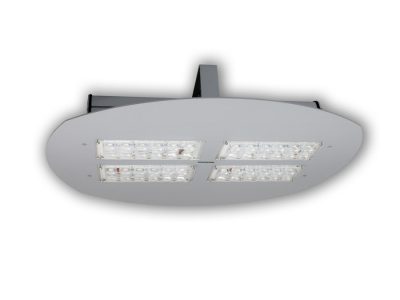
| HBR Series | LED high-bay | Multiple wattages (80–240 W), 150+ lm/W, DALI dimmable, IP66, adjustable beam (60°/90°/120°), 4000 K, CRI >80 | Main warehouse bays, open storage, picking zones, cold stores (cold-rated versions available) |
Industrial Linear & Area Luminaires
| Product | Type | Key Specifications | Application |
|---|---|---|---|
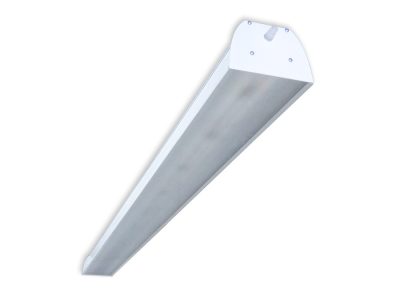
| INDUS | Industrial luminaire | IP66, robust aluminium housing, multiple wattage options, 4000 K | Racking aisles, loading docks, maintenance areas, corridor lighting in industrial zones |
Cold-Rated & Extreme Temperature Linear Luminaires
| Product | Type | Key Specifications | Application |
|---|---|---|---|
| VELISTI-IND | Industrial linear IP66 | Anodised aluminium, up to 170 lm/W, up to 20 400 lm, 6 beam angle options, DALI / 1-10 V dimmable, optional 3 h emergency, L70B10 >100 000 h, 8-year warranty | Cold stores (–30 °C), freezers, transition zones, high-temperature process areas, food-grade environments, harsh industrial zones |
Recommended Product-Zone Matrix
| Zone | Primary Luminaire | Secondary / Supplementary | Control |
|---|---|---|---|
| Ambient warehouse | HBR (standard) | INDUS (aisles) | DALI + occupancy |
| Picking / packing | HBR (high CRI) | INDUS (vertical boost) | DALI + daylight |
| Chilled store | HBR (IP66, cold-rated) | INDUS (IP66) | Microwave occupancy |
| Frozen store | HBR (IP66, –30 °C rated) | — | Microwave ON/OFF |
| Loading dock | HBR (IP66, IK10) | INDUS | Schedule + occupancy |
| VNA aisles | INDUS (rack-mount) | — | Per-aisle occupancy |
| Extreme temp zones | VELISTI-IND (cold/heat rated) | HBR (high-bay complement) | DALI / 1-10 V |
✅ Design Support: TECHLUMEN provides free photometric calculations, DIALux EVO simulations, and application advice for warehouse and cold store projects. Contact our engineering team at [email protected] for project-specific luminaire selection and lighting layouts.
13. Frequently Asked Questions (FAQ)
No. Standard LED high-bays are typically rated for a minimum ambient temperature of +5 °C. In cold stores (–18 °C to –30 °C), the LED driver contains electrolytic capacitors that degrade rapidly at low temperatures, leading to failure within 6–12 months. You must specify luminaires explicitly rated for the minimum operating temperature of the zone — typically –30 °C or –40 °C rated. Cold-rated models use specially selected components and often feature silicone-potted drivers.
PIR (Passive Infrared) sensors detect the temperature difference between a moving person and the background. In cold stores, workers wear heavy insulated clothing that masks their body heat, and the cold environment further reduces the thermal contrast. The result is unreliable detection — lights may not switch on when a worker enters. Microwave (high-frequency / HF) sensors detect physical movement through Doppler shift and work reliably regardless of temperature, making them the correct choice for cold store applications.
For a 24/7 warehouse replacing metal halide or fluorescent lighting with LED high-bays and controls, the typical payback period is 1.5–3 years. Factors that accelerate payback include: higher operating hours (24/7 vs. single shift), higher electricity costs, and the addition of occupancy/daylight controls. Cold stores typically achieve faster payback because LEDs gain efficiency in cold environments and the high cost of operating refrigeration makes any reduction in heat load from lighting (compared to legacy HID) a double saving.
Transition zones between warm and cold areas are the highest-risk locations for condensation-related failure. Specify luminaires with IP66 rating and built-in Gore-Tex breather valves that allow pressure equalisation without admitting moisture. In severe cases (e.g., blast freezer entry from ambient), consider luminaires with self-heating lenses that prevent ice and fog formation. Ensure all cable entries are sealed with cold-rated glands, and use silicone-jacketed cables throughout the transition zone.
As a general rule: the higher the mounting height, the narrower the beam angle required to deliver sufficient intensity at floor level. For 6–8 m, use 90°–120° wide beam; for 8–10 m, use 60°–90°; for 10–12 m, use 45°–60°; for 12–15 m, use 30°–45°. Many modern high-bays offer interchangeable optics (snap-on reflectors) that allow field adjustment. Always verify with a photometric calculation — the S/H ratio, aisle width, and racking height all affect the optimal choice.
Yes. EN 1838 and national fire codes require emergency lighting in all occupied spaces, including cold stores and freezers. Emergency luminaires in cold stores must be rated for the operating temperature and must maintain the required 1 lux on escape routes for at least 1 hour. Self-contained emergency luminaires with LiFePO4 batteries are preferred for cold stores because NiCd and NiMH batteries lose significant capacity at low temperatures. Alternatively, a central battery system located in a warm plant room can feed cold-rated emergency luminaires via fire-rated cabling.