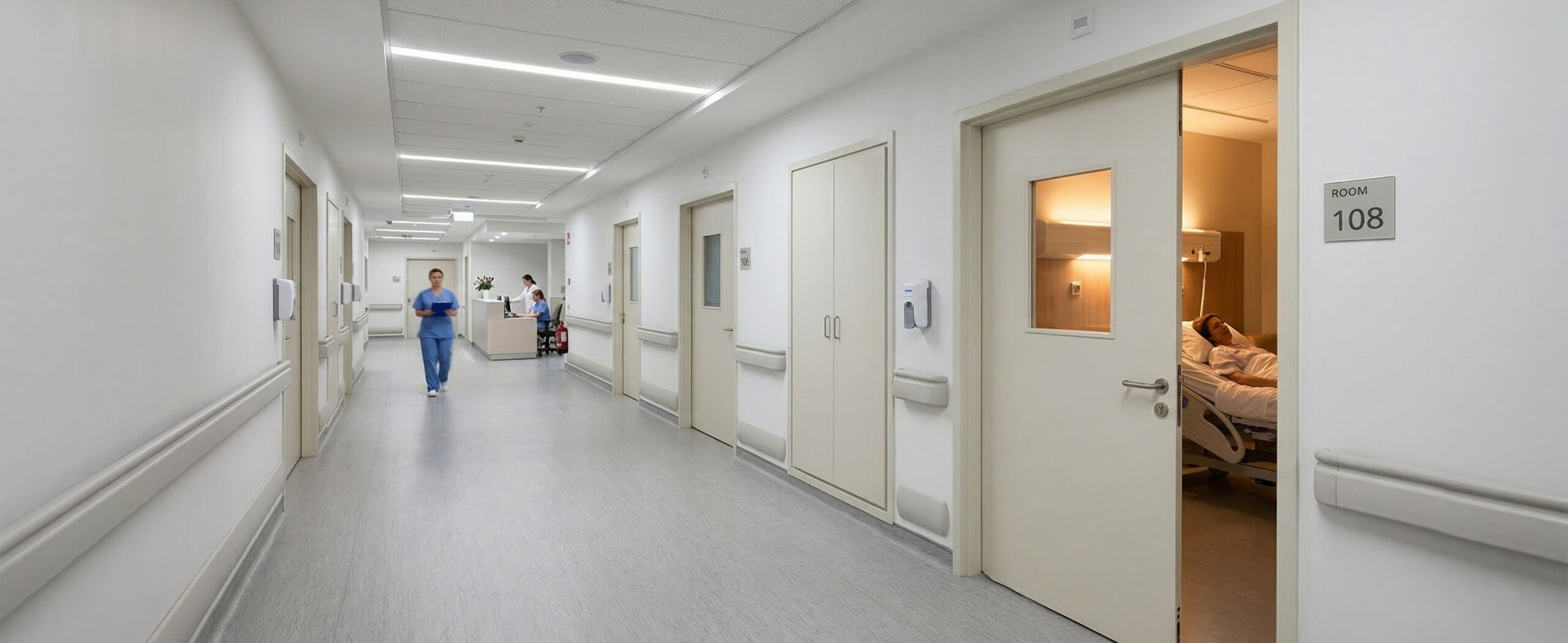
Complete technical reference for patient rooms, examination areas, corridors, operating theatres, and specialist healthcare zones — circadian design, infection control, and clinical-grade colour rendering.
📄 Version 1.0 — 2025
📏 EN 12464-1 Healthcare Areas
⚡ CRI ≥ 90 Clinical Grade
🌍 Circadian / HCL Tunable White
Purpose of this guide: Provide lighting designers, hospital facility managers, architects, and biomedical engineers with a comprehensive technical reference for healthcare and hospital lighting. Covers EN 12464-1 requirements for medical environments, patient room layered lighting, circadian (Human Centric Lighting) design, examination and operating theatre specifications, infection control luminaire requirements, and energy-efficient control strategies.
1. Introduction & Regulatory Framework
Healthcare lighting is unlike any other building category. It must simultaneously serve clinical function (accurate colour assessment of skin, tissue, and fluids), patient wellbeing (comfort, sleep support, recovery), staff performance (long shifts, high-acuity tasks), and safety (emergency evacuation, infection control). Poor hospital lighting has measurable consequences: increased medical errors, disrupted patient circadian rhythms, longer recovery times, and staff fatigue.
Modern LED technology enables tunable-white (HCL) systems that adjust colour temperature throughout the day to support natural circadian rhythms, high-CRI sources that reveal tissue colour accurately, and sealed luminaires that meet the stringent hygiene requirements of clinical environments. However, healthcare lighting design requires deep understanding of the unique standards and functional layers involved.
Key Regulatory Framework
Standard / Regulation
Scope
Key Requirements
EN 12464-1:2021
Indoor workplace lighting — healthcare areas
Illuminance, uniformity, UGR, CRI per medical zone
EN 1838
Emergency lighting
Escape route ≥1 lux, 3-hour duration for hospitals
German standard for medical lighting, operating theatres
IEC 62471
Photobiological safety
Blue light hazard classification for patient exposure
EN 60598-1
Luminaire safety
Construction, IP rating, thermal endurance
IEC 62386 (DALI)
Digital addressable lighting interface
Scene control, tunable white, emergency integration
National Fire Codes
Country-specific fire regulation
3-hour emergency duration for sleeping/hospital wards
⚠️ Critical — CRI Requirement: Healthcare environments demand CRI ≥ 90 (Ra ≥ 90) for all clinical areas where skin, tissue, or fluid colour assessment takes place. Standard commercial luminaires with CRI 80 are not acceptable in examination rooms, treatment areas, or nursing stations. This is not a recommendation — it is a medical safety requirement that directly affects diagnostic accuracy.
2. Lighting Standards & Requirements
EN 12464-1:2021 contains an extensive section dedicated to healthcare areas, specifying illuminance, uniformity, glare rating, and colour rendering for over 30 distinct hospital zones. The table below summarises the most critical entries.
EN 12464-1 — Healthcare Area Requirements
Area / Task
Ēm (lux)
Uo
UGRL
Ra (CRI)
Notes
Patient room — general
100
0.40
19
90
Dimmable, indirect preferred
Patient room — reading
300
0.60
19
90
Bedhead luminaire, individual
Patient room — simple examination
300
0.60
19
90
Adjustable, doctor's control
Patient room — night
5
—
—
—
Low-level orientation, amber preferred
Examination room
500
0.60
19
90
Supplementary task light available
Treatment room
500
0.60
19
90
CRI critical for tissue assessment
Operating theatre — general
500
0.60
19
90
Supplemented by surgical luminaire
Operating field (surgical light)
10,000–100,000
—
—
≥95
Specialist medical device, not general LED
Corridor — day
200
0.40
22
80
Higher than standard commercial
Corridor — night
50–100
0.40
22
80
Reduced to support patient sleep
Nurse station
500
0.60
19
90
VDT-compatible, CRI for charts
Intensive Care Unit (ICU)
100–300
0.60
19
90
Variable, patient-controlled dimming
Pharmacy / dispensing
500
0.60
19
90
Label discrimination critical
Laboratory
500
0.60
19
90
Microscopy areas may need supplementary
Waiting area
200
0.40
22
80
Comfortable, calming atmosphere
Staff room / rest
300
0.40
19
80
Circadian support for shift workers
Psychiatric ward
300
0.60
19
90
IK10, anti-ligature luminaires
Exam / Treatment
500
lux (Ēm)
Patient Room
100
lux (general)
CRI Clinical
≥90
Ra (minimum)
Emergency
3 h
duration (hospitals)
3. Healthcare Zones & Illuminance Levels
A hospital is a collection of vastly different environments — from the quiet darkness of a sleeping patient room to the intense, colour-critical illumination of an operating theatre. Effective healthcare lighting design begins with a clear zone map.
Hospital Lighting Zones — Illuminance & CRI Map
PATIENT ROOM General: 100 lux
Reading: 300 lux
Exam: 300 lux
Night: 5 lux (amber) CRI ≥ 90
Tunable white
2700–5000 K
DALI dimming
Bedside control
4 lighting layers
IP44 / cleanable
EXAMINATION General: 500 lux
Task: 1000 lux
UGR ≤ 19 CRI ≥ 90
4000 K standard
Flicker-free
No shadows
Task lamp available
Colour-critical
IP44+ / sealed
CORRIDOR Day: 200 lux
Night: 50–100 lux
UGR ≤ 22 CRI ≥ 80
3000–4000 K
Day/night scene
Emergency backup
DALI dimming
IP44 / cleanable
OPERATING Ambient: 500 lux
Field: 10K–100K lux
UGR ≤ 19 CRI ≥ 90 (amb.)
CRI ≥ 95 (field)
4000–5000 K
Shadow-free
Clean room class
Specialist devices
IP54+ / sealed
SPECIALIST Psychiatric: 300 lux
MRI: non-ferrous
Neonatal: dimmable
Pharmacy: 500 lux CRI ≥ 90
IK10 (psych.)
Anti-ligature
Antimicrobial
Zone-specific
IP65 (some)
← Comfort-oriented — — — — — — — — — — — — — — — — Clinical/specialist →
All clinical areas require CRI ≥ 90 · Emergency lighting: 3-hour minimum in all hospital zones
Figure 1 — Hospital lighting zones mapped by illuminance, CRI, and special requirements. Patient comfort zones (left) require tunable white and circadian support; clinical zones (right) demand high CRI, shadow-free illumination, and specialist fixtures.
The patient room is the most complex lighting challenge in a hospital. It must support four distinct functional layers, each controlled independently and often simultaneously:
Four Lighting Layers in a Patient Room
Layer
Function
Illuminance
CCT
Control
1. General (ambient)
Room orientation, visitor comfort, general visual tasks
100 lux
3000–4000 K (tunable)
DALI dimming, nurse/patient
2. Reading (bedside)
Patient reading, personal tasks
300 lux at pillow
2700–4000 K
Patient bedside control
3. Examination
Bedside medical examination by clinician
300–500 lux on patient
4000 K (fixed, high CRI)
Doctor's switch/remote
4. Night orientation
Safe movement without waking patient
5 lux max, floor-level
Amber (≤2200 K)
Motion sensor or nurse switch
Patient Room — Four Lighting Layers (Cross-Section)
① General — 100 lux · tunable 3000–4000 K
Patient bed
② Reading — 300 lux
Patient control
③ Examination
300–500 lux · CRI ≥ 90
Doctor's switch
④ Night — 5 lux · amber (≤2200 K) · motion sensor
Layer Control
① Nurse / patient
② Patient bedside
③ Doctor's switch
④ Motion / nurse Each layer operates
independently via
DALI-2 scenes
Circadian schedule:
cool daytime → warm evening
Figure 2 — Four lighting layers in a patient room: ① general ambient (tunable, ceiling), ② reading (bedhead, patient-controlled), ③ examination (overhead, doctor-controlled, CRI ≥ 90), ④ night orientation (amber floor-level, motion-activated). Each layer is controlled independently via DALI-2 scenes.
Circadian (HCL) Design in Patient Rooms
Human Centric Lighting (HCL) adjusts colour temperature and intensity throughout the day to support the patient's natural circadian rhythm. Research consistently demonstrates that circadian-aligned lighting in hospitals reduces patient anxiety, improves sleep quality, shortens recovery times, and reduces painkiller consumption. A typical HCL profile for a patient room:
Time
CCT
Intensity
Effect
06:00–08:00
3000 K → 4000 K (rising)
50 → 100 lux
Gentle wake-up, cortisol support
08:00–12:00
4000–5000 K
100 lux
Peak alertness, clinical rounds
12:00–16:00
4000 K
100 lux
Sustained alertness
16:00–20:00
4000 → 3000 K (falling)
100 → 50 lux
Relaxation, melatonin preparation
20:00–22:00
2700 K
50 → 20 lux
Pre-sleep, warm and dim
22:00–06:00
Amber (≤2200 K)
5 lux (if needed)
Night orientation only, no circadian disruption
💡 Design Tip: The night orientation layer (≤ 5 lux, amber/warm white ≤ 2200 K) is critical for patient recovery. Blue-rich light (>4000 K) at night suppresses melatonin and disrupts sleep. Specify amber LED sources (590–600 nm peak) or very warm white (≤2200 K) for all night-time lighting in patient areas. Standard 3000 K is too blue for night use.
5. Examination & Treatment Areas
Examination and treatment rooms are colour-critical environments where the quality of light directly affects diagnostic accuracy. A clinician assessing skin colour (cyanosis, jaundice, erythema), wound condition, or tissue health relies entirely on the spectral quality of the illumination.
Key Specifications for Clinical Areas
Parameter
Requirement
Rationale
Illuminance (Ēm)
500 lux general, 1000 lux task
Fine-detail clinical tasks
CRI (Ra)
≥90, R9 ≥50 recommended
R9 (deep red) critical for tissue/blood assessment
R9 (Deep Red) Index ≥ 50Standard CRI (Ra) averages 8 colour samples — but R9 (saturated red) is not included.For medical applications, always specify R9 separately. Blood, tissue, and skin tones require R9 ≥ 50.
⚠️ Critical — UGR in Clinical Rooms: Patients in examination rooms are typically supine (lying down) and looking directly at the ceiling. Conventional downlights and exposed luminaires can cause severe glare. Specify recessed luminaires with microprismatic diffusers or indirect-direct systems with UGR ≤ 19 when assessed from the supine position — not just the standard seated/standing reference.
6. Corridors, Nurse Stations & Waiting Areas
Hospital corridors serve a fundamentally different purpose from commercial corridors: they are 24-hour patient transport routes, staff working zones, and wayfinding paths that must operate at different intensities day and night. The day/night dimming profile is critical for patient sleep quality.
Corridor Day/Night Profiles
Period
Illuminance
CCT
Rationale
Day (07:00–21:00)
200 lux
4000 K
Active clinical environment, wayfinding, patient transport
Evening (21:00–23:00)
100 lux
3000 K
Transition period, reduced stimulation
Night (23:00–06:00)
50 lux
2700 K
Minimum for safety, reduced circadian disruption
Emergency
≥1 lux (escape route)
—
EN 1838, 3-hour battery duration for hospitals
Nurse Stations
Nurse stations are high-acuity workstations where staff read patient charts, administer medications, and use computer screens for extended periods. EN 12464-1 specifies 500 lux with CRI ≥ 90 and UGR ≤ 19. The lighting must be VDT-compatible (no reflections on screens) while providing sufficient colour rendering for medication label discrimination.
ℹ️ Waiting Areas: Waiting areas (200 lux, CRI ≥ 80) should prioritise a calming atmosphere. Indirect lighting, warm white (3000 K), and low UGR create a less clinical environment that reduces patient anxiety. Consider wall-washing techniques to make the space feel larger and more comfortable.
7. Operating Theatres & Clean Rooms
The operating theatre has the most demanding lighting requirements in any building. The ambient (general) lighting must provide 500 lux with CRI ≥ 90, while the surgical luminaire (a specialist medical device, not a general LED luminaire) delivers 10,000–100,000 lux to the surgical field with CRI ≥ 95 and shadow-free illumination.
Operating Theatre Lighting Components
Component
Illuminance
CRI
Function
Type
Surgical luminaire
10,000–100,000 lux
≥95
Illumination of surgical field
Specialist medical device (EN 60601)
Ambient ceiling
500 lux
≥90
General theatre lighting, peripheral vision
Sealed recessed LED panel
Instrument table
500–1000 lux
≥90
Instrument identification
Adjustable task luminaire
Wall washing
200 lux vertical
≥80
Reduce luminance contrast, reduce fatigue
Recessed wall wash
ℹ️ Important Distinction: The surgical luminaire (operating light) is a specialist medical device regulated under EN 60601-2-41 (the medical electrical equipment standard), not a general luminaire under EN 60598. It is not within the scope of general LED lighting design. General lighting designers are responsible for the ambient ceiling lighting, wall washing, and corridor/preparation areas only. The surgical luminaire is specified by the clinical team and the medical equipment supplier.
Clean Room Lighting
Clean rooms (ISO 14644 classified) require luminaires that do not harbour microorganisms or shed particles. Luminaires must be fully sealed (IP54 minimum, IP65 preferred), flush-mounted with seamless joints, and have smooth non-porous surfaces that can withstand chemical cleaning agents (hydrogen peroxide vapour, chlorine). Gaskets must be silicone, not foam.
8. Colour Rendering, Flicker & Visual Comfort
In healthcare, visual quality is not an amenity — it is a clinical tool. Three parameters are critical: colour rendering (CRI/R9), flicker (SVM/PstLM), and glare (UGR).
CRI and R9 Explained
Metric
What It Measures
Healthcare Minimum
Why It Matters
CRI (Ra)
Average of R1–R8 colour samples
≥90
General colour accuracy across pastel tones
R9
Deep saturated red reproduction
≥50
Blood, tissue, skin redness assessment
R13
Caucasian skin tone
≥90
Accurate skin colour perception
R15
Asian skin tone
≥90
Accurate skin colour perception
Rf (TM-30)
Fidelity index (99 samples)
≥90
More comprehensive than CRI
Rg (TM-30)
Gamut index (saturation)
95–105
Neither desaturating nor over-saturating
Flicker Requirements
Metric
Standard
Healthcare Limit
Notes
SVM (Stroboscopic Visibility Measure)
EN 61547 / IEEE 1789
≤0.4
Visible stroboscopic effect on moving objects
PstLM (Flicker Perception)
EN 61547
≤0.5
Visible flicker for stationary observer
Flicker %
IEEE 1789
≤5 % at 100 Hz
High-risk patients (epilepsy, migraine)
💡 Design Tip: Request the luminaire manufacturer's IES TM-30 report in addition to CRI values. TM-30 uses 99 colour evaluation samples (vs. 8 for CRI Ra) and provides both fidelity (Rf) and gamut (Rg) indices, giving a far more complete picture of colour rendering quality. For clinical areas, specify Rf ≥ 90 and Rg 95–105.
9. Controls, Circadian (HCL) & DALI Scenes
Healthcare lighting control is more complex than any other building type because of the multiple user types (patient, nurse, doctor, visitor), the 24-hour operation, the need for circadian-aligned dimming, and the integration with nurse call, emergency, and building management systems.
Control Strategies by Zone
Zone
Control Strategy
Technology
Key Scenes
Patient room
4-layer DALI, circadian schedule, bedside patient control
DALI-2 + tunable white
Wake, Day, Exam, Read, Night
Corridor
Day/night dimming schedule
DALI-2 + astronomical clock
Day (200 lux), Night (50 lux)
Nurse station
Task lighting + VDT scene
DALI-2 + personal control
Active, Computer, Night
Examination room
Scene preset + task lamp
DALI-2
Prepare, Examine, Clean
Operating theatre
Multi-zone, integration with surgical light
DALI-2 + medical system bus
Prep, Surgery, Clean, Emergency
Waiting area
Schedule + daylight harvesting
DALI-2 + daylight sensor
Day, Evening
ICU
Individual bed zones, circadian, manual override
DALI-2 + per-bed control
Monitoring, Procedure, Rest, Night
Patient Scenes
5+
per room
Protocol
DALI-2
+ tunable white
Corridor Saving
40–60
% (night dimming)
Emergency
3 h
all hospital zones
10. Infection Control, IP Ratings & Specialist Zones
Hospital-acquired infections (HAIs) are a critical concern, and lighting fixtures are potential reservoirs for microorganisms if not properly specified and maintained. The luminaire selection must consider cleanability, sealing, and antimicrobial properties.
⚠️ Psychiatric Wards: In psychiatric and mental health facilities, all luminaires must be anti-ligature — designed so that no part of the fitting can support a ligature point. This requires flush mounting, rounded profiles, tamper-proof fixings, and IK10 impact resistance. Standard commercial luminaires are not suitable. Specify purpose-designed anti-ligature fittings from manufacturers with documented compliance to anti-ligature guidelines.
Tunable white 2700–5000 K with automated DALI schedule
6
1-hour emergency batteries in hospital
Non-compliance — hospitals require 3 hours
3-hour rated batteries (LiFePO4 preferred)
7
Standard fixtures in psychiatric wards
Ligature risk, patient safety hazard
Anti-ligature, IK10, flush-mounted, tamper-proof
8
Ignoring vertical illuminance for examinations
Insufficient light on patient's face/body for assessment
Verify ≥300 lux vertical on the examination plane
12. TECHLUMEN Product Recommendations
TECHLUMEN manufactures LED luminaires that serve both clinical and support areas in healthcare facilities. The QUDO-60-AS series is specifically designed for clean-zone, surgical, and clinical environments, while VELISTI and INDUS serve corridor, utility, and technical infrastructure.
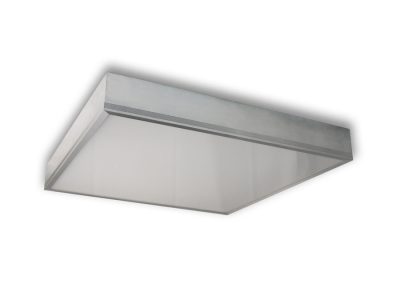
✅ QUDO-60-AS — Purpose-Built for Healthcare: The QUDO-60-AS series is specifically designed for clinical environments. The CRI 90 version meets the EN 12464-1 requirement for medical areas. The microprismatic diffuser option delivers UGR <19 — critical for patient comfort in the supine position. Tunable CCT (3000–6500 K) enables circadian (HCL) profiles in patient rooms, while the built-in 3-hour emergency pack meets the hospital emergency duration requirement. IP65 rating ensures compatibility with clean-zone and chemical disinfection protocols.
IP66, DALI dimmable, aluminium heavy-duty housing, multiple wattages, CRI ≥ 80, emergency option (LiFePO4, 1 h / 3 h)
Hospital corridors, service corridors, parking structures, loading areas, technical zones — combined normal + emergency
INDUS
Industrial luminaire
IP66, robust plastic housing, multiple wattages
Plant rooms, generator rooms, mechanical areas, service tunnels
Application Matrix
Hospital Zone
TECHLUMEN Product
Emergency
Notes
Operating theatre (ambient)
QUDO-60-AS (CRI 90, IP65)
QUDO-60-AS Em 3 h
Microprismatic UGR <19, sealed for HPV
Examination / treatment
QUDO-60-AS (CRI 90)
QUDO-60-AS Em 3 h
4000 K fixed or tunable
Patient rooms
QUDO-60-AS (CRI 90, tunable)
QUDO-60-AS Em 3 h
Circadian HCL 3000–5000 K via DALI
Nurse station
QUDO-60-AS (CRI 90)
QUDO-60-AS Em 3 h
500 lux, VDT-compatible
ICU
QUDO-60-AS (CRI 90, tunable)
QUDO-60-AS Em 3 h
Per-bed DALI zone dimming
Pharmacy / laboratory
QUDO-60-AS (CRI 90)
QUDO-60-AS Em 3 h
Label discrimination, 500 lux
Clean room / sterile
QUDO-60-AS (IP65)
QUDO-60-AS Em 3 h
Clean-zone rated, sealed construction
Hospital corridors
VELISTI (IP66)
VELISTI + 3 h emergency
Day/night DALI dimming
Plant / generator rooms
INDUS (IP66)
VELISTI + emergency
Robust, high-risk task area
Multi-storey car park
VELISTI (IP66)
VELISTI + 3 h emergency
Anti-panic + escape route
Exterior / ambulance bay
DROMOS (IP66)
—
External approach lighting
✅ Design Support: TECHLUMEN provides photometric calculations, DIALux EVO simulations, and luminaire selection support for complete healthcare facility projects — from clinical areas (QUDO-60-AS) to infrastructure (VELISTI, INDUS). Contact our engineering team at [email protected] for project-specific healthcare lighting design.
13. Frequently Asked Questions (FAQ)
Why is CRI 80 not sufficient for hospital lighting?
CRI 80 means the light source renders colours 80 % as accurately as a reference illuminant. While acceptable for offices and retail, an 80 % score means a 20 % colour distortion that is clinically significant in healthcare. Clinicians assess cyanosis (blue skin), jaundice (yellow), erythema (redness), and wound colour under artificial light. CRI ≥ 90 with R9 ≥ 50 ensures deep reds — critical for blood and tissue — are reproduced accurately. Using CRI 80 in examination rooms creates a measurable misdiagnosis risk.
What is Human Centric Lighting (HCL) and why does it matter in hospitals?
HCL (also called circadian lighting) uses tunable-white LED technology to vary colour temperature and intensity throughout the day, mimicking natural daylight patterns. In hospitals, research shows that HCL reduces patient anxiety, improves sleep quality, shortens average length of stay, reduces painkiller consumption, and supports staff alertness during night shifts. The system typically transitions from cool blue-rich light (4000–5000 K) during the day to warm amber light (2700 K) in the evening, with very low amber (≤2200 K) light at night to avoid suppressing melatonin.
Do all hospital luminaires need to be IP65?
No. IP requirements vary by zone: patient rooms and corridors typically require IP44 (splash-proof, compatible with damp-cloth cleaning), operating theatres and clean rooms require IP54–IP65, and bathrooms require IP65. The key hygiene requirement is that luminaires must have smooth, sealed, non-porous surfaces that can be wiped with clinical disinfectants without degradation. Always check the specific infection control policy of the healthcare facility.
Why is 3-hour emergency duration required in hospitals?
Hospitals contain patients who may be immobile, sedated, ventilator-dependent, or otherwise unable to self-evacuate. Evacuation of a hospital is far more complex and time-consuming than a commercial building — it may involve moving patients on beds, maintaining life-support equipment on battery power, and progressive horizontal evacuation to adjacent fire compartments. EN 1838 and national fire codes require 3-hour emergency lighting duration for all sleeping accommodation and healthcare buildings to provide sufficient time for this complex evacuation process.
Can standard LED panels be used in operating theatres?
Standard commercial LED panels are not suitable for operating theatres due to insufficient IP rating, particle-shedding risk, and incompatibility with hydrogen peroxide vapour (HPV) decontamination. However, purpose-designed clean-zone panels such as the TECHLUMEN QUDO-60-AS (IP65, sealed aluminium construction, CRI 90 version, UGR <19 microprismatic) are specifically engineered for this application. The QUDO-60-AS serves as the ambient ceiling lighting in the operating theatre. Note that the surgical luminaire (operating light above the surgical field) is a separate specialist medical device under EN 60601 — it is not a general lighting product and is specified by the clinical team.
What lighting is needed for MRI suites?
MRI (Magnetic Resonance Imaging) suites require non-ferromagnetic luminaires within the 5-gauss exclusion zone around the scanner. Standard LED luminaires contain steel housings, ferrous mounting brackets, and transformer cores that would be violently attracted to the magnet. MRI-safe luminaires use aluminium housings, copper wiring, and non-magnetic fixings. Fibre-optic lighting systems (light source outside the MRI room) are an alternative. All wiring must be RF-shielded to prevent interference with the imaging equipment.
Related Standards & References
EN 12464-1:2021 — Light and lighting — Indoor work places (healthcare areas)
EN 1838:2013 — Lighting applications — Emergency lighting