Lighting for Underground & Multi-Storey Parking Facilities
A comprehensive technical guide to the design, installation and optimization of LED lighting in parking structures — from standards and lux levels to automation systems, cost analysis and real-world case studies.
Light Source Technologies for Parking Facilities
Choosing the right lighting technology is critical for performance, safety and economy in parking facilities. While fluorescent and HID (high-intensity discharge) lamps were traditionally used, LEDs now dominate as the optimal solution across every criterion.
| Technology | Efficacy (lm/W) | Lifespan | CRI | Start-up | Dimming |
|---|---|---|---|---|---|
| LED | 80–90+ | Instant | Full | ||
| Fluorescent | 70–85 | 1–5 sec | Limited | ||
| Metal Halide (MH) | 60–90 | 1–5 min | Difficult | ||
| HPS (Sodium) | 20–30 | 3–10 min | Difficult |
Detailed technology comparison
LEDs produce far more light per Watt — a modern LED fixture achieves >120 lm/W, compared to ~80 lm/W for fluorescent and 40–90 lm/W for HID. This means a 30W LED fixture can replace a 100W HID with comparable output. The ~70% energy saving is immediately visible on the electricity bill. Beyond lumens, LEDs utilise light more effectively: superior directionality (less wasted light towards the ceiling), high CRI for improved visibility, and white light perceived as brighter than the yellow/orange of sodium lamps (scotopic/photopic effect). Even at lower lumen output, spaces appear brighter with LED than with HPS. Losses in drive systems also matter: modern LED drivers achieve 90–95% efficiency, while many magnetic HID ballasts waste 15%+ as heat.● LED Advantages
- Up to 75% energy savings vs conventional sources
- Instant on/off — no warm-up time required
- Full dimming capability — ideal for automation
- Resistant to frequent on/off switching cycles
- No mercury or toxic materials (RoHS compliant)
- Broad-spectrum white light — high CRI 80–90+
- Minimal lumen depreciation over lifetime
- Uniform light distribution, improved directionality
- Driver efficiency 90–95% (minimal losses)
● Legacy Technology Drawbacks
- Fluorescent: Mercury content (special disposal), on/off sensitivity
- Fluorescent: Reduced output at low temperatures
- Fluorescent: Limited dimming (requires special ballasts)
- MH: 1–5 minute start-up, must cool before restrike
- MH: Significant lumen depreciation, vibration sensitivity
- HPS: Very low CRI (~20–30) — orange/amber light
- HID general: Cannot dim, incompatible with automation
- HID general: 15%+ losses in magnetic ballasts
- EU: T5/T8 fluorescent tubes banned since Aug. 2023 (RoHS/EcoDesign)
Retrofit tubes vs complete fixture replacement
In practice, many parking facility managers opt for the cheaper solution: replacing only the fluorescent tubes with LED retrofit tubes (T8/T5 LED), while keeping the old fixture housing. Although this reduces upfront cost, it creates serious problems in the medium term.⚠ The problem: LED retrofit tubes
- Short lifespan: Retrofit LED tubes typically last 15,000–30,000 hours — far below the 50,000–100,000 of an integrated LED luminaire
- Thermal issues: Old housings were not designed for LED thermal management — poor cooling = faster chip degradation
- Ballast incompatibility: Many retrofit tubes require ballast bypass or removal — if done incorrectly, risk of short circuit or fire
- Lower efficacy: Retrofit tubes ~100 lm/W, integrated LED fixtures >130 lm/W — significant difference across large numbers of fixtures
- No dimming/automation: Most retrofit tubes don't support DALI or 0-10V — impossible to integrate with control systems
- Questionable warranty: Installing LED tubes in housings designed for fluorescent may void warranties and CE certifications
✓ The solution: Complete fixture replacement
- Much longer lifespan: 50,000–100,000 hours — effectively zero replacements for 10–15 years under typical parking operation
- Integrated thermal management: Aluminium housing designed for LED — proper cooling, long life, consistent performance
- Full compatibility: DALI-ready, dimming, integrated occupancy sensors — leveraging all LED advantages
- Higher efficacy: >130 lm/W system efficacy — fewer Watts for the same or more lux
- Regulatory compliance: CE certified, IP65, IK08+ — fully meets EN 12464-1 and electrical installation codes
- Uniform illumination: Modern optics (prismatic, asymmetric) ensure uniformity without dark zones — e.g. VELISTI-T with 7 beam angle options
Lux Requirements, Uniformity & Lighting Zones
Lighting standards define minimum lux levels, uniformity, glare control and colour rendering for each zone within a parking facility. The primary design reference is EN 12464-1:2021 (indoor workplaces) and DIN EN 12464-2 (outdoor areas).
| Zone | Lux (avg) | U₀ (min/avg) | UGR | CRI | Notes |
|---|---|---|---|---|---|
| Main areas & traffic lanes | 150lux | ≥ 0,40 | ≤ 25 | ≥ 60 | Primary vehicle & pedestrian circulation zone |
| Entrance / Exit (daytime) | 300lux | ≥ 0,40 | ≤ 25 | ≥ 60 | Eye adaptation — preventing "black hole effect" |
| Entrance / Exit (night) | 75lux | ≥ 0,40 | ≤ 25 | ≥ 60 | Lower — no contrast with daylight needed |
| Ramps & bends | 150–300lux | ≥ 0,40 | ≤ 22 | ≥ 60 | Critical areas — higher levels near entrances |
| Stairs & elevators | 150lux | ≥ 0,40 | ≤ 22 | ≥ 80 | Pedestrian zone — critical for fall prevention |
| Emergency lighting | ≥ 1lux | — | — | — | EN 1838 — autonomy ≥ 1 hour |
Glare, colour rendering & vertical illuminance
EN 12464-1 sets maximum glare rating limits of UGR ≤ 22–25 for traffic areas. Disabling glare can temporarily blind drivers or pedestrians — it is controlled through louvres, prismatic diffusers and proper mounting height. A colour rendering index of CRI ≥ 60–80 is recommended for adequate recognition of vehicle colours, signage and clothing. The U.S. General Services Administration CRI of at least 70 is recommended internationally for parking facilities. Do not overlook vertical illuminance: light on vertical surfaces (face height) is critical for recognising pedestrians, signage and wayfinding. Target: at least ¼ to ⅓ of horizontal illuminance on vertical surfaces. Per DIN EN 12464-2, minimum semi-cylindrical illuminance is 0.4–3 lux for facial recognition. This increases perceived brightness and eliminates dark corners.Intelligent Lighting Control Systems
Integrating intelligent control systems dramatically improves both energy efficiency and safety. The combination of LED + sensors can reduce energy consumption by 60–80% compared to static HID lighting, and is increasingly mandated by building energy codes.
Automation technologies
Occupancy / Motion Sensors
PIR (infrared) or microwave detectors. Dim to 20% when vacant, ramp to 100% on detection. Studies show +76% additional savings beyond LED alone. Modern fixtures with integrated sensors (bi-level control).Daylight Harvesting
Photosensors measure ambient light and adjust artificial lighting accordingly. Fixtures near openings switch off automatically during daylight. Many sensors combine occupancy + daylight in one unit.Time Scheduling
Reduce lighting after midnight to security level, restore before morning arrival. Seasonal adjustment (summer/winter schedules). Combined with sensors.DALI (Digital Addressable)
Digital protocol — individual addressable control of each fixture. Dimming, zone grouping, lighting scenes, fault notification, remote management.KNX & BMS
Building-wide automation system integrating lighting, HVAC and security. Works with DALI gateways. Central monitoring of entire parking facility.Dimming (0-10V / DALI)
Smooth luminous flux adjustment. Operate at 50% during low traffic. LED: full dimming. HID: cannot easily dim — a critical LED advantage for automation.Control system architecture
Adaptive Lighting — Dynamic adjustment
Adaptive lighting combines occupancy sensors + photosensors + time schedules in real time, ensuring optimal balance between energy and safety. Example: after midnight in an office building car park, lighting drops to 20% but ramps to 100% on motion detection, with smooth fade transitions to avoid startling occupants.Cost, Savings & Return on Investment
Parking lighting often operates 24/7 in basements, hospitals and shopping centres. System energy efficiency plays a massive role in operating costs — LEDs reduce both energy consumption and maintenance expenses.
Annual consumption comparison
Scenario: 10 fixtures, continuous operation 8,760 hours/year, rate €0.15/kWh
* Sensor savings estimated at ~60% (average parking occupancy).
Energy efficiency factors
Luminous efficacy (lm/W)
LED >120 lm/W, fluorescent ~80 lm/W, HID 40–90 lm/W. A 30W LED replaces a 100W HID. The saving ~70% is immediately apparent on the electricity bill.Qualitative performance
LEDs utilise light better: directionality, high CRI, scotopic/photopic effect. Drivers 90–95% efficiency vs 85% magnetic HID ballasts.W/m²/100 lux indicator
Modern LED parking: <2 W/m²/100 lux (excellent). Legacy systems: >5 W/m²/100 lux. Critical metric in building energy audits KENAK.Life cycle cost (LCC)
LED: 5× lifespan vs HID, minimal replacements, reduced need for access platforms, less waste. For 24/7 installations, payback can occur within months.Calculation example — 10 × MH → LED retrofit
| Parameter | HID (MH) 150W | LED 60W | LED 60W + sensors |
|---|---|---|---|
| Power / fixture | 150 W | 60 W | 60 W |
| Hours / year | 8.760 | 8.760 | ~3.504 (equivalent) |
| Consumption / year | 13.140 kWh | 5.256 kWh | 2.102 kWh |
| Cost @ €0,15/kWh | €1.971 | €788 | €315 |
| Savings vs HID | — | €1.183 (60%) | €1.656 (84%) |
| Lamp replacements / year | ~0,6 per lamp | ~0 (100Kh life) | ~0 |
Regulatory Framework & Compliance
Parking lighting design must comply with multiple standards at national, European and international level — covering safety, ergonomics, energy performance and environmental compliance.
Lighting & safety standards
| Standard | Scope | Key Requirements |
|---|---|---|
| EN 12464-1:2021 | Indoor workplace lighting | Lux, uniformity U₀, UGR, CRI — primary parking design basis |
| DIN EN 12464-2 | Outdoor workplace lighting | Semi-cylindrical illuminance 0.4–3 lux for facial recognition |
| EN 1838 | Emergency lighting | ≥ 1 lux floor level, autonomy ≥ 1 hour, exit signage |
| ISO/CIE 8995-1 | Workplace lighting (ISO) | Equivalent to EN 12464-1 — identical requirements |
National regulations & energy
| Regulation | Scope | Relevance to Parking |
|---|---|---|
| KENAK / TOTEE 20701-1 | Building energy performance (GR) | Energy performance indicators, EN 12464-1 compliance without exceeding |
| P.D. 41/2018 | Fire safety (GR) | Emergency luminaires, exit signage, autonomy requirements |
| IEC 60364 / IEC 60364 | Low-voltage installations | Earthing, RCD, conductor sizing, switchboards, surge protection |
| ATEX 2014/34/EU | Explosive atmospheres | Explosion-proof fixtures Zone 2 (where required) |
Environmental compliance
| Directive / Standard | What It Requires | Impact |
|---|---|---|
| RoHS (2011/65/EU) | Prohibition of mercury in luminaires | Fluorescent & HID phased out — LED only option |
| EcoDesign (2019/2020) | Minimum energy efficiency thresholds | T5/T8 fluorescent tubes banned from Aug. 2023 |
| ISO 50001 | Energy management systems | Parking lighting = primary intervention area |
Installation Guidelines, Safety & Maintenance
Installing luminaires in parking facilities requires equipment rated for the environment (humidity, dust, exhaust fumes, impact), careful design to avoid glare and shadows, and compliance with electrical installation codes.
Protection ratings & durability
Parking environments feature humidity, dust, exhaust fumes and potential water (from vehicles, sprinklers, cleaning). IP65+ IP65+ protection is recommended for dust and water jet resistance. Fixtures also face impact risk from tall vehicles and vandalism — IK08–IK10. Use metallic housings with polycarbonate or tempered glass covers.Installation & safety checklist
-
Ingress protection IP65+ — Dust & water jet resistance. For parking with car washes or sprinkler systems, consider IP66. All switches/panels: minimum IP54. TECHLUMEN VELISTI-T and INDUS series are IP66 rated as standard.
-
Impact resistance IK08–IK10 — Metallic housings, polycarbonate covers. Low-profile LED panels designed for harsh environments.
-
Electrical safety (IEC 60364) — Earthing of metal parts, RCD protection, correct conductor sizing, armoured cabling (conduit/trunking), surge protection on LED drivers.
-
ATEX (if required) — In areas with fuel vapour risk: explosion-proof fixtures Zone 2. Critical in workshops, fuel pumps, hydrogen/LNG charging. Rare in well-ventilated parking.
-
Anti-glare design — Louvres, prisms, opaque reflectors. Ceiling-mounted (outside driver's direct line of sight). UGR ≤ 22–25. Avoid deep shadows behind columns.
-
Uniform coverage — Grid spacing ~7.5 × 7.5 m at 3.0–3.5 m height. Align with traffic lanes. Additional fixtures near columns. Use Dialux/Relux/AGi32 for design.
-
Signage & emergency lighting — Exit signs with 3-hour autonomy, full-light recall buttons, ≥ 1 lux escape routes. Standalone battery or UPS/generator-backed luminaires.
-
Maintenance & access — Provision for mobile ladders/lift platforms. Lock-out/tag-out procedures, PPE (helmet, insulating gloves, non-slip boots). Distribution boards at accessible locations. Periodic fixture cleaning.
-
CCTV coordination — ≥ 100 lux at camera positions for colour HD footage. Additional fixtures above ANPR cameras at entry/exit points.
-
Surge protection — SPDs on LED drivers (lightning, grid fluctuations). Critical in underground facilities with significant leakage currents.
Surface finishes & reflectance
Light-coloured walls (~20–30% reflectance) improve lighting uniformity, while dark ceilings reduce unwanted reflections on windscreens. Surface colour choices significantly affect perceived brightness and can reduce the number of fixtures required.Design, Application & Practical Guidelines
Theory must translate into practice through proper lighting design. Here are indicative layout examples and practical design guidance.
Design example: Underground parking 68 × 35 m
| Parameter | Value |
|---|---|
| Dimensions | ~68 m × 35 m (≈2.380 m²) |
| Ceiling height | ~3,2 m (clear) |
| Number of fixtures | 27 × TECHLUMEN VELISTI-T 66 W |
| Luminous flux / fixture | ~5.000 lm |
| Light distribution | Type V (symmetric diffuse) |
| Colour temperature | 5000 K — CRI 80 (VELISTI-T) |
| Fixture grid spacing | ~7,6 × 7,6 m (25' × 25') |
| Average horizontal illuminance | ~54 lux |
| Vertical wall illuminance | ~36 lux |
| Power density | ~1,08 W/m² |
| Uniformity | Meets EN 12464-1 (U₀ ≥ 0.40) |
| Savings vs fluorescent | 40–50% lower consumption |
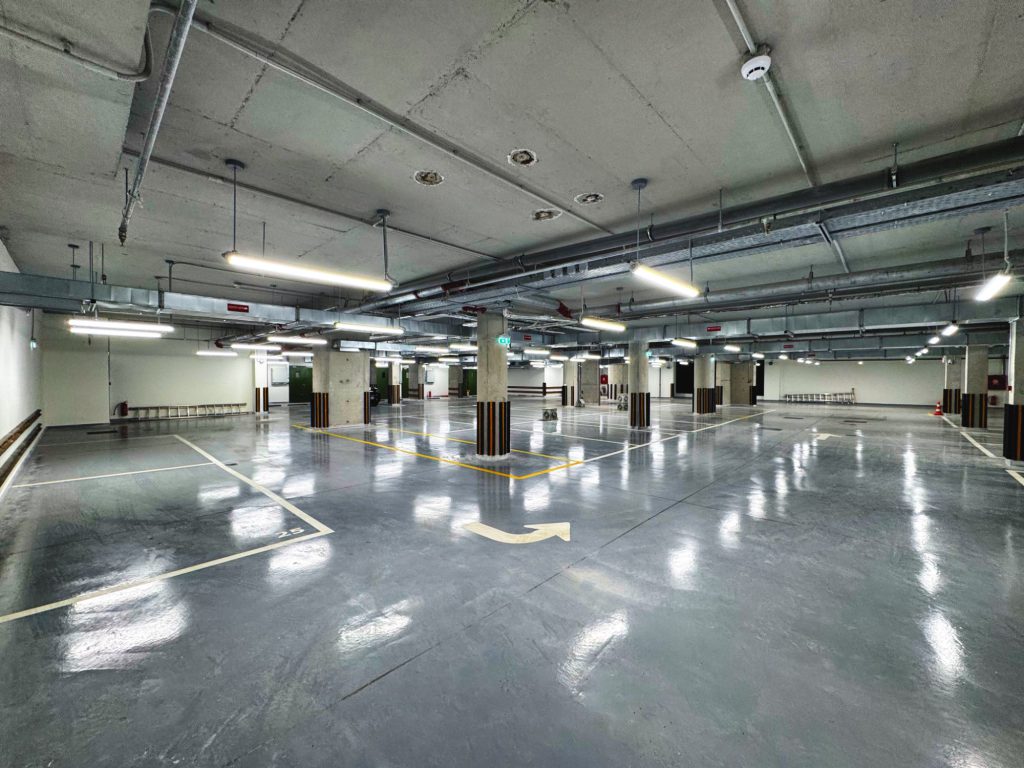
Recommended TECHLUMEN fixtures for parking
| Series | Type | IP / IK | lm/W | L80B10 | Dimming | Ideal for |
|---|---|---|---|---|---|---|
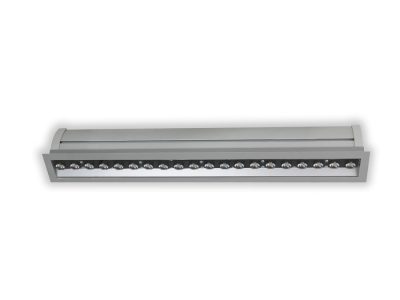
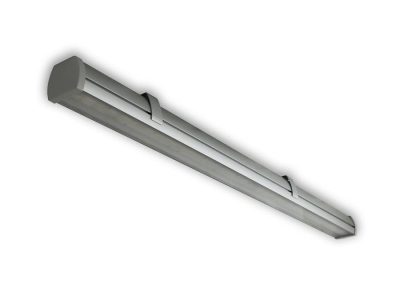
| VELISTI-T | Linear LED, anodised aluminium | IP66 | up to 176 | >80,000h | DALI / 1-10V / Em 3h | Premium installations, automation, high-spec projects |
| INDUS | Linear LED, polycarbonate | IP66 / IK08 | 132 | >50,000h | — | Cost-effective installations, large car parks |
Practical design guidelines
📐 Fixture Layout
- Align fixtures with vehicle traffic lanes
- Width >15 m: two or more fixture rows
- Additional fixtures near columns (shadow avoidance)
- Grid ~7.5 × 7.5 m at 3.0–3.5 m mounting height
🚪 Entrance Zone
- 300 lux daytime in the first 5–10 m
- Denser layout or higher-output fixtures
- "Daylight fixtures" that only activate during the day
- Prevent "black hole effect" at the entrance
💻 Design Software
- Dialux, Relux, AGi32 for photometric analysis
- Floor plans with isolux contour lines
- Vertical illuminance on walls & facial planes
- Wiring diagrams & control zone layouts
🔄 Zoning & Flexibility
- Each floor = independent control zone
- Perimeter (daylight) vs core zones
- Post-installation fine-tuning capability
- Light wells / atriums in multi-storey designs