Office & Workspace
Lighting Guide
A comprehensive guide to designing effective lighting that enhances productivity, visual comfort, and employee well-being.
Why Office Lighting Matters
Office lighting is not just about achieving adequate lux levels. It directly affects productivity, concentration, visual comfort, and the long-term health of employees.
Poorly designed lighting leads to fatigue, headaches, reduced performance, and increased complaints, even when it meets requirements "on paper." Compliance with standards is necessary but not sufficient for quality lighting.
Who This Guide Is For
🔧 Lighting Designers & Electricians
- Designing lighting studies
- Selecting appropriate luminaires
- DIALux/Relux calculations
- Standards compliance
🏗️ Architects & Designers
- Integrating lighting into design
- Aesthetics & functionality
- Collaboration with lighting consultants
- WELL/LEED certifications
🏢 Owners & Facility Managers
- Understanding requirements
- Evaluating proposals
- Choosing the right solutions
- Cost/benefit assessment
The Regulatory Framework
The primary European standard for office spaces is EN 12464-1, which defines minimum lighting requirements for indoor workplaces.
📋EN 12464-1: Basic Office Requirements
The standard defines minimum values for key lighting quality indicators:
| Parameter | Minimum Value | Recommended | Significance |
|---|---|---|---|
| Illuminance (Ēm) | 500 lux | 500-750 lux | Adequate lighting for visual tasks |
| Uniformity (U₀) | ≥ 0.60 | ≥ 0.70 | Avoiding harsh contrasts |
| Glare (UGR) | ≤ 19 | ≤ 16 | Visual comfort, reduced fatigue |
| Color Rendering (CRI) | ≥ 80 | ≥ 90 | Natural color reproduction |
The standard defines minimum requirements. Compliance does not guarantee quality results if actual usage conditions, screen positions, reflections, and the psychology of the space are not considered.
Light Levels & Distribution
Each type of space has different lighting requirements. Proper distribution is equally important as absolute levels.
↔️Horizontal Illuminance
Refers to horizontal work surfaces (desks, counters). This is the primary indicator measured in lighting studies and ensures visibility of documents and objects.
↕️Vertical Illuminance
Refers to vertical surfaces (faces, cabinets, partitions). Its absence makes the space feel "flat" and tiring, and affects facial recognition.
Poor uniformity creates harsh brightness contrasts that tire the eye. Especially in open-plan offices, uniformity is as important as lux levels. Aim for U₀ ≥ 0.70 for optimal results.
Detailed Requirements by Task Type
| Space / Task | Minimum Ēm (lx) | Recommended Ēm (lx) | U₀ (min) |
|---|---|---|---|
| Filing, sorting, archive storage | 200 | 300 | 0.40 |
| Filing, copying, photocopying | 300 | 500 | 0.40 |
| Writing, typing, reading, data processing | 500 | 1000 | 0.60 |
| CAD Workstations | 500 | 1000 | 0.60 |
| Technical drawing | 750 | 1500 | 0.70 |
| Meeting rooms | 500 | 1000 | 0.60 |
| Conference table | 500 | 1000 | 0.60 |
| Reception desk | 300 | 750 | 0.60 |
The above are "horizontal" values at the reference plane of each task/area, i.e., at the working plane level (e.g., desks ~0.75 m from the floor).
Lighting Zones: Task / Surrounding / Background
🎯Uniformity and Zones per EN 12464-1
EN 12464-1 doesn't only look at the "line at the desk," but also at the surrounding zones to avoid harsh contrast that tires the eye when the gaze moves.
| Zone | Description | Minimum Ēm | U₀ (min) |
|---|---|---|---|
| Task Area | The surface where the visual task is performed | 500 lux (typical office) | ≥ 0.60 |
| Immediate Surrounding | Zone ≥0.5 m around the task area | task 500 lx → 300 lx task 750 lx → 500 lx |
≥ 0.40 |
| Background Area | Beyond the surrounding (within the space) | ≈ 1/3 of surrounding | ≥ 0.10 |
When the eye moves from a bright screen or work surface to a very dark area, it needs time to adapt. This constant adaptation causes fatigue. Lighting zones ensure smooth brightness transitions throughout the space.
Light Quality Parameters
Beyond quantity, light quality determines visual comfort and employee well-being.
🌡️Color Temperature (CCT)
Color temperature affects both the aesthetics and psychology of the space. For offices, 4000K provides the ideal balance between alertness and comfort.
| Parameter | Minimum | Recommended | Why It Matters |
|---|---|---|---|
| CRI | ≥ 80 | ≥ 90 | Natural color reproduction |
| R9 (Red) | ≥ 0 | ≥ 50 | Natural skin tone rendering |
| SDCM | ≤ 5 | ≤ 3 | Color consistency |
| PstLM | ≤ 1.0 | ≤ 0.7 | Flicker - short-term annoyance |
| SVM | ≤ 1.0 | ≤ 0.4 | Stroboscopic effect - motion |
Invisible flicker can cause fatigue and discomfort without the employee understanding the cause. The PstLM (short-term flicker sensation) and SVM (stroboscopic visibility measure for moving objects) are the modern measurement standards (IEC/TR 61547-1). Quality drivers are required, especially in dimming applications.
The Most Critical Indicator
UGR (Unified Glare Rating) is the most commonly failed indicator in office lighting. A space can have perfect lux levels but be unbearable due to glare.
High visual comfort
Minimum for offices
For industrial spaces
Fatigue & discomfort
❌ Common Mistakes
- High glare index luminaires
- Placement above screens
- Incorrect LDT files
- Ignoring observer position
- Calculating for one direction only
✅ Practical Solutions
- Microprismatic diffuser
- Indirect/direct-indirect solutions
- Proper distance from workstations
- Orientation parallel to screens
- Reliable photometric data
Types & Characteristics
Choosing the right luminaire type depends on the architecture, UGR requirements, and project budget.
| Type | Advantages | Disadvantages | Ideal For |
|---|---|---|---|
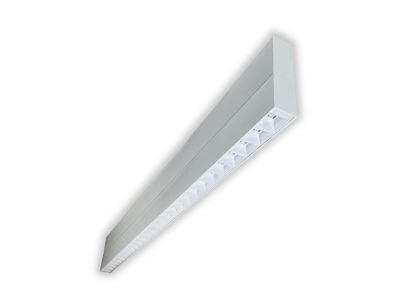
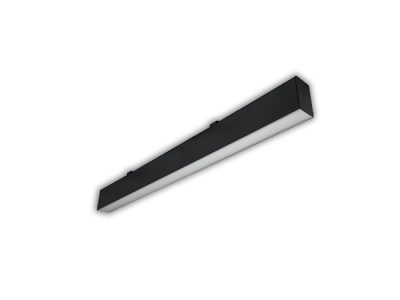
| Linear Recessed | Clean lines, uniform lighting | Requires suspended ceiling | Open-plan offices |
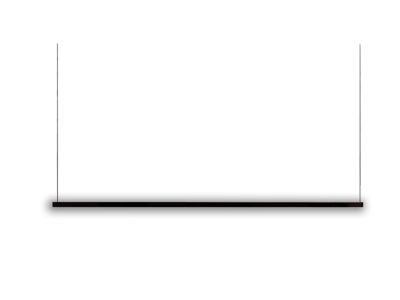
| Linear Suspended | Direct/Indirect, excellent UGR | Higher cost | Modern offices |
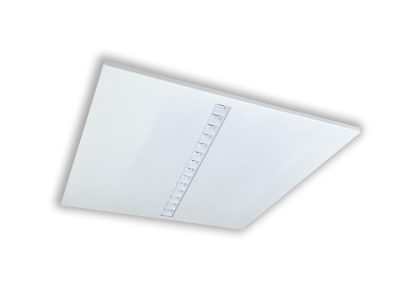
| LED Panel | Economical, easy installation | Potential UGR issues | Low budget |
| Downlights | Discreet presence | Difficult uniformity | Circulation areas |
🔍Optical Systems
Microprismatic diffuser: Ideal for low UGR, preferred in offices with screens.
Opal: Uniform light but higher UGR. Suitable only with proper design.
Louvres/Rasters: Extremely low glare, industrial aesthetic.
🌡️Thermal Management
Good cooling is critical for LED luminaires:
• Ensures stable light output over time
• Extends lifespan (L80B10 > 70,000h)
• Maintains stable color temperature
Smart Lighting Management
Modern office lighting requires flexible control that adapts to changing needs and conditions.
| Protocol | Characteristics | Ideal For | Cost |
|---|---|---|---|
| DALI | Industry standard, addressable | Large projects | €€€ |
| KNX | Integrated BMS, wired | Smart buildings | €€€€ |
| Casambi | Wireless, Bluetooth mesh | Renovations | €€ |
| 0-10V | Simple, economical | Basic dimming | € |
👁️Occupancy Sensors
Automatic on/off based on movement. Energy savings up to 30%. Ideal for meeting rooms and restrooms.
☀️Daylight Harvesting
Automatic brightness adjustment based on natural light. Energy savings up to 40% in perimeter zones.
Tunable White & Biological Rhythm
Human Centric Lighting (HCL) adapts lighting to the human circadian rhythm. But it's not always necessary.
✅ When It Makes Sense
- Spaces with long occupancy hours
- Spaces without natural light
- Night shifts
- Call centers & control rooms
- WELL certification
❌ When It's Not Worth It
- Good natural lighting
- Limited budget
- Short-term space use
- No control system
- No operation plan
Before investing in HCL, first ensure: stable and reliable lighting, low glare (UGR ≤ 19), proper dimming without flicker, and good natural lighting where possible.
Life Cycle Cost
The initial price is only part of the equation. Total Cost of Ownership (TCO) includes energy, maintenance, and replacements.
| Indicator | What It Measures | Target |
|---|---|---|
| W/m² | Installed power per square meter | 5-8 W/m² |
| kWh/m²/year | Actual consumption | 15-25 kWh |
| lm/W (system) | Luminaire system efficacy | >100 lm/W |
The cheap solution often costs more in the long run: higher consumption, more frequent replacements, lower light quality, employee complaints.
What to Avoid
Complex Projects
🏢Open-Plan Offices
Large unified spaces require careful study for uniformity, UGR, and zone flexibility.
🖥️Spaces with Screens
Reflections and glare are critical. Luminaire position must be coordinated with the layout.
🏆WELL/LEED Certifications
Strict requirements for lighting, circadian lighting, and energy efficiency.
🎨High Aesthetic Requirements
Showrooms and executive offices require a combination of technical excellence and design.
Need Help with Your Office Lighting?
TECHLUMEN offers specialized lighting design, luminaire selection with real photometric data, and support at every stage of your project.
Proper office lighting is not a cost – it's an investment.
It directly affects productivity, health, and employee satisfaction.
With proper design, quality materials, and attention to detail, a workspace
can become more pleasant, more efficient, and healthier for everyone.