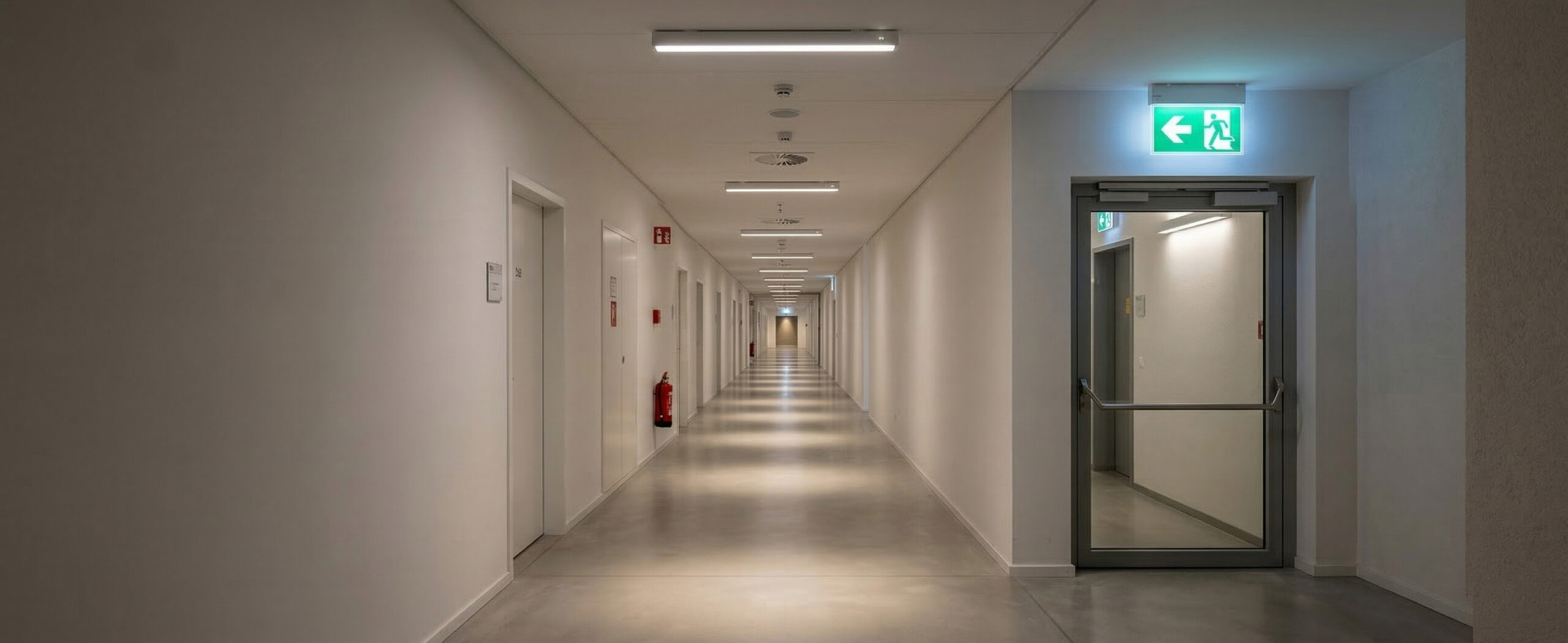
Πλήρης τεχνική αναφορά για φωτισμό οδών διαφυγής, αντι-πανικού και υψηλού κινδύνου — σχεδιασμός, συμμόρφωση, τεχνολογία μπαταριών και πρωτόκολλα ελέγχου.
📄 Έκδοση 1.0 — 2025
📏 EN 1838 Φωτισμός Ασφαλείας
⚡ EN 50172 Συστήματα Φωτισμού Διαφυγής
🌍 EN 60598-2-22 Ασφάλεια Φωτιστικών
Σκοπός αυτού του οδηγού: Παροχή πλήρους τεχνικής αναφοράς σε μελετητές φωτισμού, ηλεκτρολόγους μηχανικούς, συμβούλους πυρασφάλειας και διαχειριστές εγκαταστάσεων για φωτισμό ασφαλείας. Καλύπτει απαιτήσεις EN 1838, σχεδιασμό οδών διαφυγής και αντι-πανικού, τεχνολογίες μπαταριών, συστήματα αυτοελέγχου, συμμόρφωση με τον Ελληνικό Κανονισμό Πυροπροστασίας και πρωτόκολλα ελέγχου/συντήρησης.
1. Εισαγωγή & Κανονιστικό Πλαίσιο
Ο φωτισμός ασφαλείας είναι σύστημα προστασίας ζωής. Όταν ο κανονικός φωτισμός αποτύχει — λόγω διακοπής ρεύματος, πυρκαγιάς ή ηλεκτρικού σφάλματος — ο φωτισμός ασφαλείας παρέχει τον ελάχιστο φωτισμό για ασφαλή εκκένωση και εντοπισμό εξοπλισμού ασφαλείας. Δεν είναι προαιρετικός: ο Κανονισμός Πυροπροστασίας και η ευρωπαϊκή νομοθεσία επιβάλλουν φωτισμό ασφαλείας σε ουσιαστικά όλα τα μη οικιστικά κτίρια.
Οι συνέπειες ανεπαρκούς φωτισμού ασφαλείας είναι σοβαρές: στο σκοτάδι, ο πανικός κλιμακώνεται, οι οδοί διαφυγής γίνονται αναγνώριστες, ο πυροσβεστικός εξοπλισμός δεν εντοπίζεται, και οι διεργασίες υψηλού κινδύνου δεν μπορούν να τερματιστούν με ασφάλεια. Ένα σωστά σχεδιασμένο σύστημα φωτισμού ασφαλείας σώζει ζωές.
Αυτόνομος εξοπλισμός φωτισμού ασφαλείας (Device Type 1)
⚠️ Νομική Υποχρέωση: Ο Κανονισμός Πυροπροστασίας επιβάλλει φωτισμό ασφαλείας σε όλα τα κτίρια δημόσιας συνάθροισης, χώρους εργασίας, ξενοδοχεία, νοσοκομεία, εκπαιδευτικές εγκαταστάσεις, χώρους στάθμευσης και ψηλά κτίρια (>23 m). Η μη συμμόρφωση μπορεί να οδηγήσει σε εντολές κλεισίματος κτιρίου, ακύρωση ασφάλισης και ποινική ευθύνη σε περίπτωση πυρκαγιάς.
2. Πρότυπα & Νομικές Απαιτήσεις
Τα πρότυπα φωτισμού ασφαλείας σχηματίζουν πολυεπίπεδο πλαίσιο: το EN 1838 ορίζει τις απαιτήσεις απόδοσης (πόσο φως, για πόσο χρόνο), το EN 50172 ορίζει τον σχεδιασμό και την επαλήθευση συστήματος, και το EN 60598-2-22 ορίζει τις απαιτήσεις κατασκευής και ελέγχου φωτιστικών. Ο Ελληνικός Κανονισμός Πυροπροστασίας ενσωματώνει αυτά τα ευρωπαϊκά πρότυπα και προσθέτει εθνικές απαιτήσεις.
EN 1838 — The Core Performance Standard
EN 1838:2013 defines three categories of emergency escape lighting, each with specific illuminance, uniformity, duration, and colour rendering requirements. The standard also addresses standby lighting (for continued operation rather than evacuation) and high-risk task area lighting.
Escape Route
≥1
lux (centre line)
Anti-Panic
≥0.5
lux (floor level)
High-Risk Task
≥10%
of normal Ēm
Min. Duration
1 h
(3 h for sleeping)
Ελληνικός Κανονισμός Πυροπροστασίας
Ο Κανονισμός Πυροπροστασίας εναρμονίζεται με τα ευρωπαϊκά πρότυπα αλλά προσθέτει εθνικές απαιτήσεις. Ο παρακάτω πίνακας συνοψίζει τις κύριες ελληνικές απαιτήσεις:
Απαίτηση
Ελληνική Προδιαγραφή
Ευρωπαϊκή Βάση
Κτίρια που απαιτούν φωτισμό ασφαλείας
Όλα τα κτίρια δημόσιας συνάθροισης, χώροι εργασίας >50 m², ξενοδοχεία, νοσοκομεία, σχολεία, χώροι στάθμευσης, ψηλά κτίρια (>23 m)
EN 50172 Annex A
Ελάχιστη διάρκεια
1 ώρα (γενικά), 3 ώρες (χώροι ύπνου, νοσοκομεία)
EN 1838 §4.2
Ορατότητα σήματος εξόδου
Μέγιστη απόσταση θέασης = 200 × ύψος σήματος (εσωτ. φωτιζόμενο)
EN 1838 §4.1
Συχνότητα ελέγχων
Μηνιαίος λειτουργικός, ετήσιος πλήρους διάρκειας
EN 50172 §6
Βιβλίο συντήρησης
Υποχρεωτικό βιβλίο συντήρησης, διαθέσιμο για πυροσβεστικό έλεγχο
EN 50172 §7
Συνδυασμένα φωτιστικά
Επιτρέπονται (κανονικό + ασφαλείας σε ένα)
EN 60598-2-22
💡 Συμβουλή Σχεδιασμού: Always consult the specific national fire code for your project's country and building category. Απαίτησηs can vary significantly between building types (assembly, industrial, residential, healthcare). The project's fire safety study — prepared by a qualified fire engineer — defines the specific emergency lighting scope and must be the starting point for any design.
3. Κατηγορίες Φωτισμού Ασφαλείας
EN 1838 divides emergency lighting into distinct functional categories. Understanding these categories is essential for correct system design — each has different illuminance, uniformity, and duration requirements.
Emergency Lighting Classification (EN 1838)
EMERGENCY LIGHTING
EMERGENCY ESCAPE LIGHTING
STANDBY LIGHTING
Enables normal activities
to continue (not evacuation)
ESCAPE ROUTE
≥ 1 lux
centre line of route Uniformity ≥ 40:1 max
≤ 2 m wide routes
CRI ≥ 40 (Ra)
Duration ≥ 1 h
ANTI-PANIC (OPEN AREA)
≥ 0.5 lux
horizontal at floor level Uniformity ≥ 40:1 max
0.5 m band excluded
CRI ≥ 40 (Ra)
Duration ≥ 1 h
HIGH-RISK TASK AREA
≥ 10% of Ēm
minimum 15 lux Uniformity ≥ 10:1 max
On the task plane
CRI ≥ 40 (Ra)
Duration: as needed
EN 1838:2013 — Emergency lighting classification. All values are minimums to be maintained throughout the rated duration.
Figure 1 — EN 1838 emergency lighting classification. Emergency escape lighting is subdivided into escape route, anti-panic (open area), and high-risk task area categories. Standby lighting is a separate category for continued operation rather than evacuation.
The detailed performance requirements of EN 1838 are summarised below. These values represent the minimum maintained levels at the end of the rated duration — not initial values.
Πλήρεις Απαιτήσεις Απόδοσης EN 1838
Parameter
Escape Route
Anti-Panic
High-Risk Task
Minimum illuminance
≥1 lux on centre line
≥0.5 lux on floor
≥10 % of Ēm (min 15 lux)
Measurement plane
Floor level, centre of defined route
Floor level (excl. 0.5 m border)
Task plane
Uniformity (max:min)
≤40:1
≤40:1
≤10:1
Minimum CRI (Ra)
≥40
≥40
≥40
Glare limitation
I84 ≤8000 cd (h<2.5 m), ≤500 cd otherwise
Same as escape
Same as escape
Ελάχιστη διάρκεια
1 h (3 h sleeping risk)
1 h (3 h sleeping risk)
As per risk assessment
Response time (50 % level)
≤5 seconds
≤5 seconds
≤0.5 seconds
Response time (100 % level)
≤60 seconds
≤60 seconds
≤0.5 seconds
High-Risk Task: Eemergency ≥ 0.10 × ĒmaintainedExample: Machine room Ēm = 300 lux → Emergency ≥ 30 luxBut never less than 15 lux (EN 1838 absolute minimum)
⚠️ Κρίσιμο — Χρόνος Απόκρισης: High-risk task areas require 0.5-second response time — not 5 seconds. This eliminates most fluorescent emergency solutions and demands LED or incandescent sources with fast-switching battery backup. In practice, only LED self-contained or central battery with LED luminaires can reliably meet this requirement.
Emergency exit signs are the visual anchors of any evacuation system. They must be visible from the maximum viewing distance, recognisable within 2 seconds, and maintained in operation for the full rated duration. EN 1838 and EN ISO 7010 define the requirements.
Τύποι Σημάτων
Sign Type
Illumination Method
Max. Viewing Distance
Luminance
Internally illuminated
LED backlit (self-contained or central)
d = 200 × h (sign height)
≥2 cd/m² (green), contrast ≥5:1 to 15:1
Externally illuminated
Illuminated by nearby emergency luminaire
d = 100 × h
≥5 lux on sign face
Photoluminescent
Absorbs ambient light, glows in dark
d = dependent on material class
Must be charged by normal lighting
Viewing Distance (d) = 200 × h (internally lit)
Example: sign height h = 150 mm → d = 200 × 0.15 = 30 m max. viewing distance
Exit Sign Viewing Distance Calculation
EXIT
🚶
h
d = 200 × h (internally illuminated)
Observer
Example: h = 200 mm → d = 200 × 0.20 = 40 m maximum viewing distance
For externally illuminated signs: d = 100 × h (half the distance)
Figure 2 — Maximum viewing distance for exit signs depends on the sign height (h) and illumination method. Internally illuminated LED signs achieve twice the viewing distance of externally illuminated signs.
Εικονογράμματα EN ISO 7010
The "running man" pictogram (EN ISO 7010 E001/E002) is the standardised emergency exit symbol throughout Europe. Directional arrows indicate the evacuation direction. Signs must use white pictogram on green background (RAL 6032 equivalent) with a minimum luminance contrast ratio of 5:1 between the symbol and background.
ℹ️ European Απαίτηση: Ο Κανονισμός Πυροπροστασίας απαιτεί τη χρήση τυποποιημένων εικονογραμμάτων EN ISO 7010 (το σύμβολο του "τρέχοντος ανθρώπου"). Σήματα μόνο με κείμενο (π.χ. "ΕΞΟΔΟΣ") δεν είναι πλέον συμμορφούμενα ως μοναδική σήμανση — μπορούν να συμπληρώνουν ένα εικονόγραμμα αλλά δεν μπορούν να το αντικαταστήσουν.
6. Αρχιτεκτονικές Συστήματος: Αυτόνομο vs. Κεντρική Μπαταρία
Emergency lighting systems fall into two fundamental architectures: self-contained (each luminaire has its own battery) and central battery (a single battery room feeds all emergency luminaires). Each has distinct advantages, and many large buildings use a hybrid approach.
Σύγκριση Αρχιτεκτονικών Συστήματος
Parameter
Self-Contained
Central Battery
Battery location
Inside each luminaire
Dedicated battery room / cabinet
Wiring
Standard mains supply (same as normal)
Fire-rated cable from battery to luminaires
Luminaire cost
Higher (battery per unit)
Lower (no battery per unit)
Infrastructure cost
Lower (no fire-rated cable)
Higher (fire-rated cables, battery room)
Maintenance
Battery replacement per luminaire
Centralised battery maintenance
Testing
Per luminaire (manual or self-test)
Central monitoring panel
Duration options
1 h or 3 h (battery size limited)
1 h, 3 h, or extended (scalable)
Best for
Small/medium buildings, refurbishment
Large buildings, hospitals, high-rise
DALI integration
DALI emergency (IEC 62386-202)
DALI or proprietary bus
Single point of failure
No (distributed)
Yes (mitigated by redundancy)
System Architectures — Self-Contained vs. Central Battery
A. Self-Contained
MAINS
BATT
Luminaire + 🔋
BATT
Luminaire + 🔋
BATT
Luminaire + 🔋
✓ Standard wiring
✓ No single point of failure
B. Central Battery
Battery Room
Fire-rated
Luminaire (no batt.)
Luminaire (no batt.)
Luminaire (no batt.)
✓ Centralised monitoring
⚠ Requires fire-rated cable
Figure 3 — (A) Self-contained: each luminaire has its own battery; standard wiring; distributed risk. (B) Central battery: shared battery room; fire-rated cabling required; centralised monitoring and maintenance.
Συνδυασμένα Κανονικά + Ασφαλείας Φωτιστικά
Modern combined luminaires operate as normal lighting during mains supply and automatically switch to battery-powered emergency mode upon mains failure. This approach reduces the total number of luminaires in a building, eliminates the aesthetic issue of dedicated emergency fittings, and simplifies maintenance. Combined units are available in both self-contained and central-battery-fed variants.
💡 Συμβουλή Σχεδιασμού: Combined normal/emergency luminaires are particularly effective in corridors, lobbies, and open-plan offices where both normal and emergency illuminance must be provided. Specify the luminaire with the correct emergency lumen output — the emergency mode often operates at reduced flux (e.g., 10–20 % of normal output) sufficient to meet EN 1838 requirements.
7. Τεχνολογίες Μπαταριών & Απόδοση
The battery is the heart of any emergency lighting system. Selecting the correct battery chemistry ensures reliable performance, adequate duration, acceptable lifespan, and safe operation across all environmental conditions.
Σύγκριση Τεχνολογιών Μπαταριών
Parameter
NiCd
NiMH
LiFePO4 (LFP)
Chemistry
Nickel-Cadmium
Nickel-Metal Hydride
Lithium Iron Phosphate
Typical lifespan
4–5 years
4–5 years
7–10 years
Cycle life
~500 cycles
~500 cycles
2000+ cycles
Temperature range
–20 to +50 °C
0 to +45 °C
–20 to +60 °C
Self-discharge
~20 %/month
~30 %/month
~3 %/month
Memory effect
Yes (significant)
Slight
None
Environmental
Cadmium toxic (RoHS restricted)
Less toxic than NiCd
Non-toxic, recyclable
Weight (relative)
Heavy
Heavy
Lightest
Cost (per unit)
Low
Medium
Higher (offset by lifespan)
Cold store suitability
Good (–20 °C)
Poor (>0 °C only)
Good (–20 °C)
EU regulatory status
Being phased out (EU Battery Directive)
Permitted
Preferred
NiCd Lifespan
4–5
years
LFP Lifespan
7–10
years
LFP Cycles
2000+
charge cycles
NiCd Phase-Out
EU
Battery Directive
✅ Σύσταση: LiFePO4 (LFP) batteries are the preferred choice for new emergency lighting installations. Their longer lifespan (7–10 years vs. 4–5 for NiCd/NiMH), superior cycle life, zero memory effect, and environmental compliance make them the best total cost of ownership option. NiCd batteries are being phased out under the EU Battery Directive due to cadmium toxicity.
8. DALI Emergency, Αυτοέλεγχος & Συστήματα Παρακολούθησης
Manual testing of emergency lighting is labour-intensive, error-prone, and often neglected. DALI emergency (IEC 62386-202) and automated self-test systems eliminate these problems by providing continuous monitoring, automatic functional and duration testing, and digital reporting.
Μέθοδοι Αυτοελέγχου
Test Type
Frequency
What It Tests
Duration
Functional test
Monthly
Battery switch-over, LED operation, charge indicator
Brief (~30 seconds)
Duration test
Annually
Full rated duration under battery load
1 h or 3 h (per rating)
Continuous monitoring
Real-time
LED status, battery voltage, charge state
Continuous
Χαρακτηριστικά DALI Emergency (IEC 62386-202)
Feature
Description
Benefit
Individual addressing
Each emergency luminaire has unique DALI address
Pinpoint fault identification and location
Scheduled self-testing
Automatic functional (monthly) and duration (annual) tests
CENTRAL MONITORING
BMS / Cloud Dashboard
DALI-2 BUS
EM-001
OK
🔋 98%
Self-test: PASS
EM-002
OK
🔋 95%
Self-test: PASS
EM-015
!
🔋 42%
Battery low!
EM-016
✕
FAIL
LED failure
Healthy
Warning
Fault
Each luminaire reports status, battery level, and test results via DALI-2 bus to central monitoring
Figure 4 — DALI-2 emergency monitoring architecture. Each self-contained emergency luminaire has a unique address and reports its status (healthy, warning, fault) to a central monitoring system. Automated functional and duration tests are scheduled without manual intervention.
⚠️ Σημαντικό: Even with automated self-test systems, a qualified person must still review the test reports and ensure corrective actions are taken for failed luminaires. Self-test automates the testing — not the maintenance response. The compliance logbook must record both test results and corrective actions.
9. Ροή Σχεδιασμού & Τοποθέτηση Φωτιστικών
Emergency lighting design follows a systematic process that begins with the fire safety study and ends with commissioning and handover. The placement rules in EN 1838 are prescriptive — luminaires must be positioned at specific locations, not simply distributed evenly.
Υποχρεωτικά Σημεία Τοποθέτησης Φωτιστικών (EN 1838 / EN 50172)
Location
Απαίτηση
Type
At every exit door
Illuminated sign + escape route luminaire
Exit sign + escape route
Near each staircase
Each flight receives direct light
Escape route
At every change of direction
Luminaire at or near the turn
Escape route
At every change of floor level
Luminaire at steps, ramps, landings
Escape route
At every intersection of corridors
Luminaire at or near junction
Escape route
Near each fire alarm call point
Within 2 m of the call point
Escape route
Near each fire-fighting equipment
Within 2 m of extinguisher/hose reel
Escape route
Near each first aid point
Within 2 m
Escape route
Near disabled refuge areas
Adequate illumination + signage
Escape route + sign
At lift landings
Illuminated "do not use lift" sign
Sign + escape route
Outside each final exit
Illumination up to a place of safety
Escape route
Open areas >60 m²
Anti-panic lighting throughout
Anti-panic
Emergency Lighting Design Workflow
1. FIRE STUDY
Escape routes
Risk zones
2. CATEGORISE
Escape / panic
High-risk / sign
3. PLACE
Mandatory points
Sign positions
4. CALCULATE
Lux levels
Uniformity
5. SYSTEM
Self / central
Battery type
6. COMMISSION
Full test
Βιβλίο συντήρησης
7.
HAND
OVER
Verify: every mandatory placement point has a luminaire + sign as required
Software: DIALux EVO (emergency mode) · RELUX · Manufacturer emergency planning tools
Figure 5 — Seven-step emergency lighting design workflow. Steps 1–3 are driven by the fire safety study; steps 4–5 by engineering calculations; steps 6–7 by commissioning protocols.
💡 Συμβουλή Σχεδιασμού: DIALux EVO includes a dedicated emergency lighting calculation mode that can verify lux levels and uniformity on escape routes and open areas against EN 1838 requirements. Always run the emergency calculation as a separate scenario from normal lighting — the emergency-only luminaires must independently meet the minimum requirements.
10. Έλεγχοι, Συντήρηση & Τεκμηρίωση
Emergency lighting is a life-safety system that must be maintained in full working order at all times. Το EN 50172 και ο Κανονισμός Πυροπροστασίας επιβάλλουν τακτικούς ελέγχους, τεκμηριωμένα αρχεία και άμεση διορθωτική δράση για αστοχίες.
Πρόγραμμα Ελέγχων (EN 50172)
Test
Frequency
What to Check
Action on Failure
Daily visual check
Daily (occupied buildings)
Central system indicator lights, any visible faults
Investigate immediately
Monthly functional test
Every month
Each luminaire switches to emergency mode, LEDs operate, sign illuminated
Replace / repair within 24 hours
Annual full-duration test
Once per year
Each luminaire operates on battery for full rated duration (1 h or 3 h)
Replace batteries / luminaires that fail
Post-test recharge
After every test
System returns to full charge within 24 hours
Verify charging current/voltage
Βιβλίο Συντήρησης Συμμόρφωσης
Ο Κανονισμός Πυροπροστασίας απαιτεί τήρηση Βιβλίου Συντήρησης Φωτισμού Ασφαλείας που καταγράφει κάθε ημερομηνία ελέγχου, αποτέλεσμα, αστοχία, διορθωτική ενέργεια και υπεύθυνο πρόσωπο. Αυτό το βιβλίο πρέπει να είναι διαθέσιμο για έλεγχο από την Πυροσβεστική Υπηρεσία ανά πάσα στιγμή. Για συστήματα DALI αυτοελέγχου, οι αυτοματοποιημένες αναφορές μπορούν να χρησιμεύσουν ως βιβλίο εάν εκτυπωθούν και υπογραφούν.
Βιβλίο συντήρησης Entry
Required Information
Date of test
Day, month, year
Test type
Functional (monthly) or duration (annual)
Results
Pass / fail for each luminaire or zone
Failures identified
Luminaire ID, location, nature of fault
Corrective action
What was done, when, by whom
Responsible person
Name and signature of tester
Next scheduled test
Date of next monthly / annual test
⚠️ Ετήσιος Έλεγχος Πλήρους Διάρκειας: The annual full-duration test must discharge the batteries for the full rated time (1 h or 3 h). After this test, the building is temporarily unprotected until batteries recharge (typically 24 hours). Schedule annual tests during low-occupancy periods and ensure the building has a risk mitigation plan in place during the recharge period.
11. Συνήθη Λάθη προς Αποφυγή
#
Mistake
Consequence
Correct Approach
1
No emergency lighting in open areas >60 m²
Non-compliance; panic risk in power failure
Anti-panic lighting (≥0.5 lux) in all open areas >60 m²
2
Exit signs without EN ISO 7010 pictograms
Μη συμμορφούμενο στην Ελλάδα· οι επισκέπτες δεν κατανοούν κείμενο χωρίς εικονόγραμμα
Respect EN 1838 glare limits (≤8000 cd below 2.5 m)
8
No emergency lighting outside final exits
Evacuees exit into darkness; hazardous
Illuminate path from final exit to place of safety
12. Προτάσεις Προϊόντων TECHLUMEN
TECHLUMEN manufactures and supplies LED luminaires that can be configured with emergency lighting functionality. The following guidance maps our product range to emergency lighting applications.
Συνδυασμένα Κανονικά + Ασφαλείας Φωτιστικά
Many TECHLUMEN luminaires are available with optional self-contained emergency battery packs, enabling combined normal/emergency operation in a single fitting. This is particularly relevant for corridor, industrial, and commercial applications where both normal and emergency illuminance must be provided.
Product
Type
Emergency Option
Application
HBR Series
LED high-bay
Self-contained emergency pack option, 1 h / 3 h, LiFePO4 or NiMH
Warehouse, industrial — combined normal + emergency high-bay
✅ Υποστήριξη Σχεδιασμού: TECHLUMEN provides emergency lighting calculation support, including DIALux EVO emergency-mode simulations, luminaire selection for combined normal/emergency applications, and battery technology advice. Contact our engineering team at [email protected] for project-specific emergency lighting design.
13. Συχνές Ερωτήσεις (FAQ)
What is the difference between escape route and anti-panic lighting?
Escape route lighting illuminates defined evacuation paths (corridors, stairs, exits) to a minimum of 1 lux on the centre line. Anti-panic lighting illuminates large open areas (>60 m²) to a minimum of 0.5 lux across the floor to prevent panic and enable occupants to reach an escape route. Both have the same uniformity limit (40:1 max:min) and minimum duration (1 hour, or 3 hours for sleeping accommodation).
Can I use the same luminaire for normal and emergency lighting?
Yes. Combined (or "maintained") luminaires operate as normal lighting when mains power is available and automatically switch to reduced-output emergency mode upon mains failure. The luminaire contains an integral battery that powers a portion of the LEDs during emergency. Η προσέγγιση αυτή επιτρέπεται από το EN 60598-2-22 και τον Κανονισμό Πυροπροστασίας. The emergency lumen output must be sufficient to meet EN 1838 requirements independently of any other luminaire.
How often must emergency lighting be tested?
Το EN 50172 και ο Κανονισμός Πυροπροστασίας απαιτούν μηνιαίους λειτουργικούς ελέγχους (brief switch to battery mode to verify operation) and annual full-duration tests (1 hour or 3 hours under full battery load). A daily visual check of central system indicators is also recommended. All test results and corrective actions must be recorded in a maintenance logbook available for fire authority inspection.
Why is LiFePO4 battery preferred over NiCd?
LiFePO4 (Lithium Iron Phosphate) offers 7–10 year lifespan vs. 4–5 years for NiCd, 2000+ charge cycles vs. ~500, no memory effect, lower self-discharge, and no toxic cadmium content. While the initial cost per luminaire is slightly higher, the total cost of ownership is significantly lower due to fewer battery replacements over the building's life. Additionally, NiCd batteries are being phased out under the EU Battery Directive due to cadmium toxicity.
Do I need emergency lighting in a small office?
Στην Ελλάδα, ο Κανονισμός Πυροπροστασίας απαιτεί φωτισμό ασφαλείας σε όλους τους χώρους εργασίας >50 m², όλα τα κτίρια δημόσιας συνάθροισης, και κάθε κτίριο όπου η οδός διαφυγής δεν φωτίζεται επαρκώς από εξωτερικό φως. Ακόμα και σε μικρότερα γραφεία, σήματα εξόδου κινδύνου απαιτούνται σε οδούς διαφυγής. Για κτίρια <50 m² με άμεσες εξωτερικές θύρες, η απαίτηση μπορεί να χαλαρώσει — αλλά αυτό πρέπει να επιβεβαιωθεί από τη Μελέτη Πυροπροστασίας.
What is DALI emergency and do I need it?
DALI emergency (IEC 62386-202) is a digital protocol that enables automated self-testing, individual luminaire monitoring, status reporting, and scheduled testing for self-contained emergency luminaires. It connects via the same two-wire DALI bus used for normal lighting control. DALI emergency is strongly recommended for any building with more than 20 emergency luminaires, as it eliminates the labour and human error associated with manual monthly and annual testing. For smaller installations, standard self-test luminaires (with local LED indicators) may be sufficient.
Σχετικά Πρότυπα & Αναφορές
EN 1838:2013 — Εφαρμογές φωτισμού — Φωτισμός ασφαλείας
EN 50172:2004 — Συστήματα φωτισμού διαφυγής ασφαλείας
EN 60598-2-22 — Luminaires — Part 2-22: Particular requirements — Φωτιστικά ασφαλείας
EN ISO 7010 — Γραφικά σύμβολα — Χρώματα και σήματα ασφαλείας
IEC 62386-202 — DALI Part 202: Αυτόνομος εξοπλισμός φωτισμού ασφαλείας (Device Type 1)
EN 50171 — Κεντρικά συστήματα τροφοδοσίας
EN 12464-1:2021 — Φως και φωτισμός — Εσωτερικοί χώροι εργασίας